Department of Internal Medicine, Yonsei University Wonju College of Medicine, 20 Ilsan-ro, Wonju, 26426, Korea.
Department of Internal Medicine and Environmental Health Center, Kangwon National University, Chuncheon, Korea.
BMC Pulm Med. 2021 Sep 27;21(1):306. doi: 10.1186/s12890-021-01675-4.
With the emergence of bronchiectasis as a common respiratory disease, epidemiological data have accumulated. However, the prevalence and impact of psychological comorbidities were not sufficiently evaluated. The present study examined the prevalence of depression and its associated factors in patients with bronchiectasis.
This study involved a multicenter cohort of bronchiectasis patients recruited from 33 pulmonary specialist hospitals. The baseline characteristics and bronchiectasis-related factors at enrollment were analyzed. Depressive symptoms were assessed using the Patient Health Questionnaire (PHQ-9).
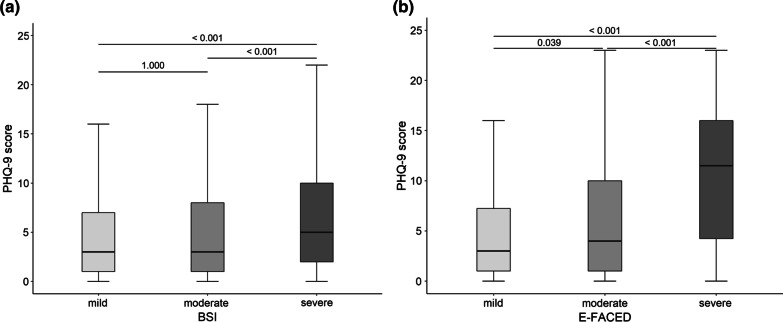
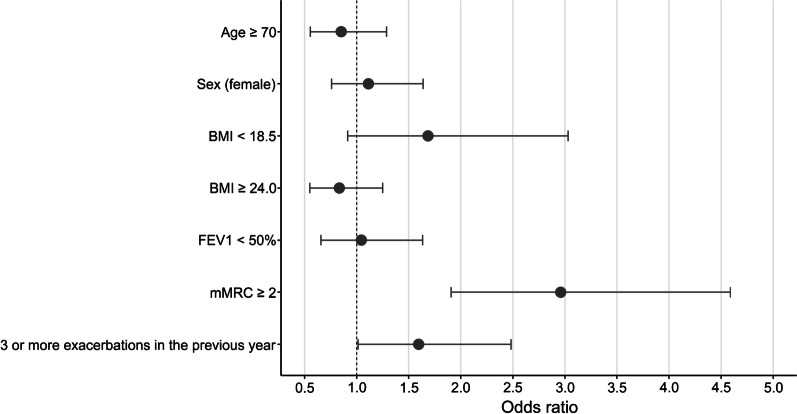
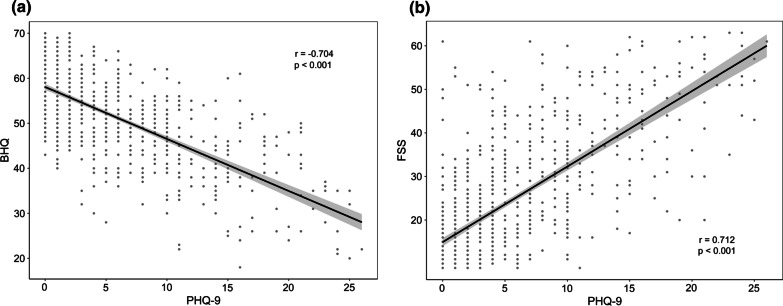
Of the 810 patients enrolled in the study, 168 (20.7%) patients had relevant depression (PHQ-9 score ≥ 10), and only 20 (11.9%) patients had a diagnosis of depression. Significant differences were noted in the depressive symptoms with disease severity, which was assessed using the Bronchiectasis Severity Index and E-FACED (all p < 0.001). Depressive symptoms inversely correlated with quality-of-life (r = - 0.704, p < 0.001) and positively correlated with fatigue severity score (r = 0.712, p < 0.001). Multivariate analysis showed that depression was significantly associated with the modified Medical Research Council dyspnea scale ≥ 2 (OR 2.960, 95% CI 1.907-4.588, p = < 0.001) and high number of exacerbations (≥ 3) in the previous year (OR 1.596, 95% CI 1.012-2.482, p = 0.041).
Depression is common, but its association with bronchiectasis was underrecognized. It negatively affected quality-of-life and presented with fatigue symptoms. Among the bronchiectasis-related factors, dyspnea and exacerbation were closely associated with depression. Therefore, active screening for depression is necessary to optimize the treatment of bronchiectasis.
The study was registered at Clinical Research Information Service (CRiS), Republic of Korea (KCT0003088). The date of registration was June 19th, 2018.
随着支气管扩张症成为一种常见的呼吸道疾病,其流行病学数据不断积累。然而,心理合并症的患病率及其影响尚未得到充分评估。本研究旨在调查支气管扩张症患者中抑郁的患病率及其相关因素。
本研究纳入了来自 33 家肺部专科医院的支气管扩张症患者的多中心队列研究。分析了入组时的基本特征和支气管扩张症相关因素。使用患者健康问卷(PHQ-9)评估抑郁症状。
在纳入的 810 名患者中,有 168 名(20.7%)患者存在相关抑郁(PHQ-9 评分≥10),仅有 20 名(11.9%)患者被诊断为抑郁症。在使用支气管扩张症严重程度指数和 E-FACED 评估的严重程度方面,患者的抑郁症状存在显著差异(均 p<0.001)。抑郁症状与生活质量呈负相关(r=-0.704,p<0.001),与疲劳严重程度评分呈正相关(r=0.712,p<0.001)。多变量分析显示,与无抑郁相比,改良的医学研究理事会呼吸困难量表≥2 分(OR 2.960,95%CI 1.907-4.588,p<0.001)和前一年≥3 次加重(OR 1.596,95%CI 1.012-2.482,p=0.041)与抑郁显著相关。
抑郁在支气管扩张症患者中较为常见,但与支气管扩张症的相关性认识不足。抑郁显著降低了患者的生活质量,伴有疲劳症状。在支气管扩张症相关因素中,呼吸困难和加重与抑郁密切相关。因此,积极筛查抑郁对于优化支气管扩张症的治疗至关重要。
本研究在韩国临床试验注册中心(CRiS)注册(注册号:KCT0003088),注册日期为 2018 年 6 月 19 日。