Department of Health, Human Performance, and Recreation, Baylor University, Waco, TX, USA.
Wake Forest School of Medicine, Winston-Salem, NC, USA.
J Int Soc Sports Nutr. 2021 Sep 27;18(1):65. doi: 10.1186/s12970-021-00461-1.
American-style football (ASF) athletes are at risk for cardiovascular disease (CVD) and exhibit elevated levels of serum neurofilament light (Nf-L), a biomarker of axonal injury that is associated with repetitive head impact exposure over the course of a season of competition. Supplementation with the w-3 fatty acid (FA) docosahexaenoic acid (DHA) attenuates serum Nf-L elevations and improves aspects of CVD, such as the omega-3 index (O3I). However, the effect of combining the w-3 FA eicosapentaenoic acid (EPA) and docosapentaenoic acid (DPA) with DHA on, specifically, serum Nf-L in ASF athletes is unknown. Therefore, this study assessed the effect of supplemental w-3 FA (EPA+DPA+DHA) on serum Nf-L, plasma w-3 FAs, the O3I, and surrogate markers of inflammation over the course of a season.
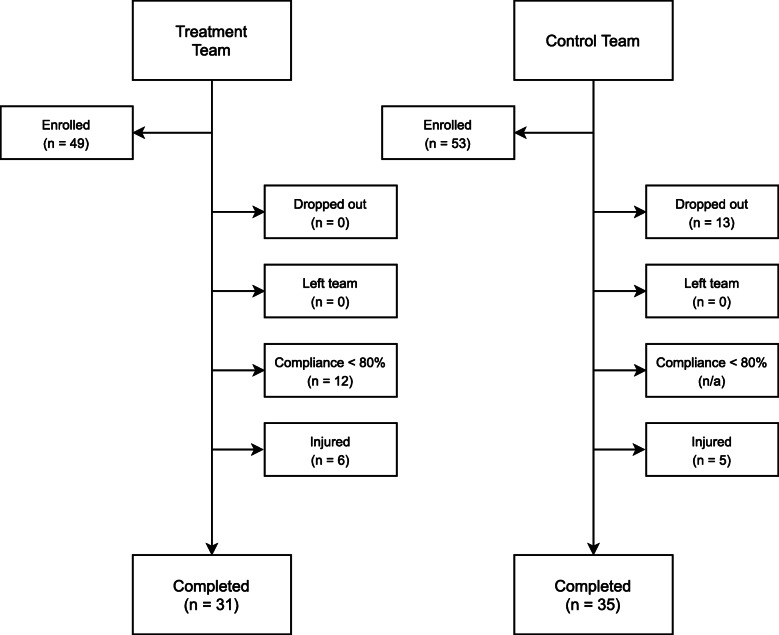
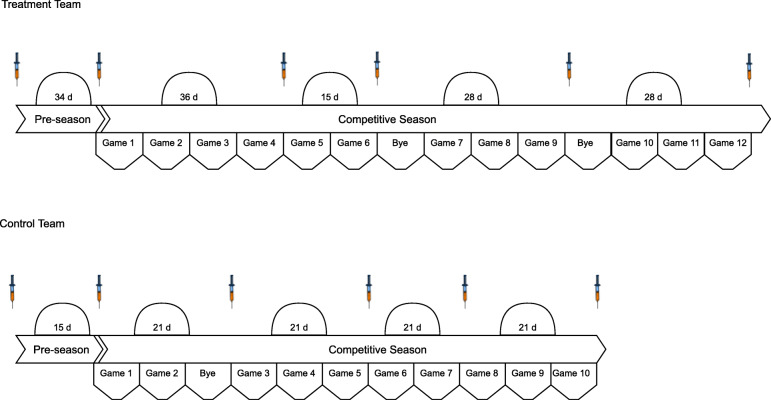
A multi-site, non-randomized design, utilizing two American football teams was employed. One team (n = 3 1) received supplementation with a highly bioavailablew-3 FA formulation (2000mg DHA, 560mg EPA, 320mg DPA, Mindset®, Struct Nutrition, Missoula, MT) during pre-season and throughout the regular season, while the second team served as the control (n = 35) and did not undergo supplementation. Blood was sampled at specific times throughout pre- and regular season coincident w ith changes in intensity, physical contact, and changes in the incidence and severity of head impacts. Group differences were determined via a mixed-model between-within subjects ANOVA. Effect sizes were calculated using Cohen's dfor all between-group differences. Significance was set a priori at p< .05.
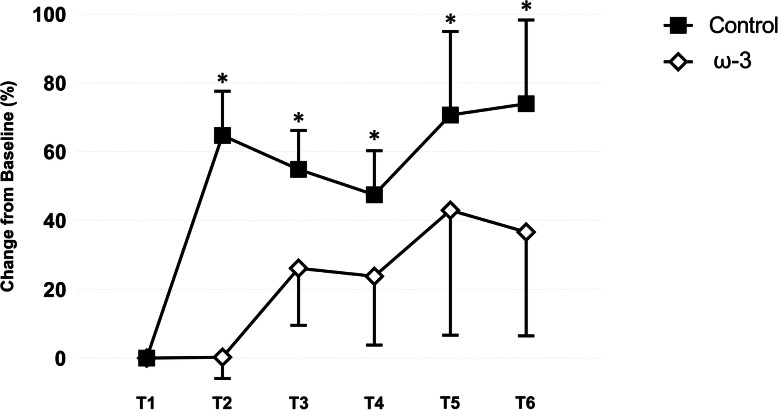
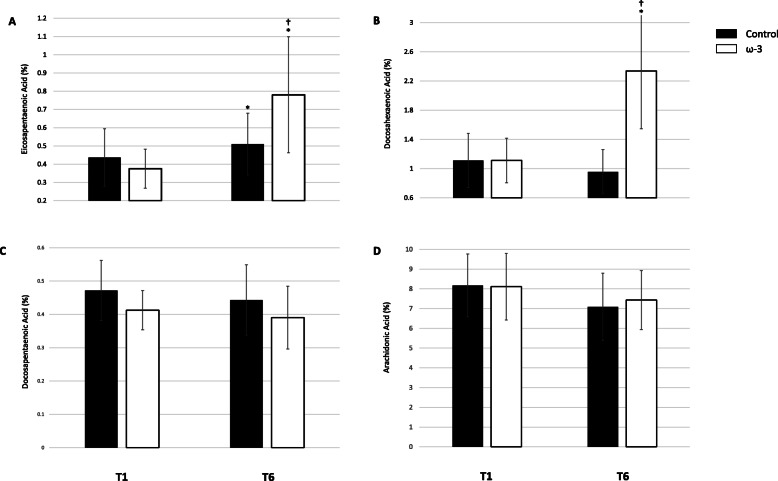
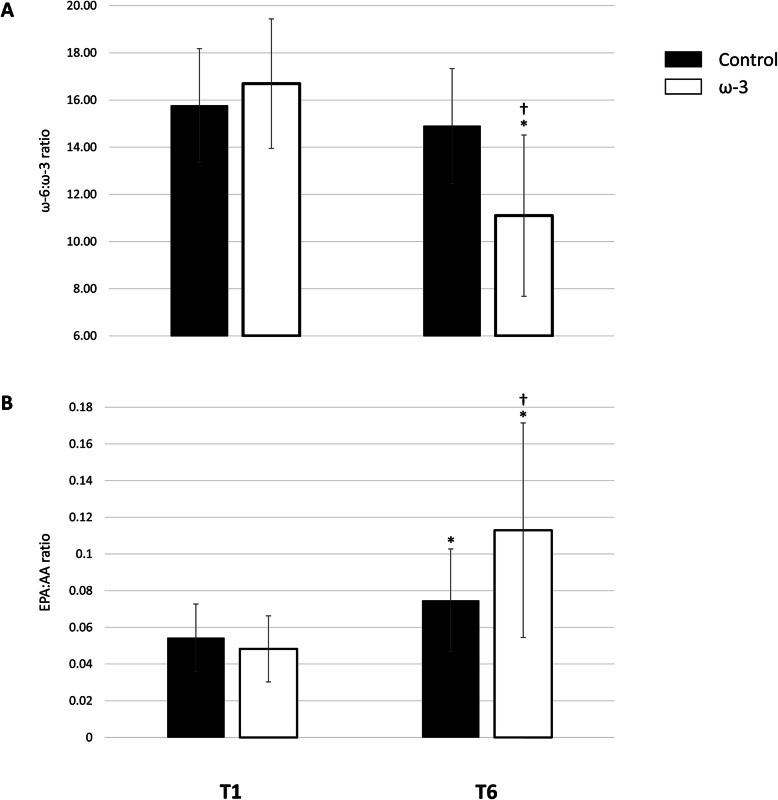
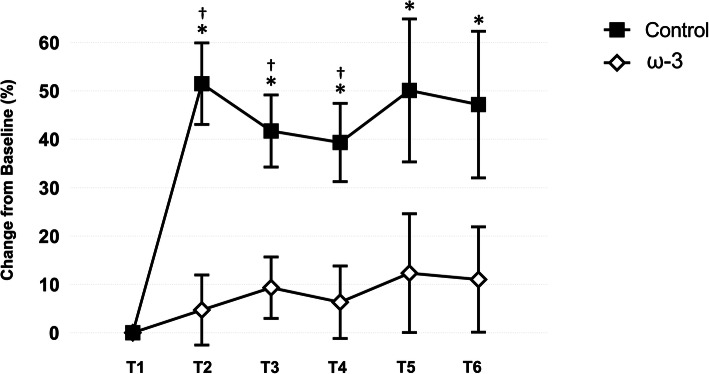
Compared to the control group, ASF athletes in the treatment group experienced large increases in plasma EPA (p < .001, d = 1.71) and DHA (p < .001, d = 2.10) which contributed to increases in the O3I (p < .001, d = 2.16) and the EPA:AA ratio (p = .001, d = 0.83) and a reduction in the w-6: w-3 ratio (p < .001, d = 1.80). w-3 FA supplementation attenuated elevations in Nf-L (p = .024). The control group experienced a significant increase in Nf-L compared to baseline at several measurement time points (T2, T3, and T4 [p range < .001 - .005, drange = 0.59-0.85]).
These findings suggest a cardio- and neuroprotective effect of combined EPA+DPA+DHA w-3 FA supplementation in American-style football athletes.
This trial was registered with the ISRCTN registry ( ISRCTN90306741 ).
美式足球运动员存在心血管疾病(CVD)风险,其血清神经丝轻链(Nf-L)水平升高,Nf-L 是一种轴突损伤的生物标志物,与整个赛季的反复头部撞击暴露有关。ω-3 脂肪酸(FA)二十二碳六烯酸(DHA)的补充可降低血清 Nf-L 升高,并改善 CVD 等方面,如 ω-3 指数(O3I)。然而,联合 ω-3 FA 二十碳五烯酸(EPA)和二十二碳五烯酸(DPA)与 DHA 对美式足球运动员血清 Nf-L 的具体影响尚不清楚。因此,本研究评估了补充 ω-3 FA(EPA+DPA+DHA)对血清 Nf-L、血浆 ω-3 FA、O3I 和炎症替代标志物在整个赛季中的影响。
采用多地点、非随机设计,利用两支美式足球队。一队(n=31)在赛前和整个常规赛期间接受高生物利用度 ω-3 FA 配方(2000mg DHA、560mg EPA、320mg DPA、Mindset®、Struct Nutrition、Missoula、MT)补充,而第二队作为对照组(n=35)不接受补充。在强度、身体接触以及头部撞击的发生率和严重程度发生变化时,在赛前和常规赛的特定时间点采集血液样本。通过混合模型的组间和组内方差分析确定组间差异。使用 Cohen's d 计算所有组间差异的效应大小。预先设定显著性水平为 p<.05。
与对照组相比,治疗组的美式足球运动员血浆 EPA(p <.001,d = 1.71)和 DHA(p <.001,d = 2.10)大幅增加,这导致 O3I(p <.001,d = 2.16)和 EPA:AA 比值(p=.001,d = 0.83)增加,而 ω-6:ω-3 比值(p <.001,d = 1.80)降低。ω-3 FA 补充可降低 Nf-L 升高(p=.024)。对照组在几个测量时间点(T2、T3 和 T4 [p 范围 <.001-.005,d 范围 = 0.59-0.85])与基线相比,Nf-L 显著增加。
这些发现表明,在美式足球运动员中,联合 EPA+DPA+DHA ω-3 FA 补充具有心脏和神经保护作用。
本试验在 ISRCTN 注册(ISRCTN90306741)。