Department of Urology, China Medical University, The First Hospital of China Medical University, Shenyang, 110001, Liaoning, China.
J Transl Med. 2021 Sep 27;19(1):409. doi: 10.1186/s12967-021-03061-4.
The Wnt signaling pathway is core to the growth of bladder tumors. Epithelial-to-mesenchymal transition (EMT) is significant for bladder tumor metastasis. Nevertheless, the relationship between the Wnt signaling pathway, outcomes of bladder cancer (BLCA), and the specific mechanisms driving immune infiltration have not been studied.
We obtained Wnt pathway-related gene mRNA and clinicopathological data from the Cancer Genome Atlas (TCGA). We obtained 34 genes that were greatly correlated with outcome using univariate Cox regression analysis and conducted a completely randomized data t-test to perform clinical staging. According to the single-sample gene set enrichment analysis (ssGSEA), the weighted correlation network analysis (WGCNA) was applied to identify relevant biological functions. Various subtypes were identified using consensus cluster analysis. Univariate Cox regression and least absolute shrinkage sum selection operator-Cox regression algorithm analysis were conducted on TCGA and Gene Expression Omnibus data to identify risk characteristics. The Kaplan-Meier method and receiver running feature curves were adopted to calculate overall survival. Single-sample gene set enrichment analysis (ssGSEA) was adopted for the assessment of the degree of immune infiltration. Then, we demonstrated the relationship between PPP2CB and EMT function in two cell lines.
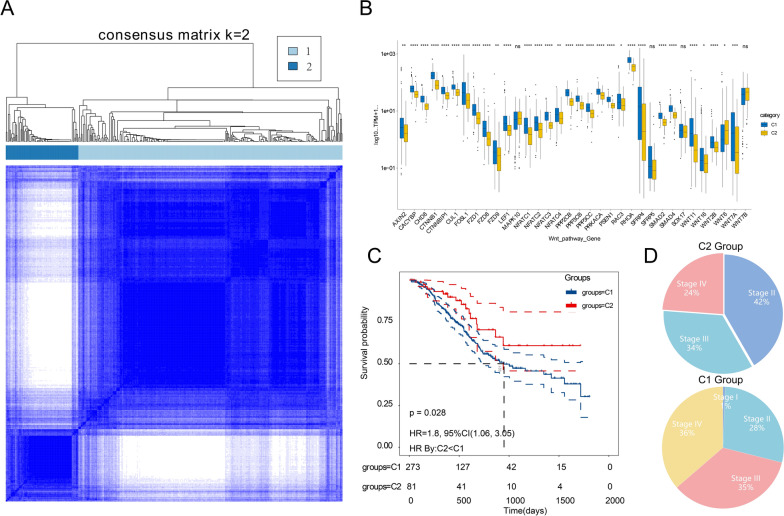
Thirty-four Wnt signaling pathway-related genes were risk factors for BLCA outcome, and their expression levels differed by clinical stage. The co-expression of WGCNA showed the relationship between the Wnt signaling pathway and biological functions and was closely associated with EMT. We divided BLCA patients into two subtypes using consensus clustering. Survival curves and clinical analysis showed that the Wnt pathway enriched group had worse outcomes. The Wnt signature showed the significance of the outcome for MAPK10, PPP2CB, and RAC3. Based on these genes, the degree of immune infiltration was evaluated. Cell function experiments suggested that PPP2CB drives the proliferation and migration of BLCA cells.
We found that Wnt signaling pathway-related genes can be used as prognostic risk factors for BLCA, and the Wnt signaling pathway is a cancer-promoting signaling pathway associated with EMT. We identified three critical genes: MAPK10, RAC3, and PPP2CB. The genes in these three Wnt signaling pathways are associated with tumor cell EMT and immune cell infiltration. The most important finding was that these three genes were independent prognostic factors for BLCA.
Wnt 信号通路是膀胱癌生长的核心。上皮-间充质转化(EMT)对膀胱癌转移至关重要。然而,Wnt 信号通路与膀胱癌(BLCA)结局之间的关系以及驱动免疫浸润的具体机制尚未得到研究。
我们从癌症基因组图谱(TCGA)获得了 Wnt 通路相关基因的 mRNA 和临床病理数据。我们使用单因素 Cox 回归分析获得了 34 个与结局高度相关的基因,并进行完全随机数据 t 检验进行临床分期。根据单样本基因集富集分析(ssGSEA),应用加权相关网络分析(WGCNA)识别相关生物学功能。通过共识聚类分析确定各种亚型。对 TCGA 和基因表达综合数据库进行单因素 Cox 回归和最小绝对收缩和选择算子-Cox 回归算法分析,以确定风险特征。采用 Kaplan-Meier 方法和接收器工作特征曲线计算总生存期。采用单样本基因集富集分析(ssGSEA)评估免疫浸润程度。然后,我们在两个细胞系中证明了 PPP2CB 与 EMT 功能的关系。
34 个 Wnt 信号通路相关基因是 BLCA 结局的危险因素,其表达水平与临床分期有关。WGCNA 的共表达显示了 Wnt 信号通路与生物学功能的关系,并与 EMT 密切相关。我们使用共识聚类将 BLCA 患者分为两种亚型。生存曲线和临床分析表明,Wnt 通路富集组的预后较差。Wnt 特征显示了 MAPK10、PPP2CB 和 RAC3 对结局的重要性。基于这些基因,评估了免疫浸润程度。细胞功能实验表明,PPP2CB 驱动 BLCA 细胞的增殖和迁移。
我们发现 Wnt 信号通路相关基因可作为 BLCA 的预后危险因素,Wnt 信号通路是与 EMT 相关的促进癌症的信号通路。我们确定了三个关键基因:MAPK10、RAC3 和 PPP2CB。这三个 Wnt 信号通路中的基因与肿瘤细胞 EMT 和免疫细胞浸润有关。最重要的发现是,这三个基因是 BLCA 的独立预后因素。