Han Lin, Yang Hao-Yu, Zheng Yu-Jiao, Wei Xiu-Xiu, Dan Wen-Chao, Zhang Li-Li, Ding Qi-You, Ma Xu, Wang Xin-Miao, Zhao Lin-Hua, Tong Xiao-Lin
Guang'anmen Hospital, China Academy of Chinese Medical Sciences, Beijing, 100053, China.
Beijing University of Chinese Medicine, Beijing, 100029, China.
Chin Med. 2021 Sep 27;16(1):93. doi: 10.1186/s13020-021-00479-2.
The Gouqi-wentang formula (GQWTF) is a herbal formula used by Academician Xiao-lin Tong for the clinical treatment of T2DM. GQWTF is beneficial to qi, nourishes Yin, clears heat, and promotes fluid production, but the effective components and their mechanism of action remain unclear.
The main components of GQWTF were detected by LC-MS, and the multi-target mechanisms of GQWTF in T2DM were elucidated using network pharmacology analysis, including target prediction, protein-protein interaction network construction and analysis, Gene Ontology (GO) terms, Kyoto Encyclopaedia of Genes and Genomes (KEGG) pathway annotation, and other network construction. Finally, the efficacy of the GQWTF was verified using biological experiments.
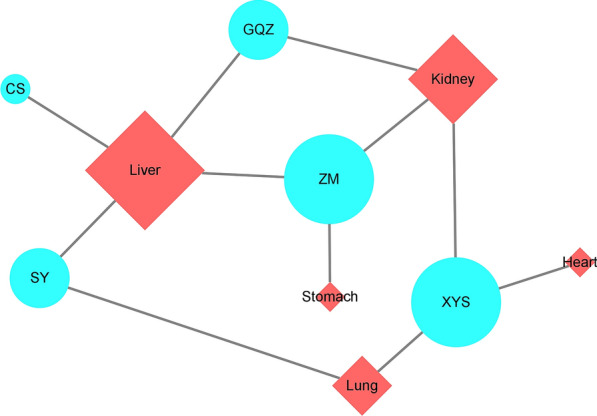
First, the "herb-channel tropism" network suggested that GQWTF focuses more on treating diseases by recuperating the liver, which is considered as an important insulin-sensitive organ. Subsequently, a total of 16 active ingredients in GQWTF were detected and screened, and their biological targets were predicted. Then, "compound-target" network was constructed, where enrichment analysis of GQWTF targets reflected its potential pharmacological activities. After T2DM-related target identification, 39 cross targets of GQWTF and T2DM were obtained, and 30 key targets highly responsible for the beneficial effect of GQWTF on T2DM were identified by PPI analysis. GO analysis of these key targets showed that many biological processes of GQWTF in treating T2DM are key in the occurrence and development of T2DM, including components related to inflammatory/immune response, insulin, and metabolism. KEGG analysis revealed the regulation of multiple signalling pathways, such as insulin resistance, PPAR signalling pathway, FoxO signalling pathway, Fc epsilon RI signalling pathway, and pathways that influence diabetes primarily by regulating metabolism as well as other T2DM directly related pathways. Furthermore, a "formula-compound-pathway-symptom" network was constructed to represent a global view of GQWTF in the treatment of T2DM.
This study explored the mechanism of action of GQWTF in T2DM by multi-component and multi-target multi pathways, which could provide a theoretical basis for the development and clinical application of GQWTF.
枸杞温汤方(GQWTF)是童小林院士用于临床治疗2型糖尿病(T2DM)的中药方剂。枸杞温汤方有益气、养阴、清热、生津之功效,但其有效成分及其作用机制尚不清楚。
采用液相色谱 - 质谱联用(LC - MS)检测枸杞温汤方的主要成分,并运用网络药理学分析方法阐明枸杞温汤方治疗T2DM的多靶点机制,包括靶点预测、蛋白质 - 蛋白质相互作用网络构建与分析、基因本体论(GO)术语、京都基因与基因组百科全书(KEGG)通路注释以及其他网络构建。最后,通过生物学实验验证枸杞温汤方的疗效。
首先,“本草归经”网络表明枸杞温汤方更侧重于通过调理肝脏来治疗疾病,肝脏被认为是一个重要的胰岛素敏感器官。随后,检测并筛选出枸杞温汤方中的16种活性成分,并预测了它们的生物学靶点。接着,构建了“化合物 - 靶点”网络,枸杞温汤方靶点的富集分析反映了其潜在的药理活性。在确定T2DM相关靶点后,获得了枸杞温汤方与T2DM的39个交叉靶点,并通过蛋白质 - 蛋白质相互作用(PPI)分析确定了30个对枸杞温汤方治疗T2DM有益作用高度负责的关键靶点。对这些关键靶点的GO分析表明,枸杞温汤方治疗T2DM的许多生物学过程在T2DM的发生和发展中起关键作用,包括与炎症/免疫反应、胰岛素和代谢相关的成分。KEGG分析揭示了多个信号通路的调控,如胰岛素抵抗、过氧化物酶体增殖物激活受体(PPAR)信号通路、叉头框蛋白O(FoxO)信号通路、FcεRI信号通路,以及主要通过调节代谢影响糖尿病的通路以及其他与T2DM直接相关的通路。此外,构建了“方剂 - 化合物 - 通路 - 症状”网络,以呈现枸杞温汤方治疗T2DM的全局视图。
本研究通过多成分、多靶点、多途径探索了枸杞温汤方治疗T2DM的作用机制,可为枸杞温汤方的开发和临床应用提供理论依据。