Department of Pulmonary Medicine, Erasmus University Medical Center, Rotterdam, the Netherlands.
Department of Molecular Genetics, Erasmus MC Cancer Institute, Erasmus University Medical Center, Rotterdam, the Netherlands.
Clin Cancer Res. 2021 Dec 1;27(23):6602-6612. doi: 10.1158/1078-0432.CCR-21-1681. Epub 2021 Sep 27.
We investigated whether organoids can be generated from resected tumors of patients who received eight cycles of neoadjuvant FOLFIRINOX chemotherapy before surgery, and evaluated the sensitivity/resistance of these surviving cancer cells to cancer therapy.
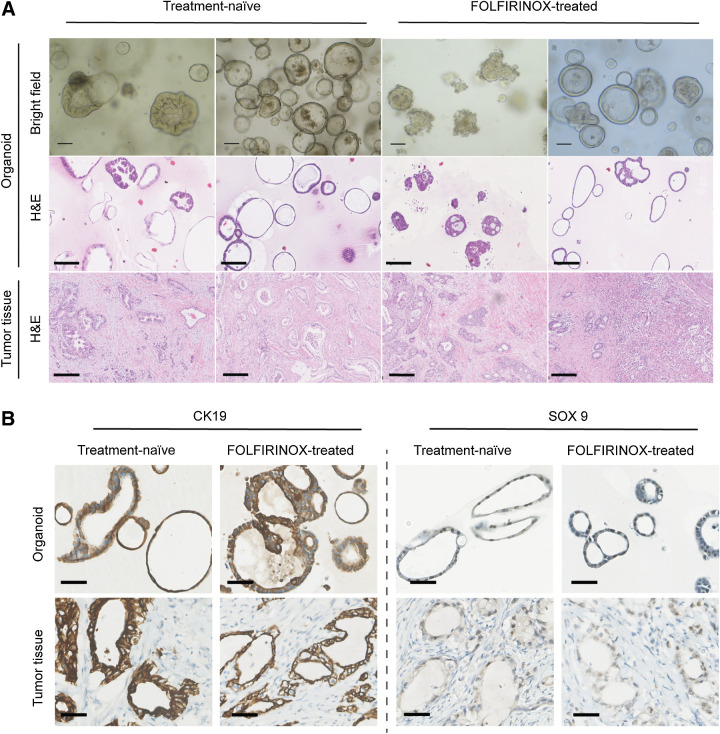
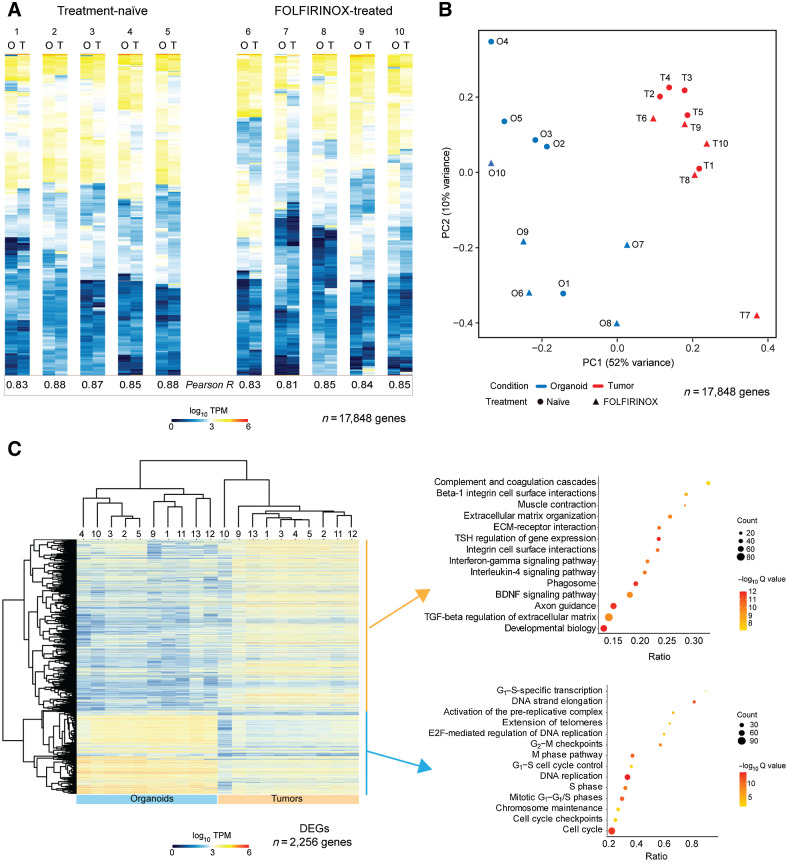
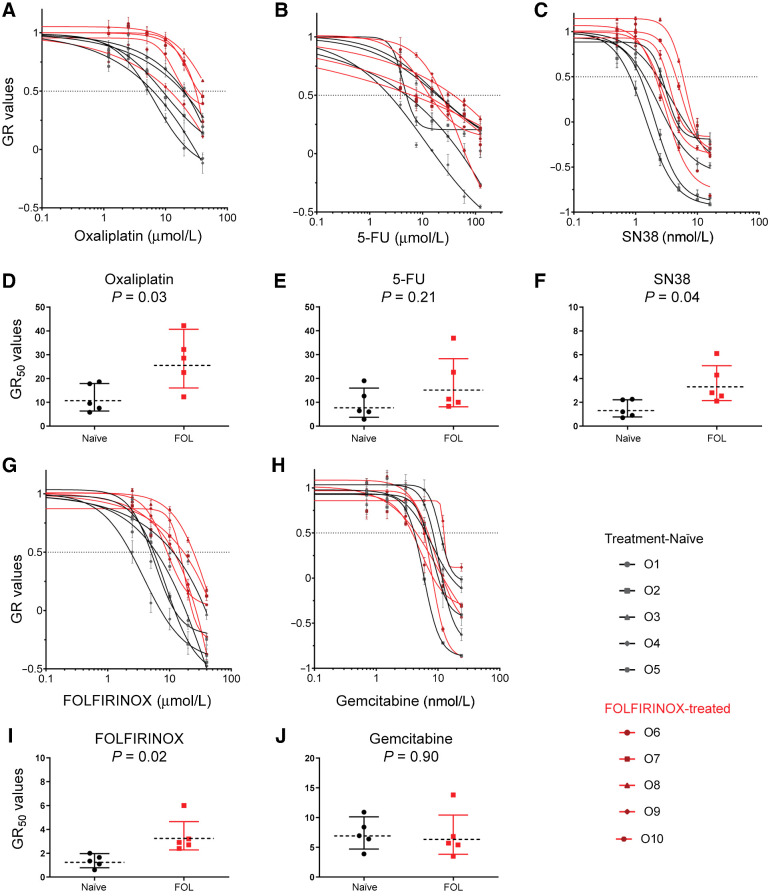
We generated a library of 10 pancreatic ductal adenocarcinoma (PDAC) organoid lines: five each from treatment-naïve and FOLFIRINOX-treated patients. We first assessed the histologic, genetic, and transcriptional characteristics of the organoids and their matched primary PDAC tissue. Next, the organoids' response to treatment with single agents-5-FU, irinotecan, and oxaliplatin-of the FOLFIRINOX regimen as well as combined regimen was evaluated. Finally, global mRNA-seq analyses were performed to identify FOLFIRINOX resistance pathways.
All 10 patient-derived PDAC organoids recapitulate histologic, genetic, and transcriptional characteristics of their primary tumor tissue. Neoadjuvant FOLFIRINOX-treated organoids display resistance to FOLFIRINOX (5/5), irinotecan (5/5), and oxaliplatin (4/5) when compared with treatment-naïve organoids (FOLFIRINOX: 1/5, irinotecan: 2/5, oxaliplatin: 0/5). 5-Fluorouracil treatment responses between naïve and treated organoids were similar. Comparative global transcriptome analysis of treatment-naïve and FOLFIRINOX samples-in both organoids and corresponding matched tumor tissues-uncovered modulated pathways mainly involved in genomic instability, energy metabolism, and innate immune system.
Resistance development in neoadjuvant FOLFIRINOX organoids, recapitulating their primary tumor resistance, suggests continuation of FOLFIRINOX therapy as an adjuvant treatment may not be advantageous for these patients. Gene-expression profiles of PDAC organoids identify targetable pathways involved in chemoresistance development upon neoadjuvant FOLFIRINOX treatment, thus opening up combination therapy possibilities.
我们研究了是否可以从接受 8 个周期新辅助 FOLFIRINOX 化疗后手术的患者切除的肿瘤中生成类器官,并评估这些存活的癌细胞对癌症治疗的敏感性/耐药性。
我们生成了 10 个胰腺导管腺癌 (PDAC) 类器官系库:每个治疗初治患者和 FOLFIRINOX 治疗患者各 5 个。我们首先评估了类器官及其匹配的原发性 PDAC 组织的组织学、遗传和转录特征。接下来,评估了类器官对 FOLFIRINOX 方案的单药治疗-5-FU、伊立替康和奥沙利铂-以及联合方案的反应。最后,进行了全局 mRNA-seq 分析以确定 FOLFIRINOX 耐药途径。
所有 10 个患者来源的 PDAC 类器官均再现了其原发性肿瘤组织的组织学、遗传和转录特征。与治疗初治的类器官相比,新辅助 FOLFIRINOX 治疗的类器官对 FOLFIRINOX(5/5)、伊立替康(5/5)和奥沙利铂(4/5)显示耐药性(FOLFIRINOX:1/5,伊立替康:2/5,奥沙利铂:0/5)。5-FU 治疗在初治和治疗后的类器官之间的反应相似。在类器官和相应匹配的肿瘤组织中,对治疗初治和 FOLFIRINOX 样本进行的比较性全局转录组分析揭示了主要涉及基因组不稳定性、能量代谢和固有免疫系统的调节途径。
在新辅助 FOLFIRINOX 类器官中观察到耐药性的发展,这与原发性肿瘤的耐药性相吻合,这表明继续使用 FOLFIRINOX 辅助治疗可能对这些患者不利。PDAC 类器官的基因表达谱确定了新辅助 FOLFIRINOX 治疗后涉及化疗耐药发展的可靶向途径,从而开辟了联合治疗的可能性。