Pascal Mariona, Moreno Carmen, Dávila Ignacio, Tabar Ana I, Bartra Joan, Labrador Moisés, Luengo Olga
Immunology Department, Centre de Diagnòstic Biomèdic, Hospital Clínic de Barcelona, Institut d'Investigacions Biomèdiques August Pi i Sunyer (IDIBAPS), Universitat de Barcelona, Barcelona, Spain.
ARADyAL Network, Health Institute Carlos III, Madrid, Spain.
Clin Transl Allergy. 2021 Aug;11(7):e12052. doi: 10.1002/clt2.12052.
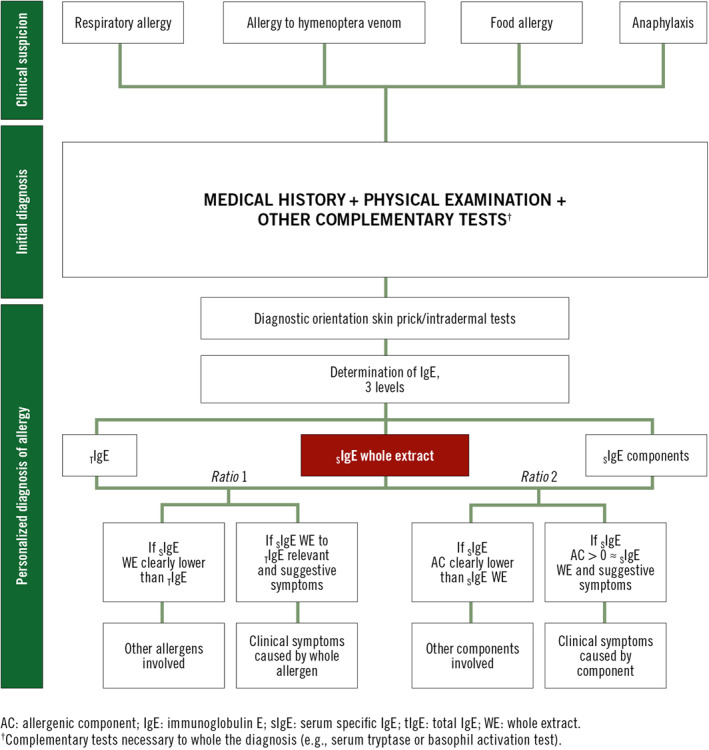
The introduction of molecular diagnosis into routine clinical practice has substantially improved the diagnosis and management of allergic patients by allowing clinicians to precisely identify the allergenic molecule responsible for immunoglobulin E (IgE)-mediated allergies. However, it can be challenging to accurately interpret the results of molecular assays, partly due to the limited evidence base. In this context, a panel of experts with extensive experience in interpreting in vitro measures of total and serum specific IgE reviewed the available scientific evidence. After this review, the panel selected a series of representative case studies to demonstrate how determination of specific and total IgE values and the relationship between them (ratio analysis) can add value to the diagnostic process by more precisely defining the patient's sensitization profile. Finally, the experts developed a series of recommendations on the clinical application of ratio analysis to optimize and complement the classical approach to allergy diagnosis.
将分子诊断引入常规临床实践,通过使临床医生能够精确识别导致免疫球蛋白E(IgE)介导的过敏反应的致敏分子,极大地改善了对过敏患者的诊断和管理。然而,准确解读分子检测结果可能具有挑战性,部分原因是证据基础有限。在此背景下,一组在解读总IgE和血清特异性IgE体外检测方面具有丰富经验的专家对现有科学证据进行了审查。审查之后,该小组选择了一系列具有代表性的案例研究,以展示特定IgE和总IgE值的测定以及它们之间的关系(比值分析)如何通过更精确地定义患者的致敏情况,为诊断过程增添价值。最后,专家们就比值分析的临床应用制定了一系列建议,以优化和补充经典的过敏诊断方法。