Zhao Zhifeng, Zhu Yiming, Ni Xiaochun, Lin Jiayun, Li Hongjie, Zheng Lei, Zhang Chihao, Qi Xiaoliang, Huo Haizhong, Lou Xiaolou, Fan Qiang, Bao Yongyang, Luo Meng
Department of General Surgery, Shanghai Ninth People's Hospital, Shanghai Jiao Tong University School of Medicine, No. 639, Zhizaoju Road, Huangpu District, Shanghai, People's Republic of China.
Department of Pathology, Shanghai Ninth People's Hospital, Shanghai Jiao Tong University School of Medicine, No. 639, Zhizaoju Road, Huangpu District, Shanghai, People's Republic of China.
Cancer Cell Int. 2021 Sep 28;21(1):517. doi: 10.1186/s12935-021-02214-1.
The gamma-glutamyl transferase (GGT) to alanine aminotransferase (ALT) ratio has been reported as an effective predictor of the severity of hepatitis and HCC. The purpose of this study was to determine the role of the GGT/ALT ratio in the prediction of vascular invasion and survival outcomes in patients with hepatitis B virus (HBV)-related hepatocellular carcinoma (HCC).
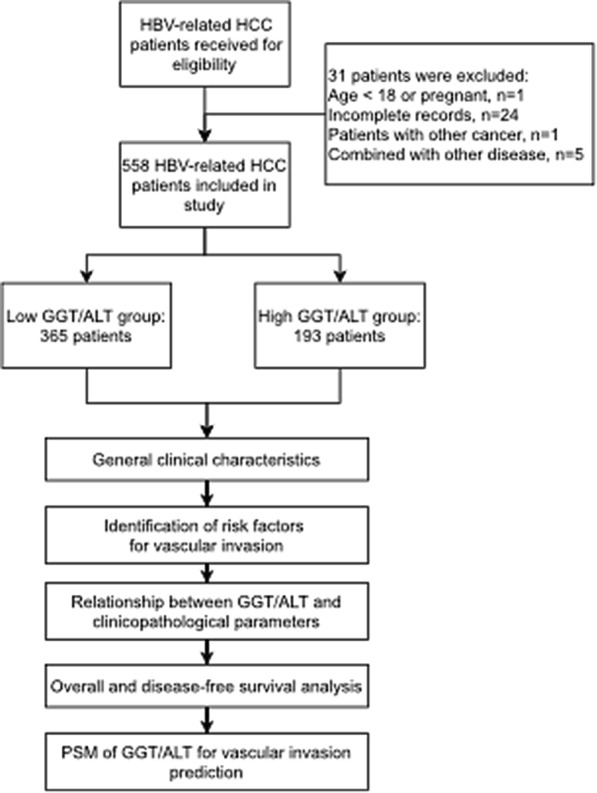
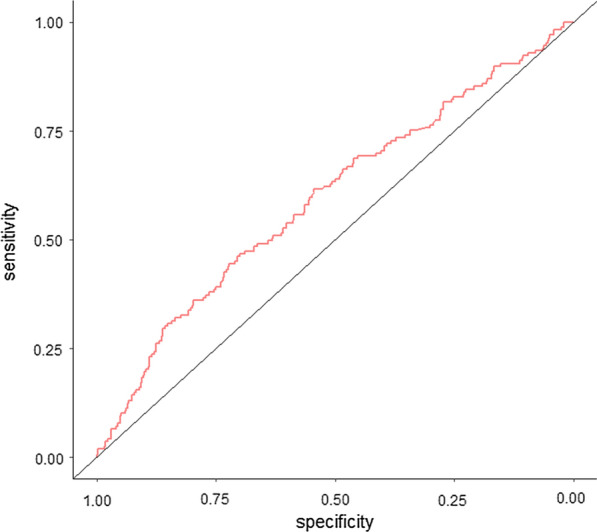
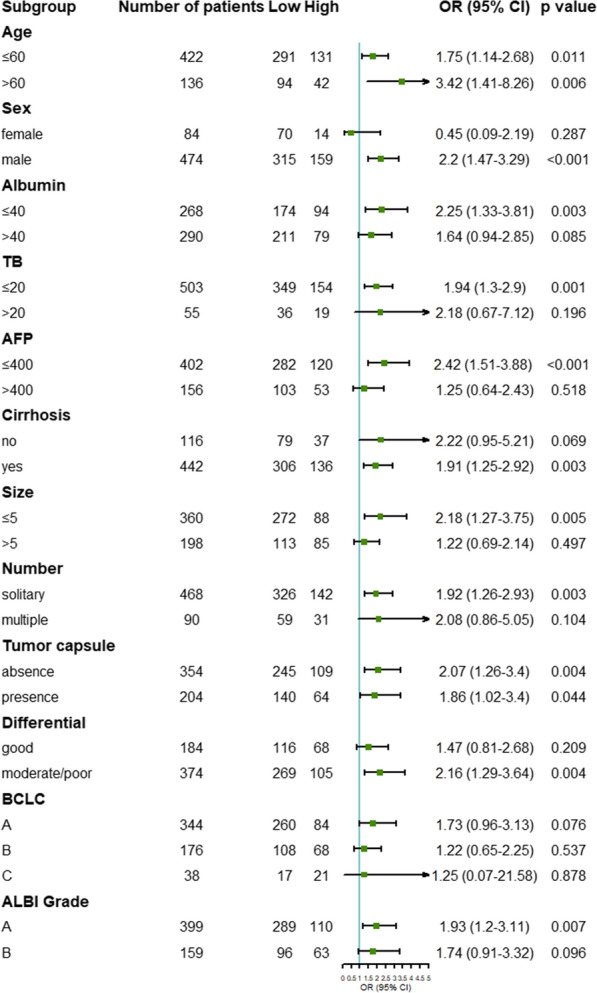
The risk factors for vascular invasion were determined by univariate/multivariate logistic analysis. The cut-off value of GGT/ALT in predicting vascular invasion was calculated using the receiver operating characteristic (ROC) curve. The prognostic value of GGT/ALT was examined by Cox analysis and Kaplan-Meier curves. Sensitivity analysis, such as subgroup analysis and propensity score matching (PSM), was performed to reduce potential confounding bias.
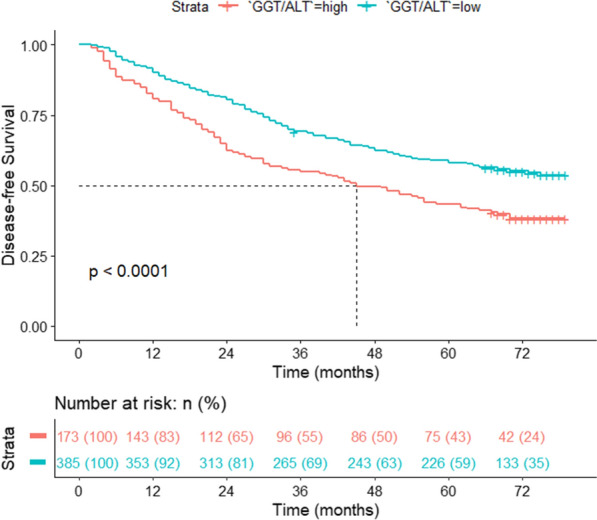
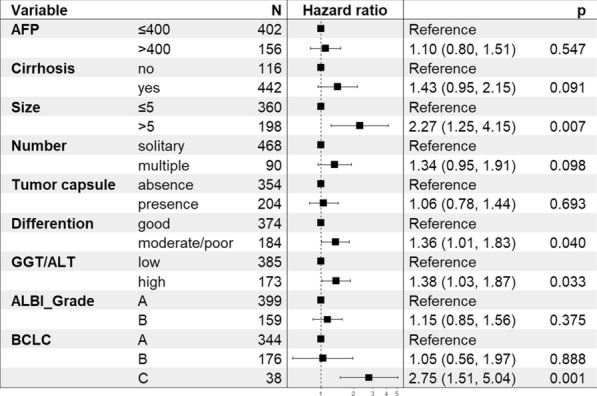
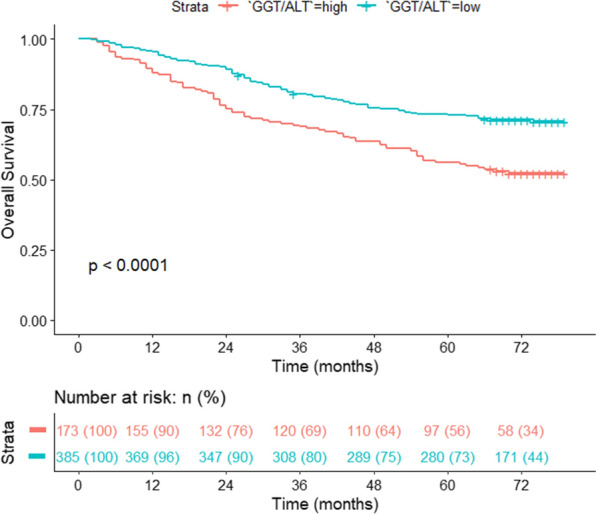
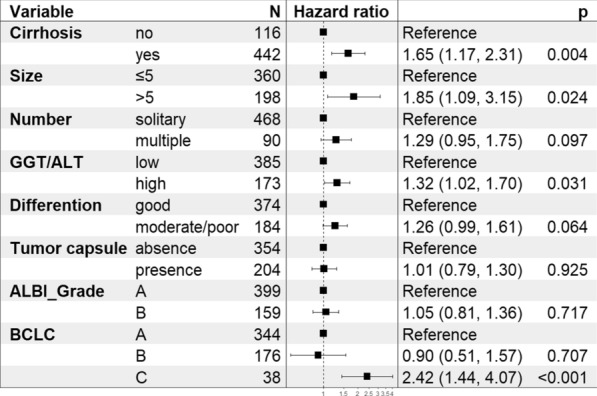
A high GGT/ALT ratio was identified as an independent risk factor for vascular invasion (P = 0.03). The correlation analysis suggested that higher GGT/ALT was associated with more severe tumour burdens, including vascular invasion (P < 0.001), tumour volume > 5 cm (P < 0.001), poor pathological differentiation (P = 0.042), more severe BCLC (P < 0.001) and ALBI grade (P = 0.007). In the survival analysis, a high GGT/ALT ratio was associated with poor overall survival (OS) (HR: 1.38; 95% CI 1.03, 1.87; P < 0.0001) and disease-free survival (DFS) (HR: 1.32; 95% CI 1.03, 1.87; P < 0.0001). In the subgroup analysis, similar results were consistently observed across most subgroups. In PSM analysis, GGT/ALT remained independently associated with vascular invasion (OR, 186; 95% CI 1.23, 3.33).
The GGT/ALT ratio was a potential effective factor in the prediction of vascular invasion and prognosis in patients with HBV-related HCC.
γ-谷氨酰转移酶(GGT)与丙氨酸氨基转移酶(ALT)的比值已被报道为肝炎和肝癌严重程度的有效预测指标。本研究的目的是确定GGT/ALT比值在预测乙型肝炎病毒(HBV)相关肝细胞癌(HCC)患者血管侵犯和生存结局中的作用。
通过单因素/多因素逻辑分析确定血管侵犯的危险因素。使用受试者工作特征(ROC)曲线计算GGT/ALT预测血管侵犯的临界值。通过Cox分析和Kaplan-Meier曲线检验GGT/ALT的预后价值。进行敏感性分析,如亚组分析和倾向评分匹配(PSM),以减少潜在的混杂偏倚。
高GGT/ALT比值被确定为血管侵犯的独立危险因素(P = 0.03)。相关性分析表明,较高的GGT/ALT与更严重的肿瘤负荷相关,包括血管侵犯(P < 0.001)、肿瘤体积>5 cm(P < 0.001)、病理分化差(P = 0.042)、更严重的BCLC(P < 0.001)和ALBI分级(P = 0.007)。在生存分析中,高GGT/ALT比值与总生存期(OS)差(HR:1.38;95%CI 1.03,1.87;P < 0.0001)和无病生存期(DFS)差(HR:1.32;95%CI 1.03,1.87;P < 0.0001)相关。在亚组分析中,大多数亚组均一致观察到类似结果。在PSM分析中,GGT/ALT仍与血管侵犯独立相关(OR,1.86;95%CI 1.23,3.33)。
GGT/ALT比值是预测HBV相关HCC患者血管侵犯和预后的潜在有效因素。