Wang Hui, Liu Wei, Zhang Dong-Ying, Si Wen-Yue, Yang Qing-Lin, Lu Lian-Wei, Wang Feng-Hua, Li Le, Wang Qi, Xia Hui-Min
The Second School of Clinical Medicine, Southern Medical University, Guangzhou, China.
Department of Pediatric Surgery, Guangzhou Women and Children's Medical Center, Guangzhou Medical University, Guangzhou, China.
Transl Pediatr. 2021 Aug;10(8):2044-2051. doi: 10.21037/tp-21-282.
The surface topography index (STI) has great potential in both routine computed tomography (CT) scan and emerging optical imaging systems. However, the diagnostic accuracy and stability of the STI as a deformity severity assessment index has not been fully confirmed. Therefore, the aim of the present study was to determine the diagnostic performance of the STI as a novel deformity severity assessment index for pectus excavatum.
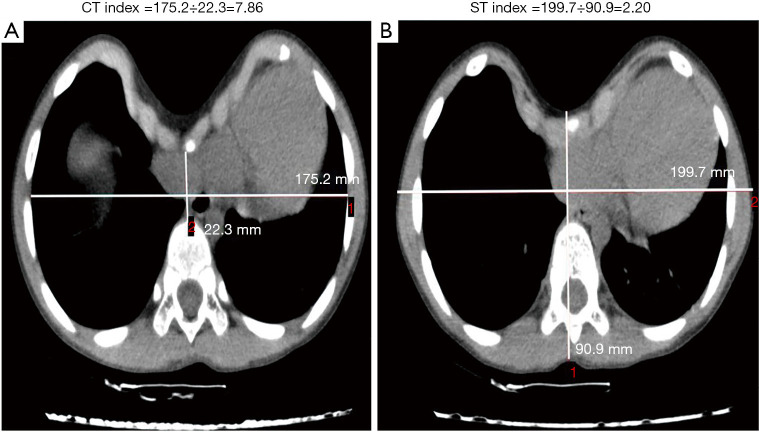
The present study consisted of 722 chest CT images from a single center. The standard CT index (CTI) and STI were calculated for all patients. The between-group difference and the level of compliance between the CTI and STI was analyzed by -test and Pearson correlation. The diagnostic value and optimum discriminatory values of the CTI and STI were calculated by a receiver-operating characteristic (ROC) curve and DeLong's test.
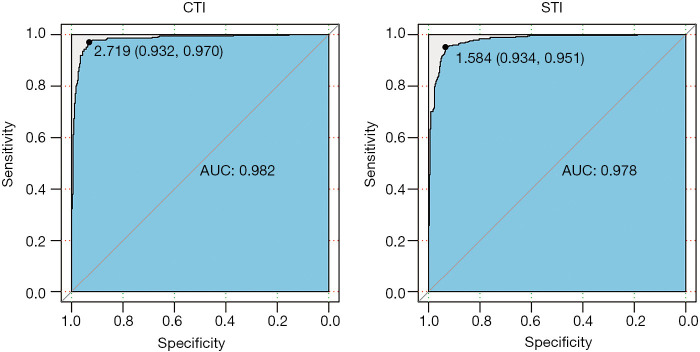
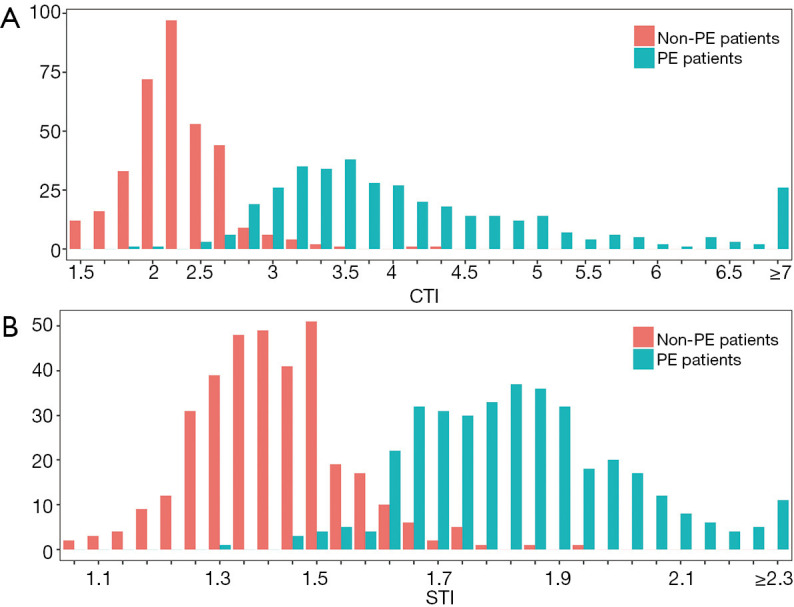
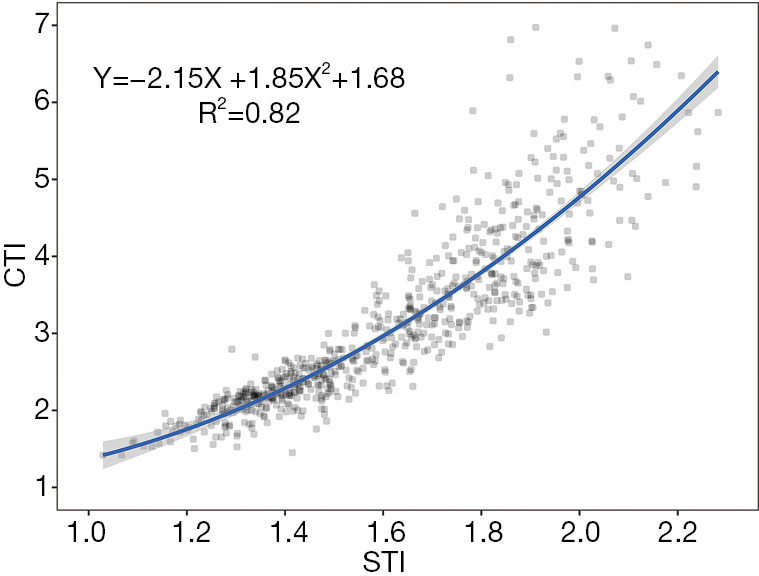
The distributions of the CTI and STI were similar and showed a slight overlap between the pectus excavatum (PE) and non-PE groups. Both the CTI and STI significantly differed between the 2 groups (P<0.001). The STI demonstrated a strong Pearson correlation with the CTI (r=0.91, 95% confidence interval: 0.88-0.91, P<0.001). The ROC curves showed that STI =1.58 (sensitivity: 0.93, specificity: 0.95) could be considered equivalent to CTI =2.72 (sensitivity: 0.93, specificity: 0.97) as the optimum discriminatory values. DeLong's test showed no significant difference in the ROC curve results between the CTI and STI (Z=0.90, P=0.37).
The STI has comparative discrimination ability in PE diagnosis and deformity severity assessment when used with the standard CTI. The STI as a novel index is not only an ideal evaluation metric of PE deformity but also an objective trait for PE patients just as weight and height for everyone.
表面形貌指数(STI)在常规计算机断层扫描(CT)和新兴光学成像系统中均具有巨大潜力。然而,作为畸形严重程度评估指标,STI的诊断准确性和稳定性尚未得到充分证实。因此,本研究旨在确定STI作为漏斗胸畸形严重程度评估新指标的诊断性能。
本研究纳入来自单一中心的722例胸部CT图像。计算所有患者的标准CT指数(CTI)和STI。通过t检验和Pearson相关性分析CTI与STI之间的组间差异和一致性水平。采用受试者操作特征(ROC)曲线和DeLong检验计算CTI和STI的诊断价值及最佳鉴别值。
CTI和STI的分布相似,漏斗胸(PE)组与非PE组之间存在轻微重叠。两组间CTI和STI均有显著差异(P<0.001)。STI与CTI呈强Pearson相关性(r=0.91,95%置信区间:0.88-0.91,P<0.001)。ROC曲线显示,STI =1.58(敏感性:0.93,特异性:0.95)可被视为等同于CTI =2.72(敏感性:0.93,特异性:0.97)的最佳鉴别值。DeLong检验显示CTI和STI的ROC曲线结果无显著差异(Z=0.90,P=0.37)。
与标准CTI联合使用时,STI在PE诊断和畸形严重程度评估方面具有相当的鉴别能力。作为一个新指标,STI不仅是PE畸形的理想评估指标,也是PE患者的一个客观特征,就如同体重和身高对每个人一样。