Kim Miyoung, Lee Ki Yeol, Park Hyung Joo, Kim Hee-Young, Kang Eun-Young, Oh Yu Whan, Seo Bo Kyung, Je Bo Kyung, Choi Eun Jung
Department of Diagnostic Radiology, Korea University Hospital, 516 Gojan-dong, Ansan, Korea.
Yonsei Med J. 2009 Jun 30;50(3):385-90. doi: 10.3349/ymj.2009.50.3.385. Epub 2009 Jun 23.
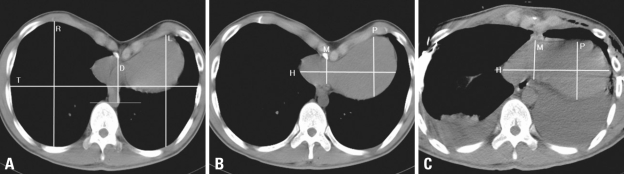
The aim of this study was to evaluate new cardiac deformity indexes (CDIs) for diagnosis of pectus excavatum as well as morphological assessment of heart on computed tomography (CT).
We retrospectively evaluated the CT images of the control group (n=200), and the pectus excavatum before and after correction groups (n=178), and calculated the CDIs; cardiac compression index (CCI), and cardiac asymmetry index (CAI). We also calculated chest wall compression index (CWCI) and asymmetry index (CWAI) on the axial images. We performed logistic regression analysis using each index and age as predictor variables.
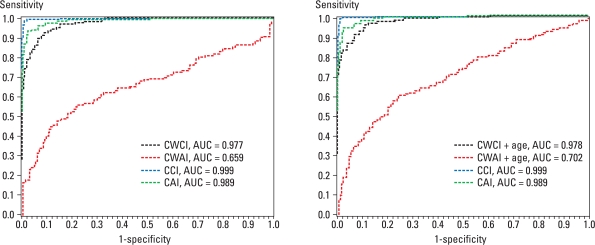
The CDIs (CCI and CAI) were significant (p < 0.05) in the diagnosis of pectus excavatum, regardless of age (p = 0.4033, p = 0.8113). The CWCI and CWAI were significant (p < 0.05) and significantly affected by age (p < 0.05). If we selected 1.82 as the cutoff of the CCI, the sensitivity and specificity were 99.4% and 98%, respectively. The following cutoffs and the sensitivity and specificity were obtained: 1.15 for the CAI gave 94.4% and 94.5%, 3.05 for the CWCI gave 92.1% and 92%, and 1 for the CWAI gave 62.4% and 65%, respectively. The CCI after repair improved from 2.83 +/- 0.84 to 1.84 +/- 0.33, while the CWCI improved from 4.49 +/- 1.61 to 2.57 +/- 0.44.
CDIs such as the CCI and CAI may be potentially useful to detect and estimate repair for pectus excavatum.
本研究旨在评估用于诊断漏斗胸以及在计算机断层扫描(CT)上对心脏进行形态学评估的新心脏畸形指数(CDIs)。
我们回顾性评估了对照组(n = 200)以及漏斗胸矫正前后组(n = 178)的CT图像,并计算了CDIs;心脏压缩指数(CCI)和心脏不对称指数(CAI)。我们还在轴位图像上计算了胸壁压缩指数(CWCI)和不对称指数(CWAI)。我们使用每个指数和年龄作为预测变量进行逻辑回归分析。
CDIs(CCI和CAI)在漏斗胸诊断中具有显著性(p < 0.05),且不受年龄影响(p = 0.4033,p = 0.8113)。CWCI和CWAI具有显著性(p < 0.05)且受年龄显著影响(p < 0.05)。如果我们将CCI的截断值设定为1.82,其敏感性和特异性分别为99.4%和98%。获得了以下截断值以及敏感性和特异性:CAI为1.15时,敏感性和特异性分别为94.4%和94.5%;CWCI为3.05时,敏感性和特异性分别为92.1%和92%;CWAI为1时,敏感性和特异性分别为62.4%和65%。修复后的CCI从2.83±0.84改善至1.84±0.33,而CWCI从4.49±1.61改善至2.57±0.44。
诸如CCI和CAI之类的CDIs可能对检测和评估漏斗胸修复有潜在作用。