Bonnet Damien
M3C-Necker, Hôpital universitaire Necker-Enfants malades, Assistance Publique-Hôpitaux de Paris, Paris, France.
Université de Paris, Paris, France.
Transl Pediatr. 2021 Aug;10(8):2241-2249. doi: 10.21037/tp-20-267.
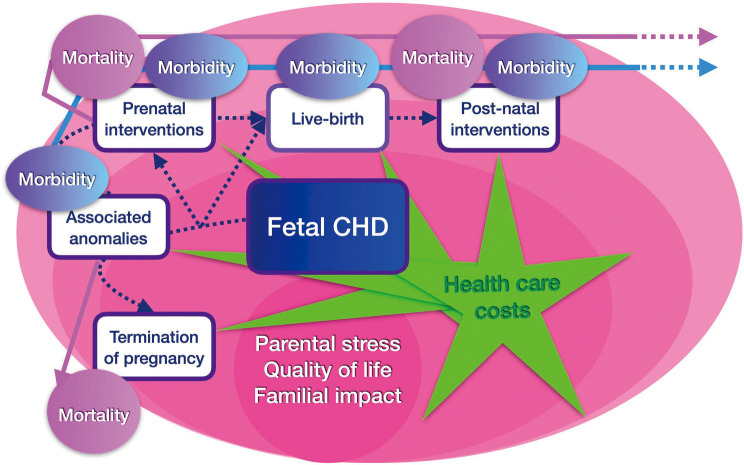
Prenatal diagnosis of congenital heart diseases (CHD) is increasingly performed in developed countries. Still, the current impacts of prenatal diagnosis on fetal and neonatal outcomes remains unclear or contradictory. We will review here the different consequences of prenatal screening and of fetal echocardiography on different categories of outcomes. Increasing detection may lead to a reduced birth incidence of severe complex CHD through a high rate of termination of pregnancy but this trend is not universal. Conversely, one of the main impacts of prenatal diagnosis is to optimize perinatal care and to improve hard outcomes such as mortality. Indeed, decrease of neonatal mortality is inconsistently observed in transposition of the great arteries and is not shown in other defects. The reduction of perinatal morbidity is a new end-point to scrutinize but how to examine this impact is controversial in the neonatal period. The influence of the reduction of neonatal distress may modify neurodevelopmental outcomes and quality of survival. The risk stratification after a prenatal diagnosis of CHD helps to optimize the timing, mode, and site of management with the aim to improve outcomes. The anticipated care is tailored according to the type of CHD and expected initial physiology. However, the imprecision of prenatal diagnosis even in expert centers hampers this logical outcome. Prediction of the type of repair is theoretically possible but remains challenging in defects such as double outlet right ventricles or pulmonary atresia with ventricular septal defect. The cost of prenatal diagnosis or of its absence is still a matter of debate and policies have to be tailored to regional health systems. Finally, the impact on parents and siblings is a rarely explored outcome. Screening and echography of fetal heart are currently performed in developed countries but it is still too early to talk about fetal cardiology.
在发达国家,先天性心脏病(CHD)的产前诊断越来越普遍。然而,目前产前诊断对胎儿和新生儿结局的影响仍不明确或存在矛盾。在此,我们将回顾产前筛查和胎儿超声心动图对不同类别结局的不同影响。检测率的提高可能会通过高终止妊娠率导致严重复杂先天性心脏病的出生发病率降低,但这种趋势并不普遍。相反,产前诊断的主要影响之一是优化围产期护理并改善诸如死亡率等硬指标结局。事实上,在大动脉转位中新生儿死亡率的降低并不一致,在其他缺陷中也未体现。围产期发病率的降低是一个需要审视的新终点,但在新生儿期如何评估这种影响存在争议。新生儿窘迫的减轻可能会改变神经发育结局和生存质量。先天性心脏病产前诊断后的风险分层有助于优化管理的时机、方式和地点,以改善结局。预期护理是根据先天性心脏病的类型和预期的初始生理状况量身定制的。然而,即使在专家中心,产前诊断的不精确性也会妨碍这一理想结局。理论上可以预测修复类型,但在诸如右心室双出口或室间隔缺损的肺动脉闭锁等缺陷中仍然具有挑战性。产前诊断或未进行产前诊断的成本仍是一个有争议的问题,政策必须根据地区卫生系统进行调整。最后,对父母和兄弟姐妹的影响是一个很少被探讨的结局。目前发达国家正在进行胎儿心脏的筛查和超声检查,但现在谈论胎儿心脏病学还为时过早。