Salvatore Michele Antonio, Salvi Silvia, D'Aloja Paola, Vergani Patrizia, Bellù Roberto, Dani Carlo, Mecacci Federico, D'Anna Maria Rosa, Ferrazzani Sergio, Battagliarin Giuseppe, Paolillo Piermichele, Picone Simonetta, Ramenghi Luca, Vento Giovanni, Donati Serena
National Centre for Disease Prevention and Health Promotion, Istituto Superiore di Sanità - Italian National Institute of Health, Viale Regina Elena 299, Rome, 00161, Italy.
UOC Ostetricia e Patologia Ostetrica, Dipartimento di Scienze della Salute della Donna e del Bambino e di Sanità Pubblica, Fondazione Policlinico Universitario A. Gemelli, IRCCS, Largo A. Gemelli 8, Rome, 00168, Italy.
Ital J Pediatr. 2024 Dec 4;50(1):256. doi: 10.1186/s13052-024-01811-w.
An effective strategy to reduce perinatal mortality requires an active surveillance system. This includes monitoring cases, organizing multidisciplinary local audits, conducting Confidential Enquiries, identifying avoidable factors, and facilitating changes in the healthcare system. In 2017, the Italian Obstetric Surveillance System launched the SPItOSS pilot Perinatal Surveillance System. The aim of this paper is to describe the results of the SPItOSS Confidential Enquiries on perinatal deaths focusing on the emergent critical aspects in obstetric and neonatal care, as well as on the healthcare facilities organization.
SPItOSS, a population-based surveillance system, collected and analysed incident perinatal deaths from July 2017 to June 2019 in three Regions encompassing 32.3% of Italian births. Cases were defined according to WHO definition as fetuses born dead ≥ 28 weeks of gestation and live newborn died within 7 days from birth. The International Statistical Classification of Diseases and related Health Problem-Perinatal Mortality was adopted for coding causes of death and contributing maternal and placenta-related conditions. Confidential Enquiries, prioritized according to perinatal deaths preventability, were conducted by expert committees at Regional and National level.
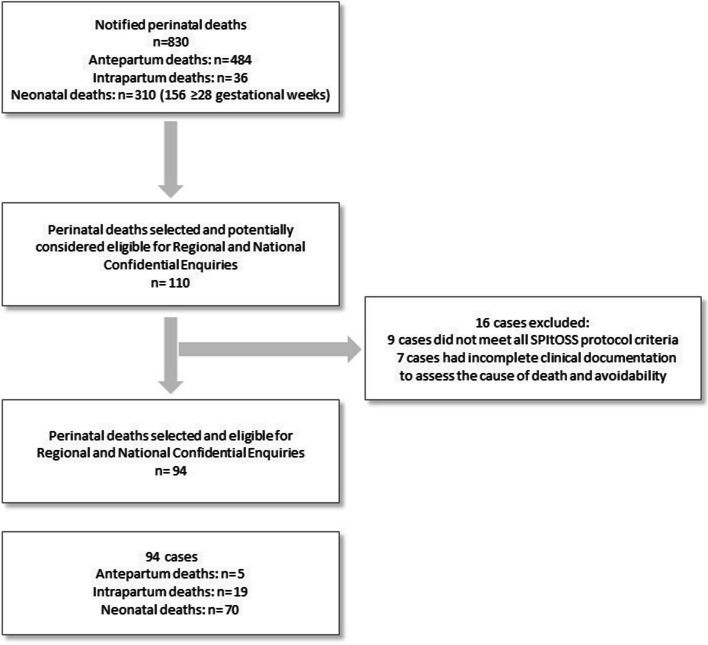
A total of 830 incident perinatal deaths were notified, with 58.3% classified as antepartum, 4.3% as intrapartum, and 37.3% as neonatal deaths. According to the SPItOSS protocol, Confidential Enquiries evaluated only the most preventable deaths, including 19 intrapartum and 70 neonatal deaths. Of these, 43.8% were assessed as unavoidable with appropriate care; 29.2% as unavoidable with improvable care, and 15.7% as avoidable due to inappropriate care. Most intrapartum deaths were attributed to intrauterine hypoxia, while neonatal deaths recognized a multifactorial aetiology. Different aspects of inappropriate care were highlighted, such as failure to recognise maternal or fetal problems before labour, delayed or inappropriate neonatal resuscitation, and poor or suboptimal neonatal monitoring.
The SPItOSS Confidential Enquires provided insights for improving maternity and perinatal services. By targeting key areas of obstetric and neonatal care, the surveillance can generate recommendations and actions to prevent avoidable perinatal deaths.
降低围产期死亡率的有效策略需要一个积极的监测系统。这包括监测病例、组织多学科的本地审核、开展保密调查、识别可避免因素以及推动医疗保健系统的变革。2017年,意大利产科监测系统启动了SPItOSS围产期监测系统试点项目。本文旨在描述SPItOSS围产期死亡保密调查的结果,重点关注产科和新生儿护理中出现的关键问题以及医疗保健机构的组织情况。
SPItOSS是一个基于人群的监测系统,收集并分析了2017年7月至2019年6月期间三个地区的围产期死亡事件,这些地区的出生人数占意大利出生总数的32.3%。病例根据世界卫生组织的定义确定为妊娠≥28周的死产胎儿以及出生后7天内死亡的活产新生儿。采用《国际疾病和相关健康问题统计分类 - 围产期死亡率》对死亡原因以及相关的孕产妇和胎盘相关情况进行编码。由地区和国家级专家委员会根据围产期死亡的可预防性进行优先排序的保密调查。
共报告了830例围产期死亡事件,其中58.3%归类为产前死亡,4.3%为产时死亡,37.3%为新生儿死亡。根据SPItOSS方案,保密调查仅评估最可预防的死亡事件,包括19例产时死亡和70例新生儿死亡。其中,43.8%被评估为即使给予适当护理也不可避免;29.2%为给予可改进的护理仍不可避免,15.7%为因护理不当可避免。大多数产时死亡归因于宫内缺氧,而新生儿死亡则被认为是多因素病因。突出了护理不当的不同方面,例如分娩前未识别出孕产妇或胎儿问题、新生儿复苏延迟或不当以及新生儿监测不佳或不理想。
SPItOSS保密调查为改善孕产妇和围产期服务提供了见解。通过针对产科和新生儿护理的关键领域,该监测可产生预防可避免围产期死亡的建议和行动。