School of Food Science and Nutrition, University of Leeds, Leeds, LS2 9JT, UK.
Faculty of Applied Medical Sciences, Department of Clinical Nutrition, King Abdul-Aziz University, Jeddah, Saudi Arabia.
Eur J Nutr. 2022 Mar;61(2):809-824. doi: 10.1007/s00394-021-02685-y. Epub 2021 Sep 29.
Findings from randomized controlled trials (RCTs) evaluating the effect of pulse intake on glycemic control are inconsistent and conclusive evidence is lacking. The aim of this study was to systematically review the impact of pulse consumption on post-prandial and long-term glycemic control in adults with and without type 2 diabetes (T2D).
Databases were searched for RCTs, reporting outcomes of post-prandial and long-term interventions with different pulse types on parameters of glycemic control in normoglycemic and T2D adults. Effect size (ES) was calculated using random effect model and meta-regression was conducted to assess the impact of various moderator variables such as pulse type, form, dose, and study duration on ES.
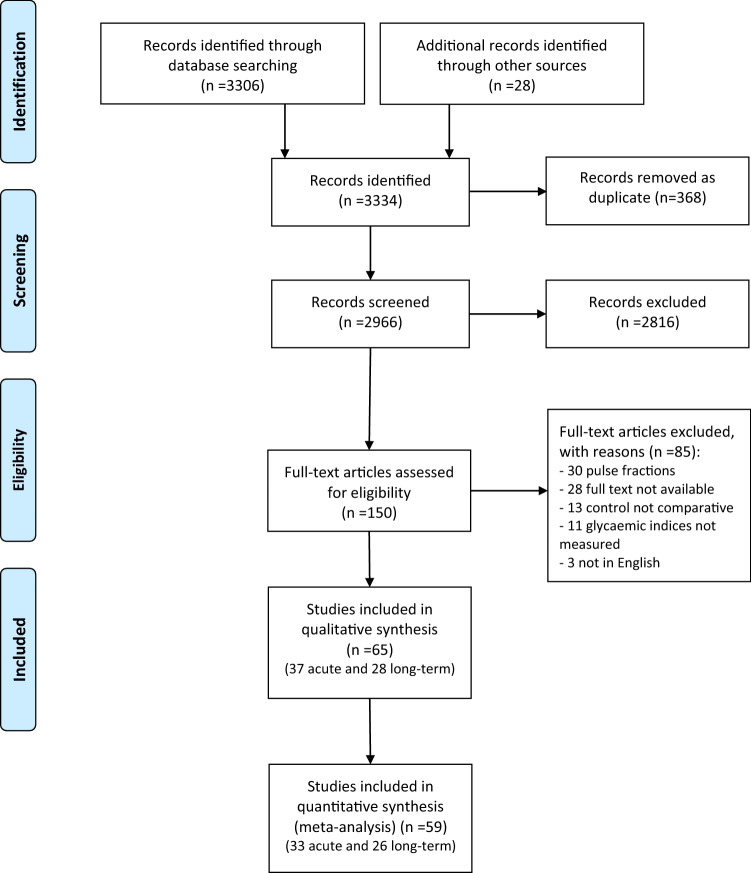
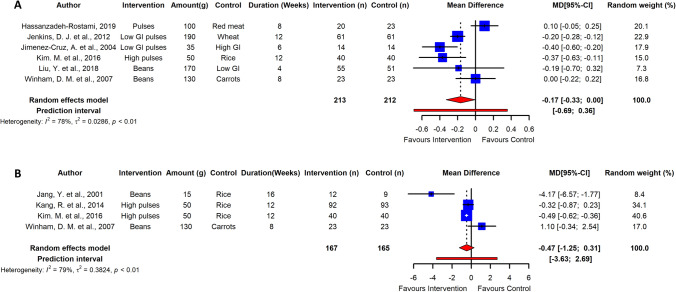
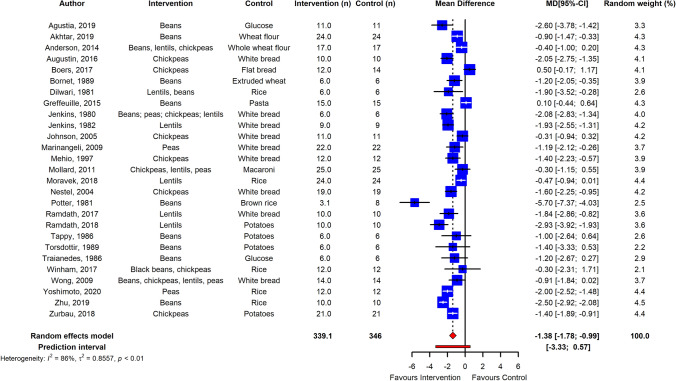
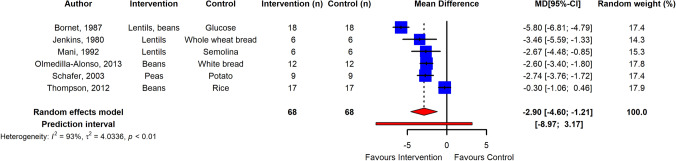
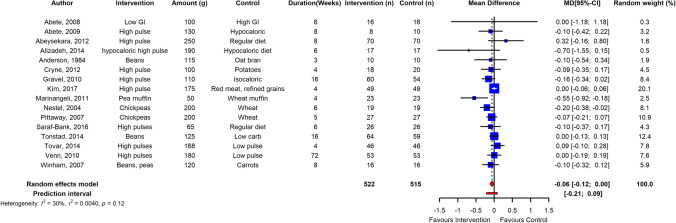
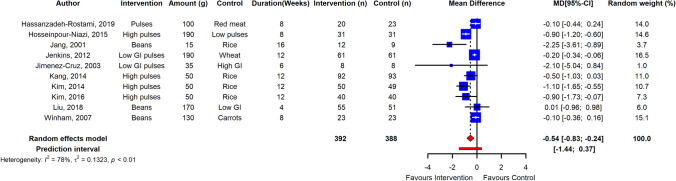
From 3334 RCTs identified, 65 studies were eligible for inclusion involving 2102 individuals. In acute RCTs, pulse intake significantly reduced peak post-prandial glucose concentration in participants with T2D (ES - 2.90; 95%CI - 4.60, - 1.21; p ≤ 0.001; I = 93%) and without T2D (ES - 1.38; 95%CI - 1.78, - 0.99; p ≤ 0.001; I = 86%). Incorporating pulse consumption into long-term eating patterns significantly attenuated fasting glucose in normoglycemic adults (ES - 0.06; 95%CI - 0.12, 0.00; p ≤ 0.05; I = 30%). Whereas, in T2D participants, pulse intake significantly lowered fasting glucose (ES - 0.54; 95%CI - 0.83, - 0.24; p ≤ 0.001; I = 78%), glycated hemoglobin A1c (HbA) (ES - 0.17; 95%CI - 0.33, 0.00; p ≤ 0.05; I = 78) and homeostatic model assessment of insulin resistance (HOMA-IR) (ES - 0.47; 95%CI - 1.25, - 0.31; p ≤ 0.05; I = 79%).
Pulse consumption significantly reduced acute post-prandial glucose concentration > 1 mmol/L in normoglycemic adults and > 2.5 mmol/L in those with T2D, and improved a range of long-term glycemic control parameters in adults with and without T2D. PROSPERO REGISTRY NUMBER: (CRD42019162322).
评估脉冲摄入对血糖控制影响的随机对照试验(RCTs)的结果不一致,缺乏确凿的证据。本研究旨在系统评价不同类型脉冲摄入对血糖正常和 2 型糖尿病(T2D)成人的餐后和长期血糖控制的影响。
检索数据库,以获取报告不同脉冲类型对血糖正常和 T2D 成人的血糖控制参数的短期和长期干预后结果的 RCTs。使用随机效应模型计算效应量(ES),并进行元回归以评估脉冲类型、形式、剂量和研究持续时间等各种调节变量对 ES 的影响。
从 3334 项 RCT 中,有 65 项研究符合纳入标准,共纳入了 2102 名参与者。在急性 RCT 中,脉冲摄入显著降低了 T2D 患者(ES-2.90;95%CI-4.60,-1.21;p≤0.001;I=93%)和非 T2D 患者(ES-1.38;95%CI-1.78,-0.99;p≤0.001;I=86%)的餐后血糖峰值。将脉冲摄入纳入长期饮食模式显著降低了血糖正常成人的空腹血糖(ES-0.06;95%CI-0.12,0.00;p≤0.05;I=30%)。而在 T2D 患者中,脉冲摄入显著降低了空腹血糖(ES-0.54;95%CI-0.83,-0.24;p≤0.001;I=78%)、糖化血红蛋白 A1c(HbA)(ES-0.17;95%CI-0.33,0.00;p≤0.05;I=78%)和稳态模型评估的胰岛素抵抗(HOMA-IR)(ES-0.47;95%CI-1.25,-0.31;p≤0.05;I=79%)。
脉冲摄入显著降低了血糖正常成人的急性餐后血糖浓度>1mmol/L 和 T2D 成人的急性餐后血糖浓度>2.5mmol/L,并改善了 T2D 患者和非 T2D 患者的一系列长期血糖控制参数。PROSPERO 注册号:(CRD42019162322)。