Servei de Pneumologia, Corporació Sanitària Parc Taulí, Parc Taulí s/n, Sabadell, 08208, Barcelona, Spain.
Universitat Autònoma de Barcelona (UAB), Barcelona, Spain.
Drugs. 2021 Oct;81(15):1763-1774. doi: 10.1007/s40265-021-01597-9. Epub 2021 Sep 29.
The efficacy of mepolizumab is well documented in severe eosinophilic asthma (SEA), although the stringent selection criteria adopted by SEA clinical trials limits the generalizability of results.
Our study evaluated the effectiveness and safety of mepolizumab in patients with SEA in Spain. The primary efficacy endpoint was the change in the rate of clinically significant asthma exacerbations 12 months after starting mepolizumab compared to the baseline rate in the 12 months prior to treatment. Patients were stratified by baseline blood eosinophil counts.
We conducted a multicentric observational cohort study of SEA patients treated with mepolizumab across 24 specialized hospital asthma units in Spain. Severe exacerbation rate, lung function, oral corticosteroid use (OCS) and asthma control test (ACT) were retrospectively collected and compared during the 12-month pre- and post-mepolizumab treatment. Adverse events were also investigated.
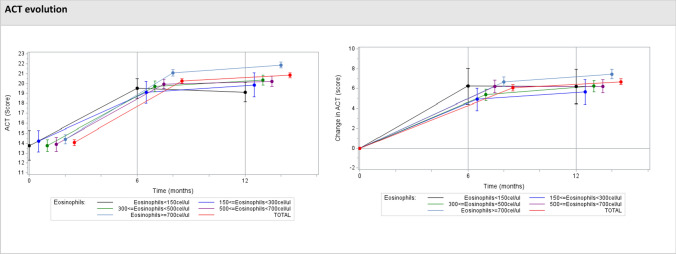
A total of 318 patients with SEA were included (mean age: 56.6 years, 69.2% female). Exacerbation rates decreased by 77.5%, and 50.6% of patients did not suffer any exacerbations during the 12 months of treatment. The difference in forced expiratory volume in 1 s (FEV1) pre- and post-bronchodilator after starting mepolizumab was 0.21 (0.46) L (95% CI 0.14-0.27) (p < 0.001). Exacerbations and lung function significantly improved across all eosinophil subgroups. Among the 98 patients on OCS, 47.8% were able to discontinue this treatment and the mean daily dose was decreased by 59.9%. The baseline ACT score was 14.1, increasing by a mean (SD) of 6.7 points (1.9) at 12 months. Adverse events related to mepolizumab were uncommon.
This real-world study of SEA patients confirms that mepolizumab is effective in reducing clinically meaningful exacerbations, improving lung function, and decreasing OCS dependence and mean OCS dose at 12 months, irrespective of baseline eosinophil counts.
美泊利珠单抗在重度嗜酸性粒细胞性哮喘(SEA)中的疗效已有充分的文献记载,尽管 SEA 临床试验采用的严格入选标准限制了研究结果的普遍性。
本研究评估了美泊利珠单抗在西班牙 SEA 患者中的疗效和安全性。主要疗效终点是与治疗前 12 个月的基线相比,起始美泊利珠单抗治疗后 12 个月内临床显著哮喘加重的发生率变化。患者根据基线血嗜酸性粒细胞计数进行分层。
我们开展了一项多中心观察性队列研究,纳入了西班牙 24 家专门的医院哮喘单位接受美泊利珠单抗治疗的 SEA 患者。回顾性收集并比较了治疗前和治疗后 12 个月内重度哮喘加重率、肺功能、口服皮质类固醇(OCS)的使用和哮喘控制测试(ACT)。还对不良事件进行了研究。
共纳入 318 例 SEA 患者(平均年龄:56.6 岁,69.2%为女性)。重度哮喘加重率下降了 77.5%,50.6%的患者在治疗的 12 个月内未发生任何加重。起始美泊利珠单抗后,支气管扩张剂后用力呼气量(FEV1)的预-后差值为 0.21(0.46)L(95%置信区间 0.14-0.27)(p<0.001)。所有嗜酸性粒细胞亚组的哮喘发作和肺功能均显著改善。在 98 例接受 OCS 治疗的患者中,47.8%的患者能够停用 OCS,且 OCS 的平均日剂量减少了 59.9%。基线 ACT 评分为 14.1,12 个月时平均(SD)增加了 6.7 分(1.9)。与美泊利珠单抗相关的不良事件并不常见。
本项针对 SEA 患者的真实世界研究证实,美泊利珠单抗可有效减少临床有意义的哮喘加重,改善肺功能,并在 12 个月时降低 OCS 的依赖和 OCS 的平均剂量,无论基线嗜酸性粒细胞计数如何。