Department of Geological Sciences, Jackson School of Geosciences, The University of Texas at Austin, Austin, USA.
Department of Integrative Biology, The University of Texas at Austin, Austin, USA.
BMC Ecol Evol. 2021 Sep 29;21(1):184. doi: 10.1186/s12862-021-01912-8.
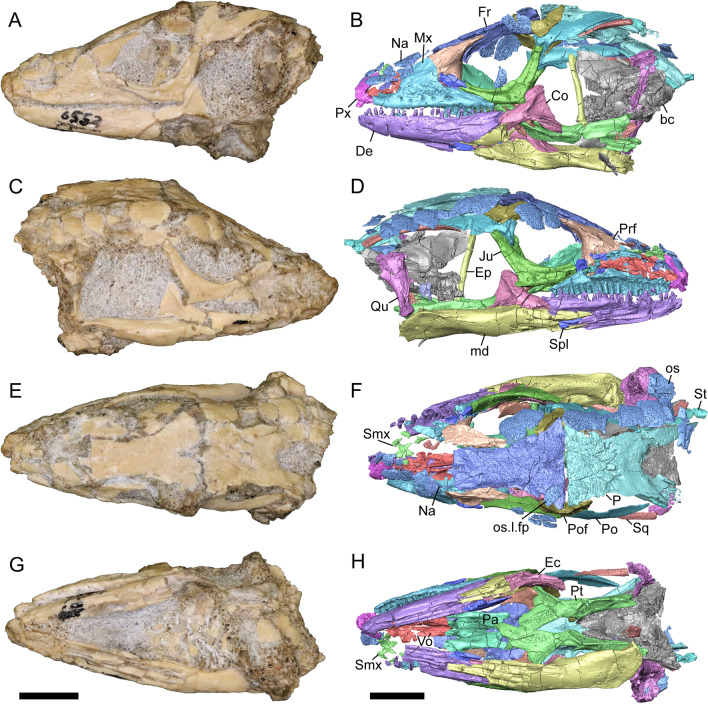
Alligator lizards (Gerrhonotinae) are a well-known group of extant North American lizard. Although many fossils were previously referred to Gerrhonotinae, most of those fossils are isolated and fragmentary cranial elements that could not be placed in a precise phylogenetic context, and only a handful of known fossils are articulated skulls. The fossil record has provided limited information on the biogeography and phylogeny of Gerrhonotinae.
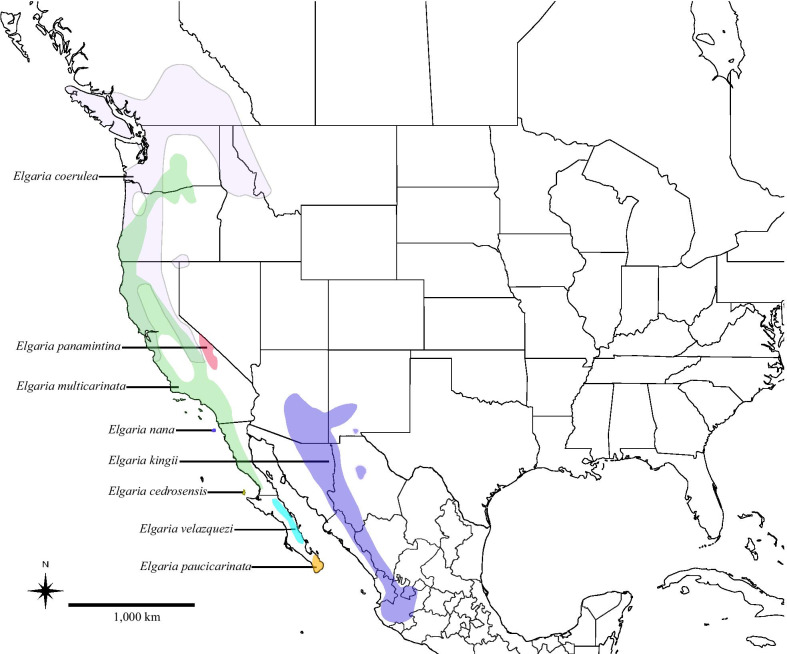
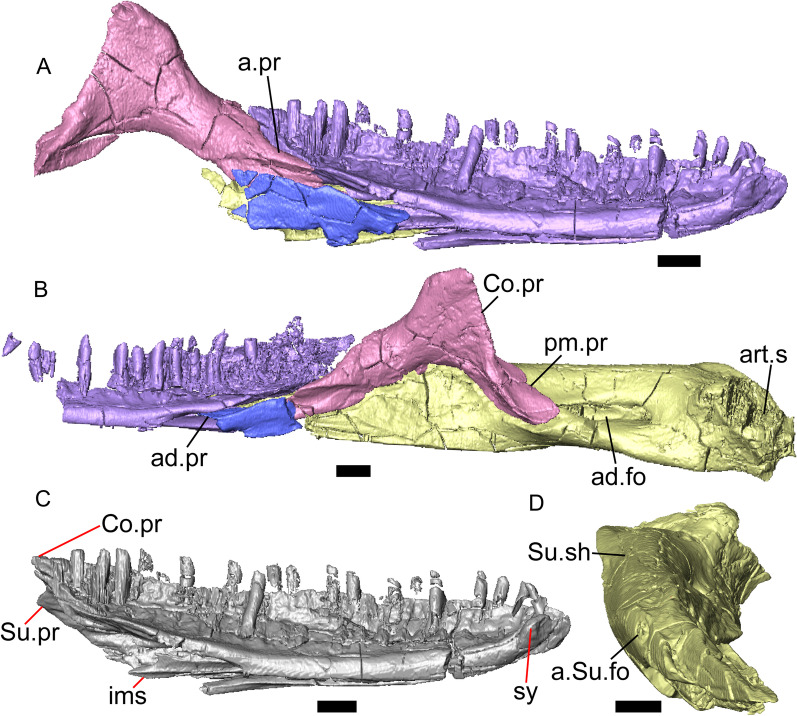
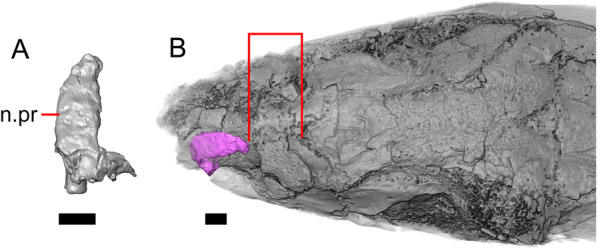
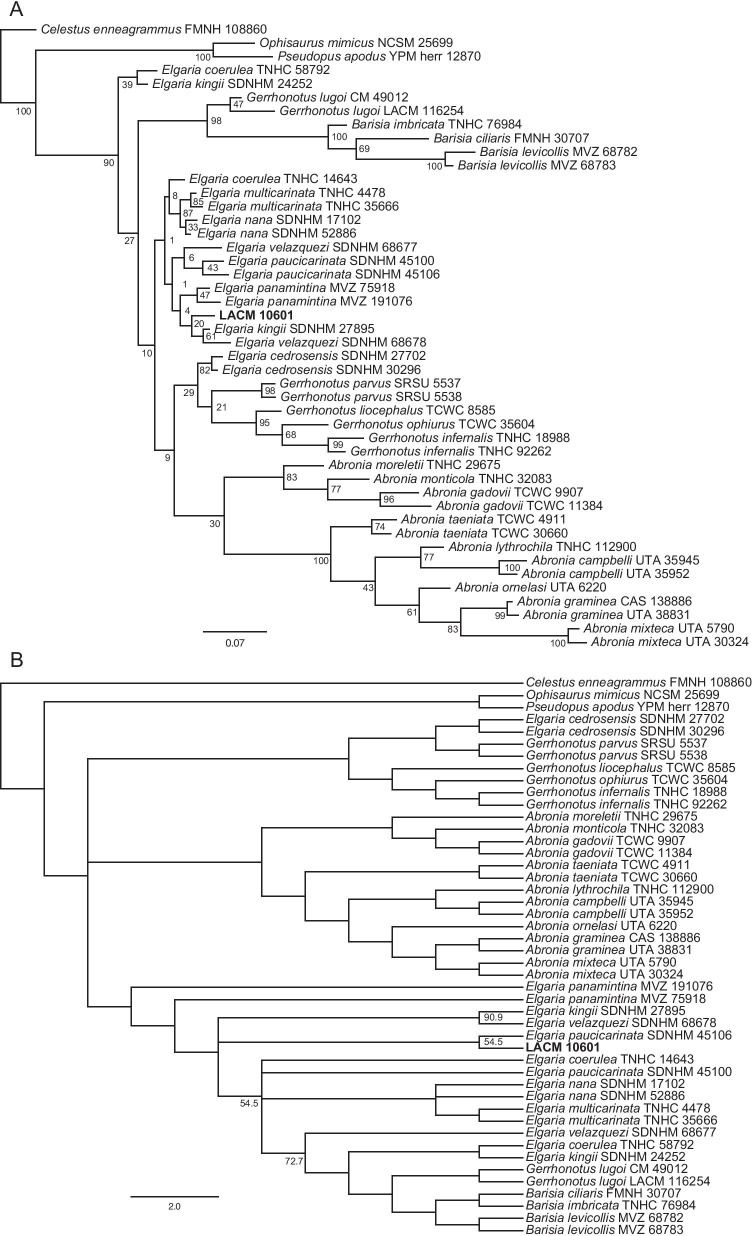
We redescribe a nearly complete articulated fossil skull from the Pliocene sediments of the Anza-Borrego Desert in southern California, and refer the specimen to the alligator lizard genus Elgaria. The fossil is a representative of a newly described species, Elgaria peludoverde. We created a morphological matrix to assess the phylogeny of alligator lizards and facilitate identifications of fossil gerrhonotines. The matrix contains a considerably expanded taxonomic sample relative to previous morphological studies of gerrhonotines, and we sampled two specimens for many species to partially account for intraspecific variation. Specimen-based phylogenetic analyses of our dataset using Bayesian inference and parsimony inferred that Elgaria peludoverde is part of crown Elgaria. The new species is potentially related to the extant species Elgaria kingii and Elgaria paucicarinata, but that relationship was not strongly supported, probably because of extensive variation among Elgaria. We explored several alternative biogeographic scenarios implied by the geographic and temporal occurrence of the new species and its potential phylogenetic placements.
Elgaria peludoverde is the first described extinct species of Elgaria and provides new information on the biogeographic history and diversification of Elgaria. Our research expands the understanding of phylogenetic relationships and biogeography of alligator lizards and strengthens the foundation of future investigations. The osteological data and phylogenetic matrix that we provided will be critical for future efforts to place fossil gerrhonotines. Despite limited intraspecific sampled sizes, we encountered substantial variation among gerrhonotines, demonstrating the value of exploring patterns of variation for morphological phylogenetics and for the phylogenetic placement of fossils. Future osteological investigations on the species we examined and on species we did not examine will continue to augment our knowledge of patterns of variation in alligator lizards and aid in phylogenetics and fossil placement.
鳄蜥(Gerrhonotinae)是一种广为人知的北美蜥蜴。虽然以前有许多化石被归为鳄蜥,但其中大多数是孤立的、不完整的头骨元素,无法确定其在系统发育上的准确位置,只有少数已知的化石是完整的头骨。化石记录为鳄蜥的生物地理学和系统发育提供了有限的信息。
我们重新描述了来自加利福尼亚州南部安扎-博雷戈沙漠上新世沉积物中的一个近乎完整的鳄蜥化石头骨,并将标本归入鳄蜥属(Elgaria)。该化石代表了一个新描述的物种,即 Elgaria peludoverde。我们创建了一个形态矩阵来评估鳄蜥的系统发育,并促进对化石鳄蜥的鉴定。与以前的鳄蜥形态学研究相比,该矩阵包含了一个相当大的分类样本,我们对许多物种进行了两次采样,以部分解释种内变异。使用贝叶斯推断和简约法对基于标本的数据集进行的系统发育分析表明,Elgaria peludoverde 是冠鳄蜥的一部分。新物种可能与现存的 Elgaria kingii 和 Elgaria paucicarinata 有关,但这种关系没有得到强有力的支持,可能是因为鳄蜥的变异范围很广。我们探讨了新物种的地理和时间发生与其潜在的系统发育位置所暗示的几种替代生物地理学情景。
Elgaria peludoverde 是描述的第一个灭绝的鳄蜥物种,为鳄蜥的生物地理历史和多样化提供了新的信息。我们的研究扩展了对鳄蜥系统发育关系和生物地理学的理解,为未来的研究奠定了基础。我们提供的骨骼数据和系统发育矩阵将对未来放置化石鳄蜥至关重要。尽管种内采样规模有限,但我们在鳄蜥中发现了大量的变异,这表明探索变异模式对于形态系统发育和化石的系统发育定位具有重要价值。对我们所研究的物种以及未研究的物种进行进一步的骨骼研究,将继续增加我们对鳄蜥变异模式的认识,并有助于系统发育和化石定位。