Zhuang Jianlong, Zhang Na, Fu Wanyu, Yao Jianfeng, Li Yanqing, Zeng Shuhong, Wang Yuanbai, Xie Yingjun, Jiang Yuying
Prenatal Diagnosis Center, Quanzhou Women's and Children's Hospital, Quanzhou, 362000, Fujian, People's Republic of China.
Department of Women Healthcare, Quanzhou Women's and Children's Hospital, Quanzhou, 362000, Fujian, People's Republic of China.
Mol Cytogenet. 2021 Sep 29;14(1):46. doi: 10.1186/s13039-021-00568-9.
There is little knowledge about partial trisomy 4q and the genotype-phenotype correlation. In this study, we presented the detail of two Chinese families with partial distal 4q duplication in an attempt to clarify the correlation between the genotype and the phenotype.
Two pedigrees with distal 4q duplication were enrolled in this study. Karyotype analysis and single-nucleotide polymorphism (SNP) array detection were performed for prenatal diagnosis. Fluorescence in situ hybridization analysis. (FISH) was conducted to verify the copy number variants.
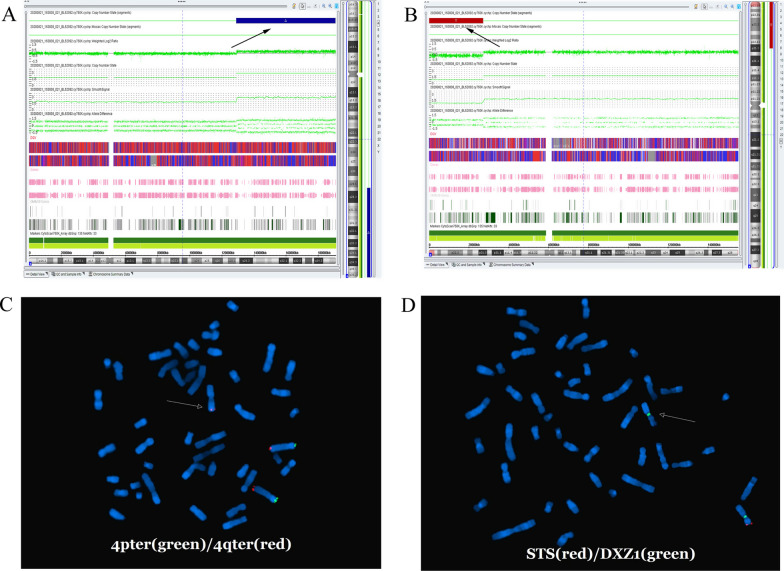
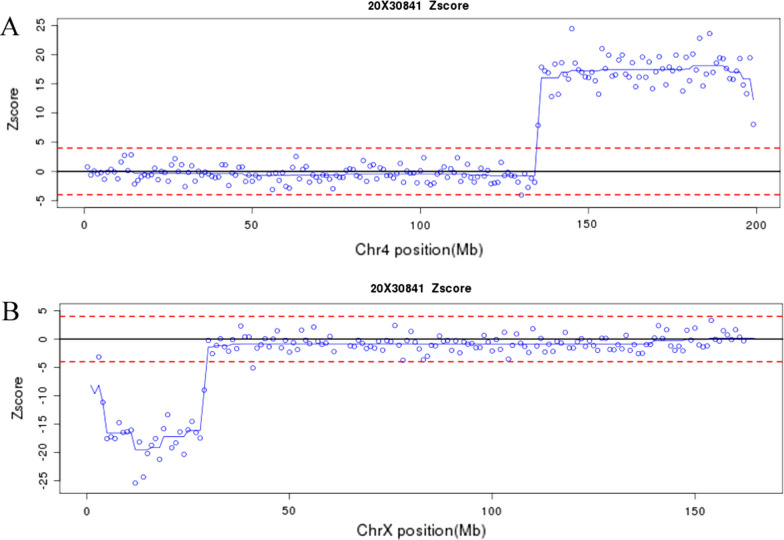
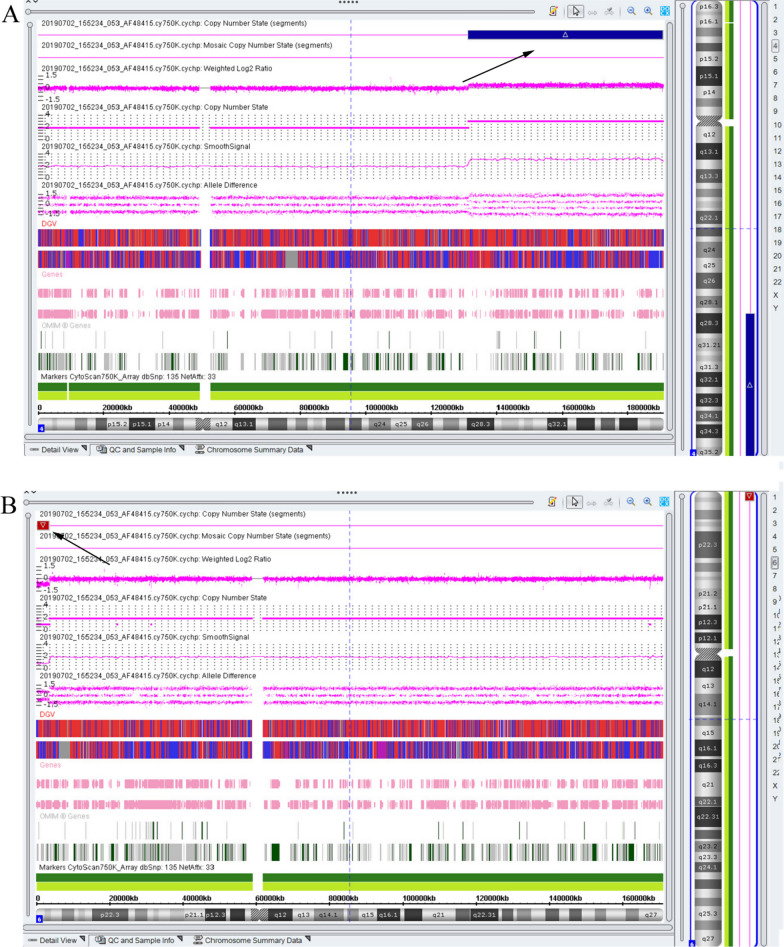
Two families with partial trisomy 4q were identified. The fetus in pedigree 1 exhibited multiple ultrasound anomalies including intrauterine growth restriction and an atrioventricular septal defect who had a duplication of 4q28.3-qter associate with 6p25.2-p25.3 deletion, which resulted from balanced translocation carried by his father t(4;6)(q28.3;p25.2). The fetus in pedigree 2 had a distal 4q28.3-qter duplication combined with monosomy of Xp21.3-p22.3, and the karyotype was described as 46,X,der(X)t(X;4)(p21.3;q28.3)mat, which originally inherited from the pregnant woman who exhibited a mild clinical phenotype limited to short stature.
In our study, we for the first time identified the partial trisomy 4q associate with 6p or Xp deletion. In addition, our finding further strengthens that mild clinical phenotype in 4q duplication case may be due to the spreading of X inactivation to the autosomal in derivation of chromosome X.
关于4q部分三体及基因型-表型相关性的了解甚少。在本研究中,我们呈现了两个中国家庭4q远端部分重复的详细情况,以试图阐明基因型与表型之间的相关性。
本研究纳入了两个4q远端重复的家系。进行了核型分析和单核苷酸多态性(SNP)阵列检测用于产前诊断。进行荧光原位杂交分析(FISH)以验证拷贝数变异。
鉴定出两个4q部分三体的家庭。家系1中的胎儿表现出多种超声异常,包括宫内生长受限和房室间隔缺损,其4q28.3 - qter重复并伴有6p25.2 - p25.3缺失,这是由其父亲携带的平衡易位t(4;6)(q28.3;p25.2)导致的。家系2中的胎儿有4q28.3 - qter远端重复并伴有Xp21.3 - p22.3单体,核型描述为46,X,der(X)t(X;4)(p21.3;q28.3)mat,最初遗传自表现出仅限于身材矮小的轻度临床表型的孕妇。
在我们的研究中,我们首次鉴定出与6p或Xp缺失相关的4q部分三体。此外,我们的发现进一步强化了4q重复病例中的轻度临床表型可能是由于X染色体失活在染色体X的衍生过程中扩展到常染色体。