Prosser Wendy, Spisak Cary, Hatch Benjamin, McCord Joseph, Tien Marie, Roche Greg
John Snow, Incorporated, 2733 Crystal Drive, 4th Floor, Arlington, VA, 22202, USA.
J Pharm Policy Pract. 2021 Sep 29;14(1):80. doi: 10.1186/s40545-021-00368-x.
Immunization supply chains (iSCs) move vaccines from manufacturer to point of use with the added complexities of requiring cold chain and an increasing need for agility and efficiency to ensure vaccine quality and availability. Underperforming iSCs have been widely acknowledged as a key constraint to achieving high immunization coverage rates in low- and middle-income countries. This paper details the system design approach used to analyze the iSC network in Sierra Leone, Madagascar, Niger and Guinea and documents six lessons.
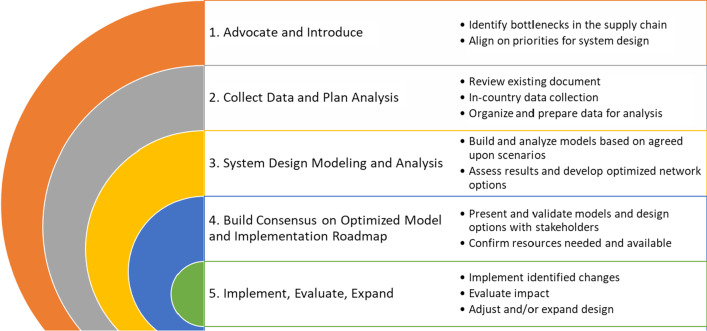
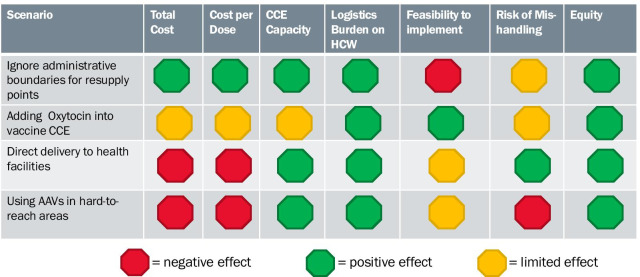
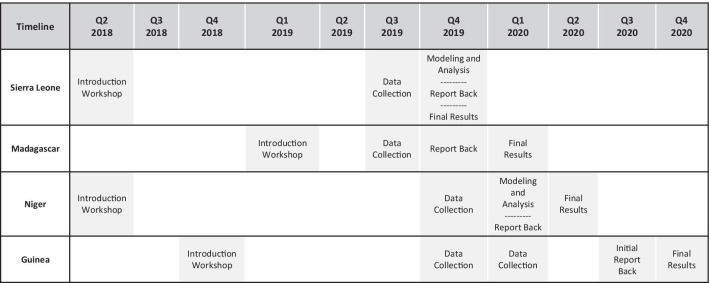
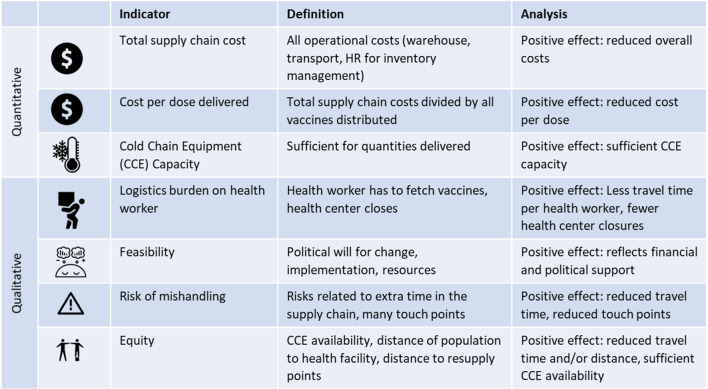
Between 2018 and 2020, these countries implemented the system design approach, involving four key steps: (1) advocate and introduce to engage stakeholders and prioritize identification of modeling scenarios; (2) collect data and plan analysis through document review and key informant interviews; (3) analyze system design scenarios using computer software modeling tools (LLamasoft's Supply Chain Guru and AnyLogic's AnyLogistix) for optimization and simulation modeling as well as further analysis with Excel, Google maps, and OpenStreetMap; and (4) build consensus on optimized model and implementation roadmap using the Traffic Light Analysis tool and building on stakeholder input.
Key lessons include the following: (1) define system design objectives based on country priorities; (2) establish consensus with stakeholders on scenarios to model; (3) modeling provides the evidence but not the answer; (4) costs should not be weighted above other decision criteria; (5) data collection-work smarter, not harder; (6) not all questions can be answered with a computer model.
A system design approach can identify changes to the design of the supply chain that can introduce efficiencies and improve reliability. This approach can be more effective when these lessons and principles are applied at the country level. The lessons from these four countries contribute to global thinking and best practices related to system design. The modeling and system design approach provides illustrative results to guide decision-makers. It does not give a "final answer", but compares and contrasts.
免疫供应链(iSCs)将疫苗从制造商运输到使用点,由于需要冷链以及对灵活性和效率的需求不断增加,以确保疫苗质量和供应,这增加了复杂性。表现不佳的免疫供应链已被广泛认为是在低收入和中等收入国家实现高免疫覆盖率的关键制约因素。本文详细介绍了用于分析塞拉利昂、马达加斯加、尼日尔和几内亚免疫供应链网络的系统设计方法,并记录了六点经验教训。
在2018年至2020年期间,这些国家实施了系统设计方法,包括四个关键步骤:(1)倡导并引入以吸引利益相关者并优先确定建模场景;(2)通过文件审查和关键信息访谈收集数据并规划分析;(3)使用计算机软件建模工具(LLamasoft的供应链大师和AnyLogic的AnyLogistix)分析系统设计场景,进行优化和仿真建模,并使用Excel、谷歌地图和OpenStreetMap进行进一步分析;(4)使用交通灯分析工具并基于利益相关者的意见,就优化模型和实施路线图达成共识。
关键经验教训如下:(1)根据国家优先事项定义系统设计目标;(2)与利益相关者就建模场景达成共识;(3)建模提供证据但不是答案;(4)成本不应比其他决策标准更受重视;(5)数据收集——更聪明地工作,而不是更努力地工作;(6)并非所有问题都能用计算机模型回答。
系统设计方法可以识别供应链设计中的变化,这些变化可以提高效率并增强可靠性。当这些经验教训和原则在国家层面应用时,这种方法可能会更有效。这四个国家的经验教训有助于全球关于系统设计的思考和最佳实践。建模和系统设计方法提供了说明性结果以指导决策者。它不会给出“最终答案”,而是进行比较和对比。