Wilczyńska Karolina, Maciejczyk Mateusz, Zalewska Anna, Waszkiewicz Napoleon
Department of Psychiatry, Medical University of Białystok, Białystok, Poland.
Department of Hygiene, Epidemiology and Ergonomics, Medical University of Białystok, Białystok, Poland.
Front Psychiatry. 2021 Sep 13;12:725511. doi: 10.3389/fpsyt.2021.725511. eCollection 2021.
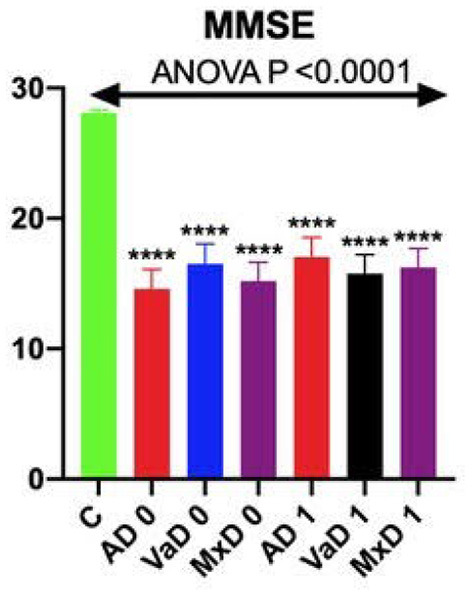
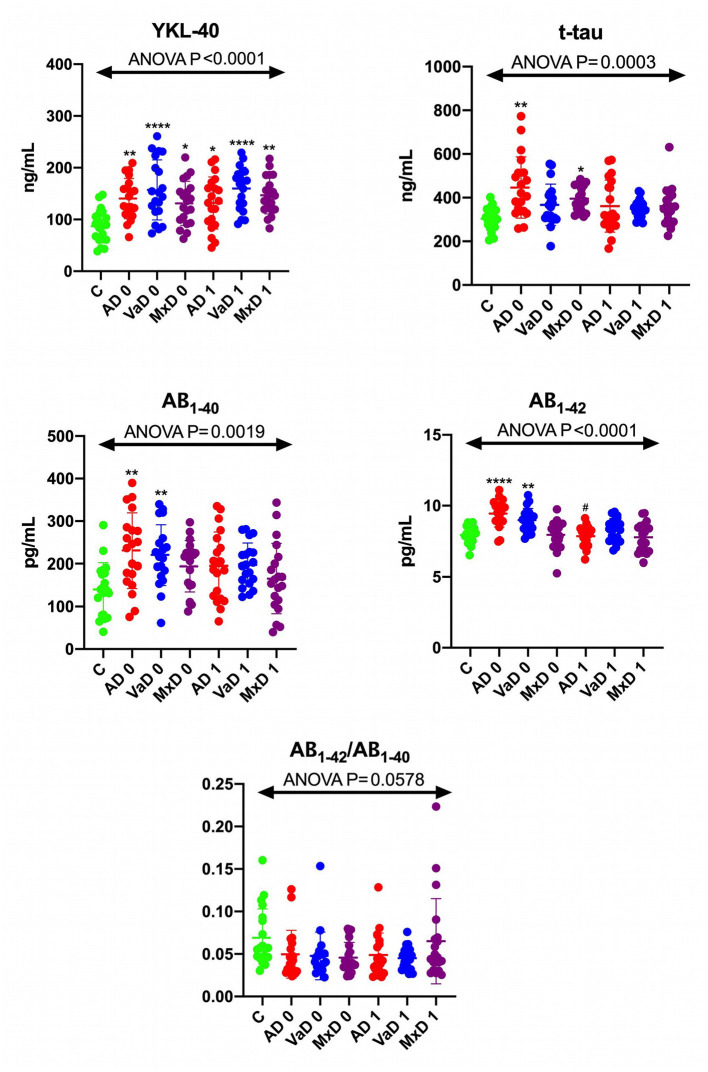
The diagnosis and treatment of dementia is one of the greatest challenges in contemporary health care. The widespread use of dementia biomarkers would improve the quality of life of patients and reduce the economic costs of the disease. The aim of the study was to evaluate the usefulness of proteins related to the Alzheimer's disease pathogenesis-amyloid beta isoform (Aβ) and total tau protein (t-tau), as well as the quite recently discovered marker YKL-40 in the most common types of dementia. 60 dementia (AD-Alzheimer's disease, VaD-vascular dementia, MxD-mixed dementia) and 20 cognitively normal subjects over 60 years old were examined. Subjects with dementia of etiology different than AD or VaD and with neoplastic or chronic inflammatory diseases were excluded. Concentrations of Aβ40, Aβ42, t-tau, and YKL-40 were measured in serum using ELISA kits on admission and after 4 weeks of inpatient treatment. ANOVA and Tukey's test or Dunn's test were used to perform comparison tests between groups. Correlations were measured using Pearson's coefficient. Biomarker diagnostic utility was assessed with ROC analysis. YKL-40 differentiates between cognitively normal and mild dementia patients with 85% sensitivity and specificity and t-tau with 72% sensitivity and 70% specificity. YKL-40 and t-tau concentrations correlate with each other and with the severity of clinically observed cognitive decline. YKL-40 is a sensitive and specific biomarker of early dementia and, to a lesser extent, of dementia progression, however, many comorbidities may influence its levels. In such conditions, less specific but still reliable t-tau may serve as an alternative marker. Obtained results did not confirm the diagnostic utility of amyloid biomarkers.
痴呆症的诊断和治疗是当代医疗保健领域面临的最大挑战之一。痴呆症生物标志物的广泛应用将改善患者的生活质量并降低该疾病的经济成本。本研究的目的是评估与阿尔茨海默病发病机制相关的蛋白质——淀粉样β亚型(Aβ)和总tau蛋白(t-tau),以及最近发现的标志物YKL-40在最常见类型痴呆症中的作用。对60例痴呆患者(AD-阿尔茨海默病、VaD-血管性痴呆、MxD-混合性痴呆)和20名60岁以上认知正常的受试者进行了检查。排除病因不同于AD或VaD以及患有肿瘤或慢性炎症性疾病的痴呆患者。入院时和住院治疗4周后,使用ELISA试剂盒检测血清中Aβ40、Aβ42、t-tau和YKL-40的浓度。采用方差分析和Tukey检验或Dunn检验进行组间比较。使用Pearson系数测量相关性。通过ROC分析评估生物标志物的诊断效用。YKL-40区分认知正常和轻度痴呆患者的敏感性和特异性为85%,t-tau的敏感性和特异性为72%和70%。YKL-40和t-tau浓度相互关联,且与临床观察到的认知衰退严重程度相关。YKL-40是早期痴呆的敏感且特异的生物标志物,在较小程度上也是痴呆进展的生物标志物,然而,许多合并症可能会影响其水平。在这种情况下,特异性较低但仍然可靠的t-tau可作为替代标志物。获得的结果未证实淀粉样生物标志物的诊断效用。