Li Zhibin, Wang Sumin, Gong Chunli, Hu Yiyang, Liu Jiao, Wang Wei, Chen Yang, Liao Qiushi, He Bing, Huang Yu, Luo Qiang, Zhao Yongbing, Xiao Yufeng
Department of Gastroenterology, Xinqiao Hospital, Third Military Medical University, Chongqing, China.
Key Laboratory of Extreme Environmental Medicine, Ministry of Education of China, Chongqing, China.
Front Cell Dev Biol. 2021 Sep 13;9:725933. doi: 10.3389/fcell.2021.725933. eCollection 2021.
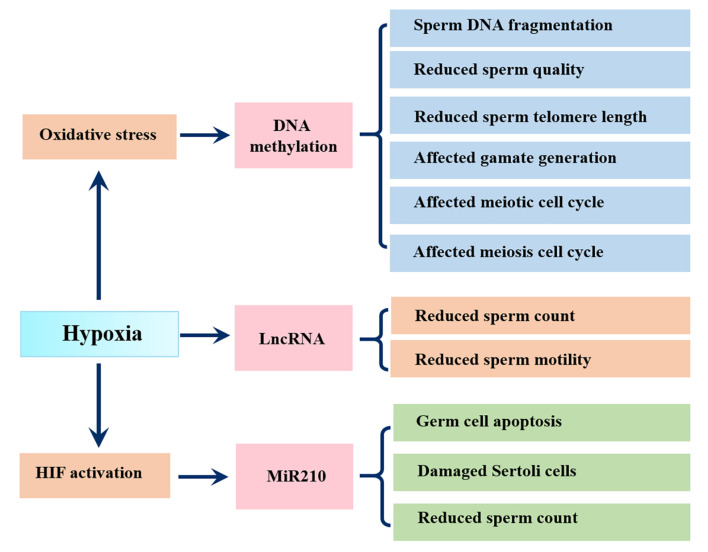
Male infertility is a widespread health problem affecting approximately 6%-8% of the male population, and hypoxia may be a causative factor. In mammals, two types of hypoxia are known, including environmental and pathological hypoxia. Studies looking at the effects of hypoxia on male infertility have linked both types of hypoxia to poor sperm quality and pregnancy outcomes. Hypoxia damages testicular seminiferous tubule directly, leading to the disorder of seminiferous epithelium and shedding of spermatogenic cells. Hypoxia can also disrupt the balance between oxidative phosphorylation and glycolysis of spermatogenic cells, resulting in impaired self-renewal and differentiation of spermatogonia, and failure of meiosis. In addition, hypoxia disrupts the secretion of reproductive hormones, causing spermatogenic arrest and erectile dysfunction. The possible mechanisms involved in hypoxia on male reproductive toxicity mainly include excessive ROS mediated oxidative stress, HIF-1α mediated germ cell apoptosis and proliferation inhibition, systematic inflammation and epigenetic changes. In this review, we discuss the correlations between hypoxia and male infertility based on epidemiological, clinical and animal studies and enumerate the hypoxic factors causing male infertility in detail. Demonstration of the causal association between hypoxia and male infertility will provide more options for the treatment of male infertility.
男性不育是一个普遍存在的健康问题,影响着约6%-8%的男性人口,而缺氧可能是一个致病因素。在哺乳动物中,已知有两种类型的缺氧,包括环境性缺氧和病理性缺氧。研究缺氧对男性不育影响的结果表明,这两种类型的缺氧都与精子质量差和妊娠结局不良有关。缺氧直接损害睾丸生精小管,导致生精上皮紊乱和生精细胞脱落。缺氧还会破坏生精细胞氧化磷酸化和糖酵解之间的平衡,导致精原细胞自我更新和分化受损以及减数分裂失败。此外,缺氧会扰乱生殖激素的分泌,导致生精停滞和勃起功能障碍。缺氧对男性生殖毒性的可能机制主要包括过量活性氧介导的氧化应激、缺氧诱导因子-1α介导的生殖细胞凋亡和增殖抑制、系统性炎症以及表观遗传变化。在这篇综述中,我们基于流行病学、临床和动物研究讨论缺氧与男性不育之间的相关性,并详细列举导致男性不育的缺氧因素。证明缺氧与男性不育之间的因果关系将为男性不育的治疗提供更多选择。