Tang Wanbo, He Jian, Huang Tao, Bai Zhijie, Wang Chaojie, Wang Haizhen, Yang Ruichuang, Ni Yanli, Hou Jun, Wang Junliang, Zhou Jie, Yao Yingpeng, Gong Yandong, Hou Siyuan, Liu Bing, Lan Yu
State Key Laboratory of Proteomics, Academy of Military Medical Sciences, Academy of Military Sciences, Beijing, China.
Key Laboratory for Regenerative Medicine of Ministry of Education, School of Medicine, Institute of Hematology, Jinan University, Guangzhou, China.
Front Cell Dev Biol. 2021 Sep 13;9:728057. doi: 10.3389/fcell.2021.728057. eCollection 2021.
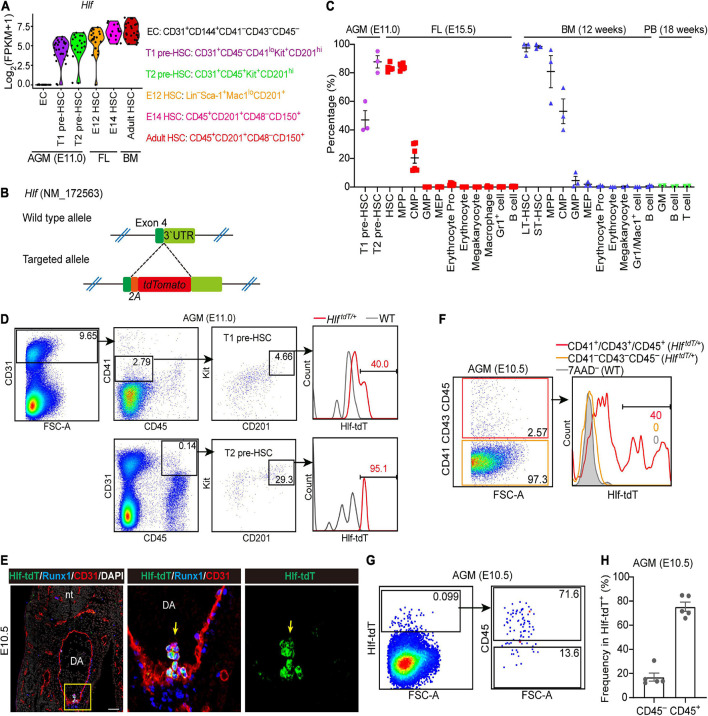
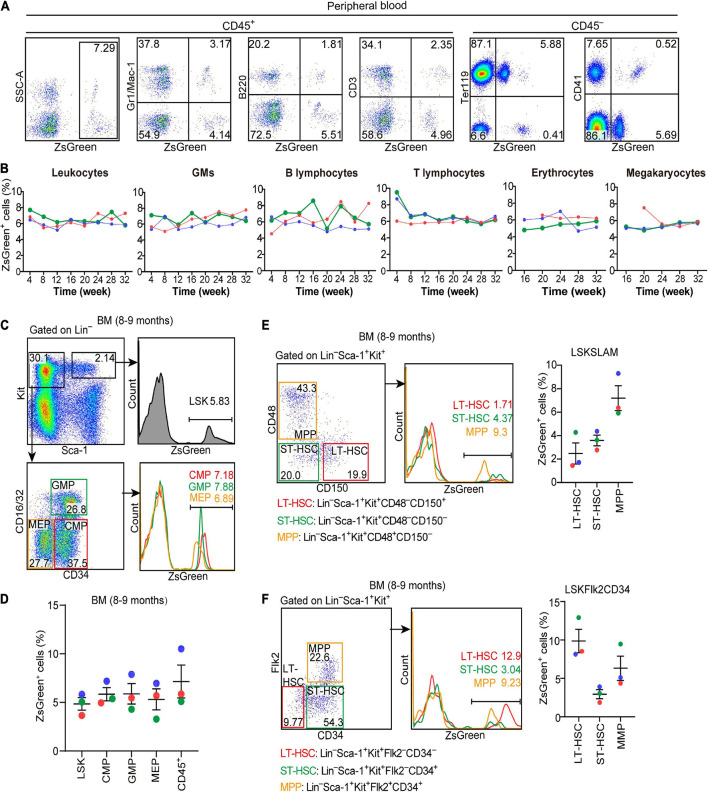
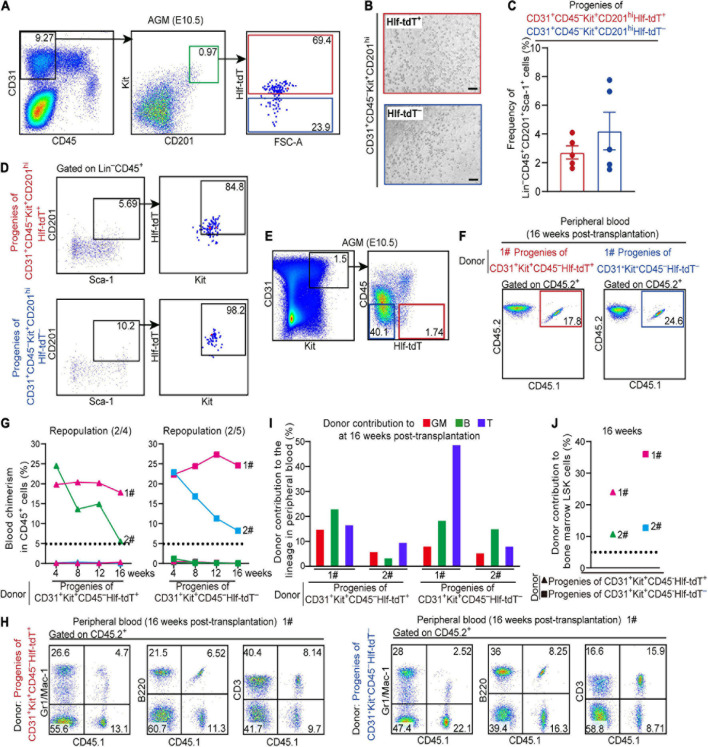
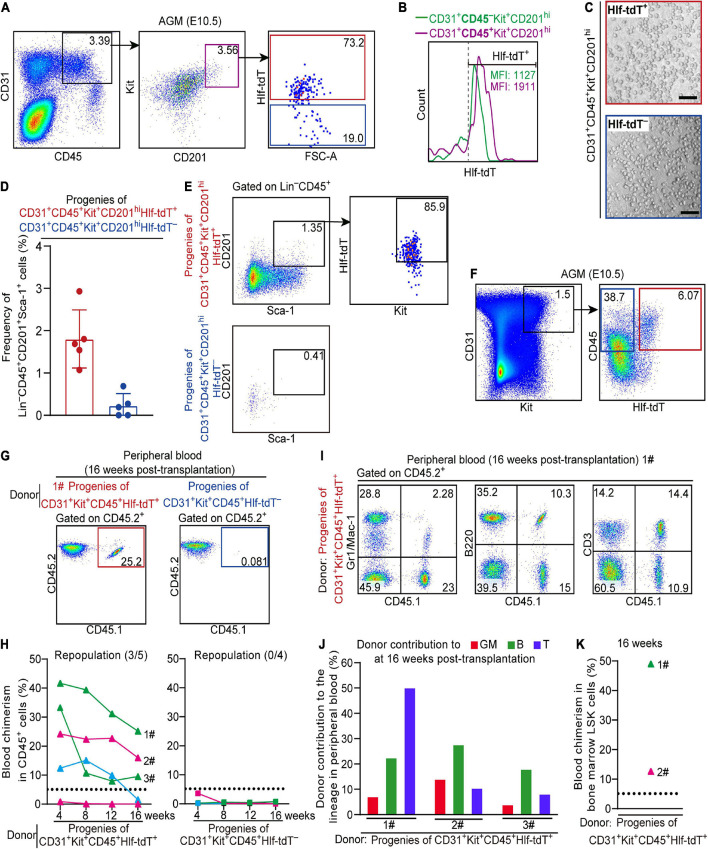
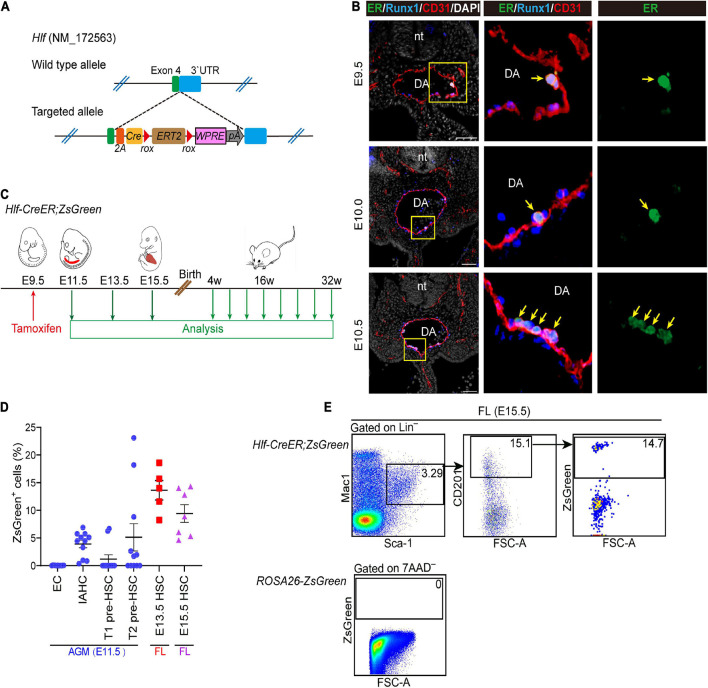
In the aorta-gonad-mesonephros (AGM) region of mouse embryos, pre-hematopoietic stem cells (pre-HSCs) are generated from rare and specialized hemogenic endothelial cells (HECs) endothelial-to-hematopoietic transition, followed by maturation into bona fide hematopoietic stem cells (HSCs). As HECs also generate a lot of hematopoietic progenitors not fated to HSCs, powerful tools that are pre-HSC/HSC-specific become urgently critical. Here, using the gene knockin strategy, we firstly developed an reporter mouse model and detected Hlf-tdTomato expression exclusively in the hematopoietic cells including part of the immunophenotypic CD45 and CD45 pre-HSCs in the embryonic day (E) 10.5 AGM region. By co-culture together with long-term transplantation assay stringent for HSC precursor identification, we further revealed that unlike the CD45 counterpart in which both Hlf-tdTomato-positive and negative sub-populations harbored HSC competence, the CD45 E10.5 pre-HSCs existed exclusively in Hlf-tdTomato-positive cells. The result indicates that the cells should gain the expression of Hlf prior to or together with CD45 to give rise to functional HSCs. Furthermore, we constructed a novel mouse model and performed time-restricted genetic lineage tracing by a single dose induction at E9.5. We observed the labeling in E11.5 AGM precursors and their contribution to the immunophenotypic HSCs in fetal liver (FL). Importantly, these Hlf-labeled early cells contributed to and retained the size of the HSC pool in the bone marrow (BM), which continuously differentiated to maintain a balanced and long-term multi-lineage hematopoiesis in the adult. Therefore, we provided another valuable mouse model to specifically trace the fate of emerging HSCs during development.
在小鼠胚胎的主动脉-性腺-中肾(AGM)区域,造血前体细胞(pre-HSCs)由罕见且特殊的造血内皮细胞(HECs)经内皮-造血转化产生,随后成熟为真正的造血干细胞(HSCs)。由于HECs还会产生许多并非注定成为HSCs的造血祖细胞,因此,针对pre-HSC/HSC特异性的强大工具变得迫切关键。在此,我们采用基因敲入策略,首次开发了一种报告基因小鼠模型,并在胚胎第10.5天(E10.5)的AGM区域中,仅在包括部分免疫表型CD45和CD45 pre-HSCs的造血细胞中检测到Hlf-tdTomato表达。通过与对HSC前体鉴定严格的长期移植分析共同培养,我们进一步发现,与CD45对应物不同,其中Hlf-tdTomato阳性和阴性亚群均具有HSC能力,而CD45 E10.5 pre-HSCs仅存在于Hlf-tdTomato阳性细胞中。结果表明,细胞应在获得CD45之前或同时获得Hlf的表达,以产生功能性HSCs。此外,我们构建了一种新型小鼠模型,并在E9.5时通过单次剂量诱导进行了时间限制的遗传谱系追踪。我们在E11.5的AGM前体中观察到标记,并发现它们对胎肝(FL)中免疫表型HSCs有贡献。重要的是,这些Hlf标记的早期细胞对骨髓(BM)中HSC池的大小有贡献并维持其大小,这些细胞持续分化以在成年期维持平衡且长期的多谱系造血。因此,我们提供了另一种有价值的小鼠模型,以特异性追踪发育过程中新兴HSCs的命运。