Smith Brittany L
Department of Pharmacology & Systems Physiology, University of Cincinnati, Cincinnati, OH, USA.
Brain Behav Immun Health. 2021 Jul 6;16:100294. doi: 10.1016/j.bbih.2021.100294. eCollection 2021 Oct.
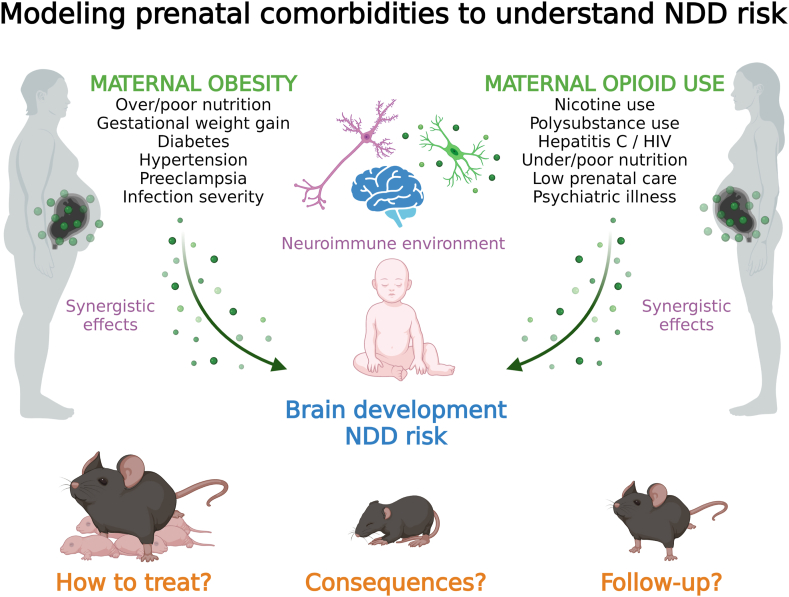
Prenatal environmental adversity is a risk factor for neurodevelopmental disorders (NDDs), with the neuroimmune environment proposed to play a role in this risk. Adverse maternal exposures are associated with cognitive consequences in the offspring that are characteristics of NDDs and simultaneous neuroimmune changes that may underlie NDD risk. In both animal models and human studies the association between prenatal environmental exposure and NDD risk has been shown to be complex. Maternal overnutrition/obesity and opioid use are two different examples of complex exposure epidemics, each with their own unique comorbidities. This review will examine maternal obesity and maternal opioid use separately, illustrating the pervasive comorbidities with each exposure to argue a need for animal models of compound prenatal exposures. Many of these comorbidities can impact neuroimmune function, warranting systematic investigation of combined exposures to begin to understand this complexity. While traditional approaches in animal models have focused on modeling a single prenatal exposure or second exposure later in life, a translational approach would begin to incorporate the most prevalent co-occurring prenatal exposures. Long term follow-up in humans is extremely challenging, so animal models can provide timely insight into neurodevelopmental consequences of complex prenatal exposures. Animal models that represent this translational context of comorbid exposures behind maternal obesity or comorbid exposures behind maternal opioid use may reveal potential synergistic neuroimmune interactions that contribute to cognitive consequences and NDD risk. Finally, translational co-exposure models can identify concerning exposure combinations to guide treatment in complex cases, and identify high risk children starting in the prenatal period where early interventions improve prognosis.
产前环境逆境是神经发育障碍(NDDs)的一个风险因素,神经免疫环境被认为在这种风险中起作用。母体不良暴露与后代的认知后果相关,这些后果是NDDs的特征,同时还有可能是NDD风险基础的神经免疫变化。在动物模型和人类研究中,产前环境暴露与NDD风险之间的关联都已被证明是复杂的。母体营养过剩/肥胖和阿片类药物使用是复杂暴露流行的两个不同例子,各自都有其独特的合并症。本综述将分别研究母体肥胖和母体阿片类药物使用情况,阐述每种暴露普遍存在的合并症,以论证需要建立复合产前暴露的动物模型。其中许多合并症会影响神经免疫功能,因此有必要对联合暴露进行系统研究,以开始理解这种复杂性。虽然动物模型中的传统方法侧重于模拟单一的产前暴露或在生命后期的二次暴露,但一种转化方法将开始纳入最普遍同时出现的产前暴露。对人类进行长期随访极具挑战性,因此动物模型可以及时洞察复杂产前暴露对神经发育的影响。代表母体肥胖背后合并暴露或母体阿片类药物使用背后合并暴露这种转化背景的动物模型,可能会揭示潜在的协同神经免疫相互作用,这些相互作用会导致认知后果和NDD风险。最后,转化性联合暴露模型可以识别令人担忧的暴露组合,以指导复杂病例的治疗,并在产前阶段识别高危儿童,早期干预可改善其预后。