Rahimian Reza, Lalancette-Hébert Melanie, Weng Yuan Cheng, Sato Sachiko, Kriz Jasna
CERVO Brain Research Centre and Department of Psychiatry and Neuroscience, Faculty of Medicine, Université Laval, QC, G1J 2G3, Canada.
Glycobiology Laboratory, Research Centre for Infectious Disease, Université Laval, QC, G1V 4G2, Canada.
Brain Behav Immun Health. 2020 Feb 5;3:100041. doi: 10.1016/j.bbih.2020.100041. eCollection 2020 Mar.
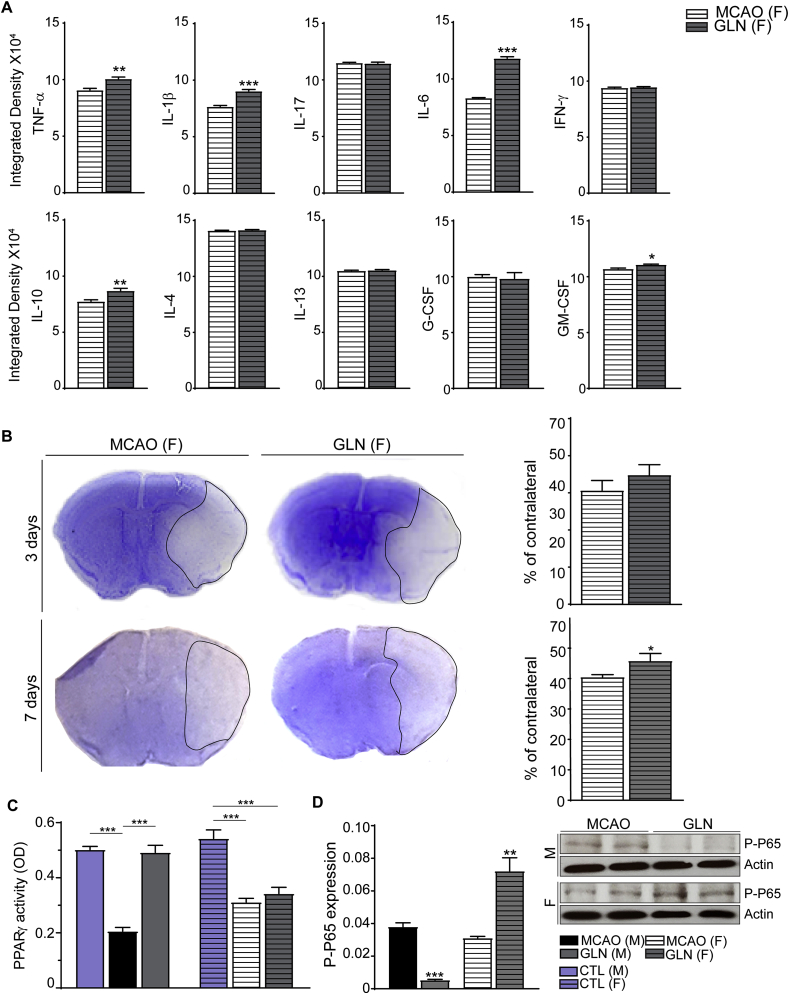
Growing evidence suggests that galectin-3 (Gal-3) is instrumental in orchestrating innate immune response and microglia activation following different brain pathologies. However, its role remains controversial. We recently showed that a readily available natural product glucosamine may act as a strong modulator of Gal-3. Glucosamine is a naturally occurring sugar and a precursor in the synthesis of glycosylated proteins. It is often used as a supplement to treat symptoms of various inflammatory conditions. Our recent work suggests that by increasing the synthesis and availability of Gal-3 ligands and/or by regulating its expression levels, glucosamine may significantly modulate Gal-3 signaling. Because evidence suggests that Gal-3 might be differentially regulated after ischemic injury in the brains of female mice, here we examined and compared the immunomodulatory potential of glucosamine in male and female stroke. The mice were subjected to transient middle cerebral artery occlusion (MCAO), followed by different reperfusion periods. The short-term 5 days treatment with glucosamine (150 mg/kg i.p.) was initiated 2 hrs after stroke. To visualize the effects of glucosamine treatment on post-stroke inflammation, we took advantage of a transgenic mouse model bearing the dual reporter system luciferase/GFP under transcriptional control of a murine TLR2 promoter (TLR2-luc-GFP) allowing bioluminescence imaging of innate immune response and microglial activation. We report that after stroke, both, male and female mice strongly up-regulate the TLR2 bioluminescence signals from activated microglia, however, the observed immunomodulatory effects of glucosamine after stroke were sex-dependent. Analysis of cytokine profiles at protein level, in glucosamine-treated male mice 72hsr after stroke, revealed down regulation of pro-inflammatory cytokines, an increase in levels of anti-inflammatory cytokines including IL-4, IL13 and colony stimulating factors MCFC and GM-CSF and a significant decrease in the size of ischemic lesion in male mice. Conversely, in female mice glucosamine markedly increases the pro-inflammatory signaling and exacerbates ischemic injury. Analysis of the downstream signaling target of glucosamine/Gal-3 revealed that glucosamine administration restored PPAR-γ activity in male but not in female mice 3 days following MCAO. Together, our results suggest that glucosamine acts as a fine tuner of post-ischemic inflammation in a sex dependent-manner and may have therapeutic potential after stroke in males. Based on our results propose that targeting immune system after stroke may require adapted sex-specific therapeutic approaches.
越来越多的证据表明,半乳糖凝集素-3(Gal-3)在不同脑病理状态下协调先天免疫反应和小胶质细胞活化中发挥着重要作用。然而,其作用仍存在争议。我们最近发现,一种现成的天然产物葡萄糖胺可能是Gal-3的强效调节剂。葡萄糖胺是一种天然存在的糖,是糖基化蛋白合成的前体。它常被用作补充剂来治疗各种炎症性疾病的症状。我们最近的研究表明,通过增加Gal-3配体的合成和可用性和/或调节其表达水平,葡萄糖胺可能会显著调节Gal-3信号传导。由于有证据表明,雌性小鼠大脑缺血损伤后Gal-3可能受到不同的调节,因此我们在此研究并比较了葡萄糖胺在雄性和雌性中风中的免疫调节潜力。对小鼠进行短暂性大脑中动脉闭塞(MCAO),随后进行不同的再灌注期。中风后2小时开始用葡萄糖胺(腹腔注射150mg/kg)进行为期5天的短期治疗。为了观察葡萄糖胺治疗对中风后炎症的影响,我们利用了一种转基因小鼠模型,该模型在小鼠TLR2启动子(TLR2-luc-GFP)的转录控制下带有双报告系统荧光素酶/绿色荧光蛋白,可对先天免疫反应和小胶质细胞活化进行生物发光成像。我们报告称,中风后,雄性和雌性小鼠均强烈上调活化小胶质细胞的TLR2生物发光信号,然而,中风后观察到的葡萄糖胺免疫调节作用具有性别依赖性。在中风后72小时对葡萄糖胺处理的雄性小鼠进行蛋白质水平的细胞因子谱分析,结果显示促炎细胞因子下调抗炎细胞因子水平升高,包括IL-4、IL13和集落刺激因子MCFC和GM-CSF,并且雄性小鼠缺血性损伤的大小显著减小。相反,在雌性小鼠中,葡萄糖胺显著增加促炎信号传导并加重缺血性损伤。对葡萄糖胺/Gal-3的下游信号靶点分析表明,MCAO后3天,葡萄糖胺给药恢复了雄性小鼠而非雌性小鼠的PPAR-γ活性。总之,我们的结果表明,葡萄糖胺以性别依赖的方式作为缺血后炎症的微调器,并且可能对雄性中风具有治疗潜力。基于我们的结果,我们提出中风后针对免疫系统可能需要采用适应性的性别特异性治疗方法。