Gomes Carly I, Barr Gordon A
Department of Neonatology, Children's Hospital of Philadelphia, Philadelphia, PA, USA.
Department of Anesthesiology and Critical Care Medicine, Children's Hospital of Philadelphia and the Perelman School of Medicine at the University of Pennsylvania, 3615 Civic Center Boulevard, Philadelphia, PA, 19104, USA.
Brain Behav Immun Health. 2020 Nov 10;9:100175. doi: 10.1016/j.bbih.2020.100175. eCollection 2020 Dec.
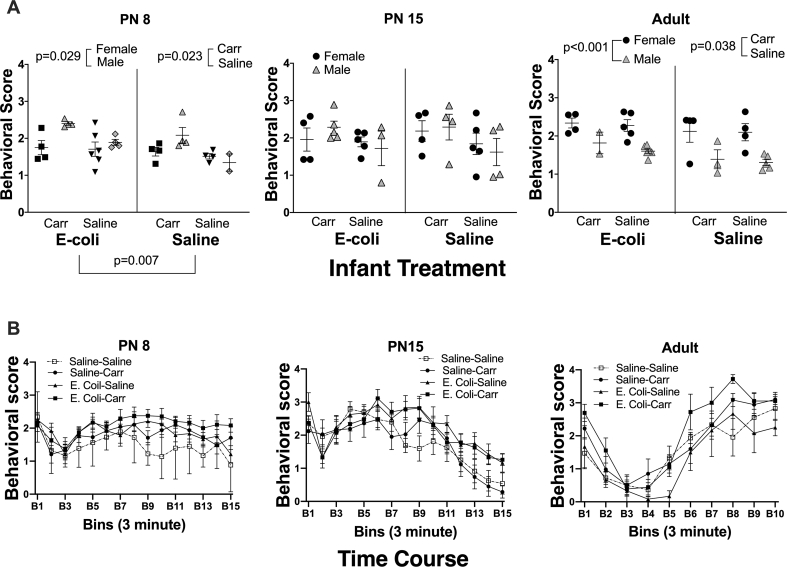
Newborns in intensive care are regularly exposed to minor painful procedures at developmental time points when noxious stimulation would be normally absent. Pain from these interventions is inconsistently treated and often exists concurrently with systemic infection, a common comorbidity of prematurity. Our understanding of the independent and combined effects of early painful experiences and infection on pain response is incomplete. The main goals of this research therefore were to understand how pain and infection experienced early in life influence future nociceptive and affective responses to painful stimuli. Rat pups were infected with E-coli on postnatal day 2 (PN2) and had left hind paw injury with carrageenan on PN3. Standard thermal tests for acute pain, formalin tests for inflammatory pain, and conditioned place aversion testing were performed at different ages to assess the nociceptive and affective components of the pain response. Early E-coli infection and early inflammatory injury with carrageenan both independently increased pain scores following hind paw reinjury with formalin on PN8, with effects persisting into adulthood in the carrageenan exposed group. When experienced concurrently, early E-coli infection and carrageenan exposure also increased conditioned aversion to pain in adults. Effect of sex was significant only in formalin testing, with males showing higher pain scores in infancy and females showing higher pain scores as adults. These findings demonstrate that infection experienced early in life can alter both the nociceptive and affective components of the pain response and that there is a cumulative effect of local and systemic pro-inflammatory processes on the aversive component of pain.
重症监护病房的新生儿在发育阶段经常会接受一些轻微的疼痛性操作,而在正常情况下这个阶段是不会有有害刺激的。这些干预带来的疼痛治疗并不一致,且常常与全身感染同时存在,全身感染是早产常见的合并症。我们对早期疼痛经历和感染对疼痛反应的独立及联合影响的理解并不完整。因此,本研究的主要目的是了解生命早期经历的疼痛和感染如何影响未来对疼痛刺激的伤害性和情感反应。出生后第2天(PN2),将大鼠幼崽感染大肠杆菌,在PN3时用角叉菜胶造成左后爪损伤。在不同年龄进行急性疼痛的标准热测试、炎症性疼痛的福尔马林测试以及条件性位置厌恶测试,以评估疼痛反应的伤害性和情感成分。早期大肠杆菌感染和早期角叉菜胶炎症性损伤均独立增加了PN8时福尔马林再次刺激后爪后的疼痛评分,角叉菜胶暴露组的这种影响持续到成年。当同时经历时,早期大肠杆菌感染和角叉菜胶暴露也增加了成年大鼠对疼痛的条件性厌恶。性别影响仅在福尔马林测试中显著,雄性在婴儿期疼痛评分较高,而雌性在成年期疼痛评分较高。这些发现表明,生命早期经历的感染可改变疼痛反应的伤害性和情感成分,并且局部和全身促炎过程对疼痛的厌恶成分有累积效应。