Liao Bin-Chi, Hsu Wei-Hsun, Lee Jih-Hsiang, Yang Ching-Yao, Tsai Tzu-Hsiu, Liao Wei-Yu, Ho Chao-Chi, Lin Chia-Chi, Shih Jin-Yuan, Yu Chong-Jen, Soo Ross A, Yang James Chih-Hsin
Department of Oncology, National Taiwan University Hospital, Taipei, Taiwan, Republic of China.
National Taiwan University Cancer Center, College of Medicine, National Taiwan University, Taipei, Taiwan, Republic of China.
JTO Clin Res Rep. 2020 Sep 19;2(1):100099. doi: 10.1016/j.jtocrr.2020.100099. eCollection 2021 Jan.
Recent advances in the detection of genomic DNA from plasma samples allow us to follow tumor DNA shedding in plasma during systemic treatment. Osimertinib is the standard of care for patients with NSCLC with acquired T790M mutations. We assessed changes in serial plasma cell-free circulating tumor DNA (ctDNA) genomic alterations to predict osimertinib efficacy.
We prospectively collected plasma from patients having -mutated advanced NSCLC previously treated with EGFR tyrosine kinase inhibitor therapy and with acquired T790M mutation detected by standard methods. Plasma samples were collected before starting osimertinib treatment, 4 weeks after osimertinib treatment, and on progression. ctDNA was analyzed using the Guardant360 assay.
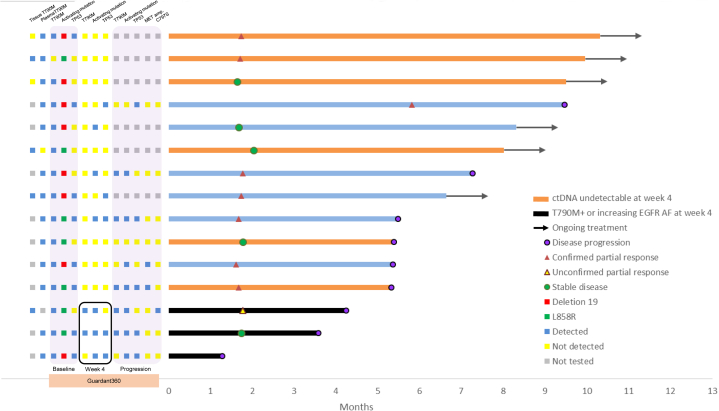
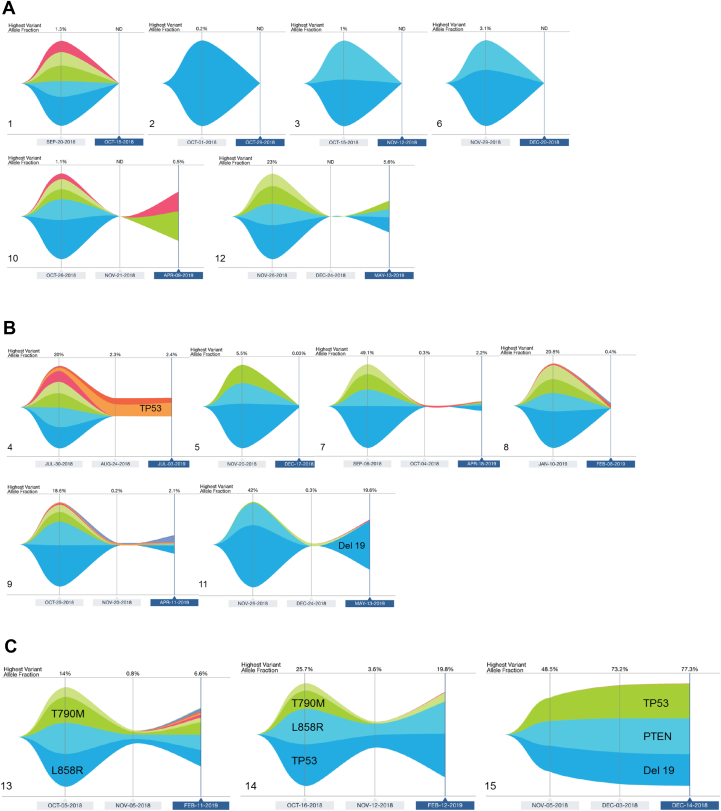
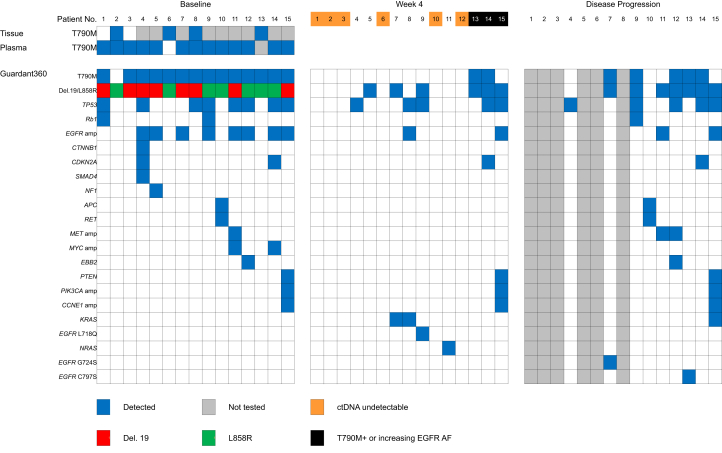
A total of 15 eligible patients received osimertinib. Before starting treatment, -activating mutations were detected in the ctDNA of all patients, and T790M was detected in 93% of the cases. Osimertinib treatment was associated with an objective response rate of 53% and a median progression-free survival of 7.3 months. A total of 12 of the 15 patients had undetectable plasma T790M and decreased activating mutation allelic frequency (AF) at week 4. None of the 12 patients had disease progression within 16 weeks. For the remaining three patients, with detectable plasma T790M (n = 2) or increased activating mutation AF (n = 1) at week 4, two had progressive disease within 16 weeks ( = 0.03).
In patients with -mutated advanced NSCLC, persistent T790M or increasing activating mutation AF as detected in ctDNA 4 weeks after the start of osimertinib treatment may predict disease progression within 16 weeks.
血浆样本中基因组DNA检测技术的最新进展使我们能够在全身治疗期间追踪血浆中肿瘤DNA的释放情况。奥希替尼是具有获得性T790M突变的非小细胞肺癌(NSCLC)患者的标准治疗药物。我们评估了连续血浆游离循环肿瘤DNA(ctDNA)基因组改变,以预测奥希替尼的疗效。
我们前瞻性收集了先前接受过EGFR酪氨酸激酶抑制剂治疗且通过标准方法检测到获得性T790M突变的晚期NSCLC患者的血浆。在开始奥希替尼治疗前、治疗4周后以及疾病进展时收集血浆样本。使用Guardant360检测法分析ctDNA。
共有15例符合条件的患者接受了奥希替尼治疗。治疗开始前,所有患者的ctDNA中均检测到激活突变,93%的病例中检测到T790M。奥希替尼治疗的客观缓解率为53%,中位无进展生存期为7.3个月。15例患者中有12例在第4周时血浆T790M检测不到且激活突变等位基因频率(AF)降低。这12例患者中无一例在16周内出现疾病进展。对于其余3例在第4周时血浆T790M可检测到(n = 2)或激活突变AF增加(n = 1)的患者,其中2例在16周内出现疾病进展(P = 0.03)。
在具有激活突变的晚期NSCLC患者中,奥希替尼治疗开始4周后ctDNA中检测到持续的T790M或激活突变AF增加可能预示16周内疾病进展。