Department of Medical Genetics and Molecular Medicine, School of Medicine, Mashhad University of Medical Sciences, Mashhad, Iran.
J Ovarian Res. 2021 Sep 30;14(1):127. doi: 10.1186/s13048-021-00882-1.
Ovarian cancer (OC) is one of the leading causes of cancer related deaths among women. Due to the asymptomatic tumor progression and lack of efficient screening methods, majority of OC patients are diagnosed in advanced tumor stages. A combination of surgical resection and platinum based-therapy is the common treatment option for advanced OC patients. However, tumor relapse is observed in about 70% of cases due to the treatment failure. Cisplatin is widely used as an efficient first-line treatment option for OC; however cisplatin resistance is observed in a noticeable ratio of cases. Regarding, the severe cisplatin side effects, it is required to clarify the molecular biology of cisplatin resistance to improve the clinical outcomes of OC patients. Cisplatin resistance in OC is associated with abnormal drug transportation, increased detoxification, abnormal apoptosis, and abnormal DNA repair ability. MicroRNAs (miRNAs) are critical factors involved in cell proliferation, apoptosis, and chemo resistance. MiRNAs as non-invasive and more stable factors compared with mRNAs, can be introduced as efficient markers of cisplatin response in OC patients.
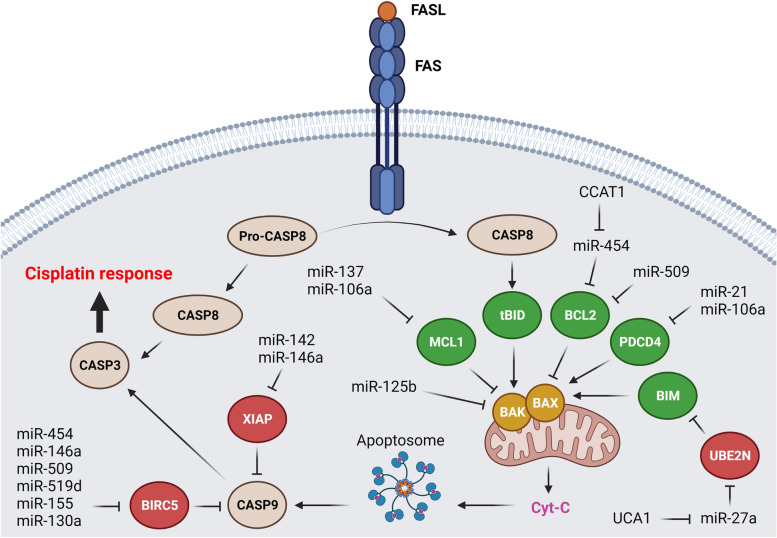
In present review, we have summarized all of the miRNAs that have been associated with cisplatin resistance in OC. We also categorized the miRNAs based on their targets to clarify their probable molecular mechanisms during cisplatin resistance in ovarian tumor cells.
It was observed that miRNAs mainly exert their role in cisplatin response through regulation of apoptosis, signaling pathways, and transcription factors in OC cells. This review highlighted the miRNAs as important regulators of cisplatin response in ovarian tumor cells. Moreover, present review paves the way of suggesting a non-invasive panel of prediction markers for cisplatin response among OC patients.
卵巢癌(OC)是导致女性癌症相关死亡的主要原因之一。由于肿瘤进展无症状且缺乏有效的筛查方法,大多数 OC 患者在肿瘤晚期被诊断出来。手术切除和铂类药物治疗相结合是晚期 OC 患者的常见治疗选择。然而,由于治疗失败,约 70%的病例观察到肿瘤复发。顺铂被广泛用作 OC 的有效一线治疗选择;然而,在相当比例的病例中观察到顺铂耐药。鉴于顺铂的严重副作用,有必要阐明顺铂耐药的分子生物学机制,以改善 OC 患者的临床结局。OC 中的顺铂耐药与异常药物转运、解毒增加、异常凋亡和异常 DNA 修复能力有关。microRNAs(miRNAs)是参与细胞增殖、凋亡和化疗耐药的关键因素。与 mRNAs 相比,miRNAs 作为非侵入性和更稳定的因素,可以作为 OC 患者顺铂反应的有效标志物。
在本综述中,我们总结了所有与 OC 中顺铂耐药相关的 miRNAs。我们还根据其靶标对 miRNAs 进行了分类,以阐明它们在卵巢肿瘤细胞顺铂耐药过程中的可能分子机制。
观察到 miRNAs 主要通过调节 OC 细胞中的凋亡、信号通路和转录因子来发挥其在顺铂反应中的作用。本综述强调了 miRNAs 作为卵巢肿瘤细胞顺铂反应的重要调节因子的作用。此外,本综述为 OC 患者提出了一种非侵入性的顺铂反应预测标志物的建议铺平了道路。