Jafri Sabih, Yaqub Abid
Internal Medicine, University of Cincinnati, College of Medicine, Cincinnati, USA.
Endocrinology, University of Cincinnati, College of Medicine, Cincinnati, USA.
Cureus. 2021 Aug 27;13(8):e17488. doi: 10.7759/cureus.17488. eCollection 2021 Aug.
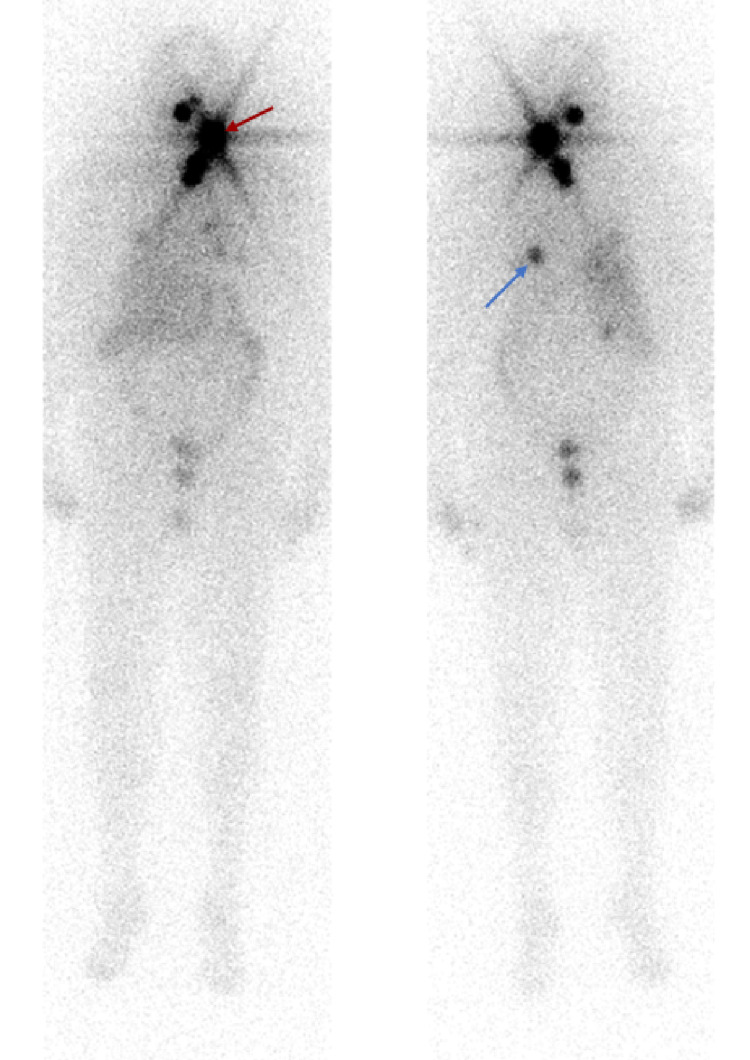
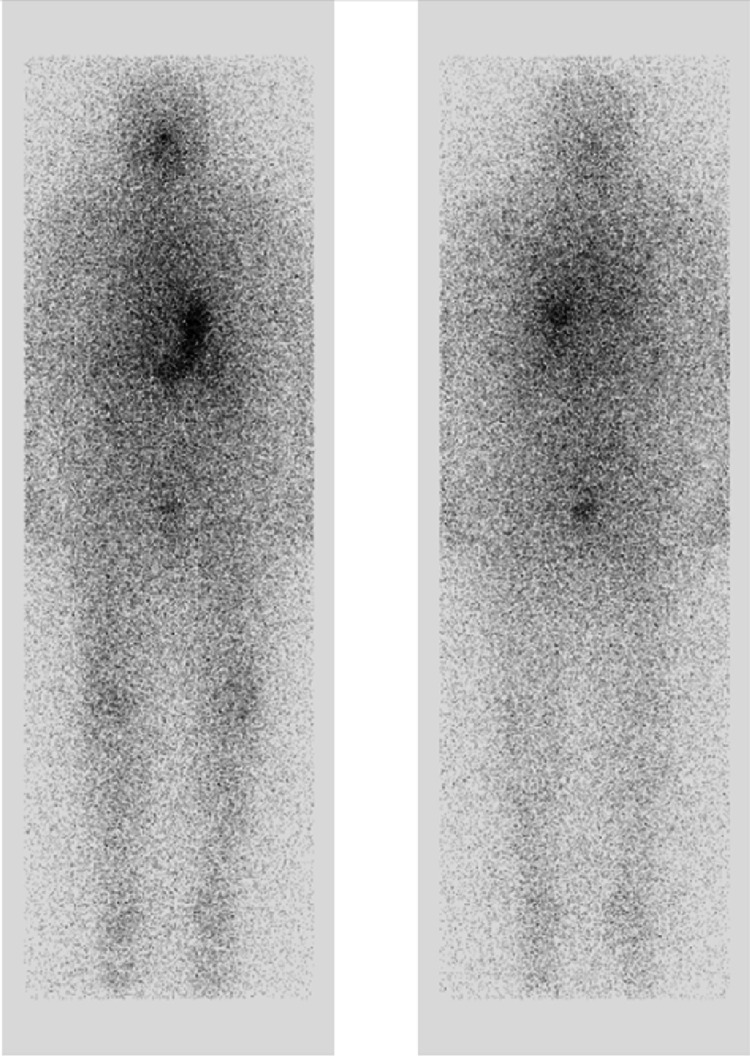
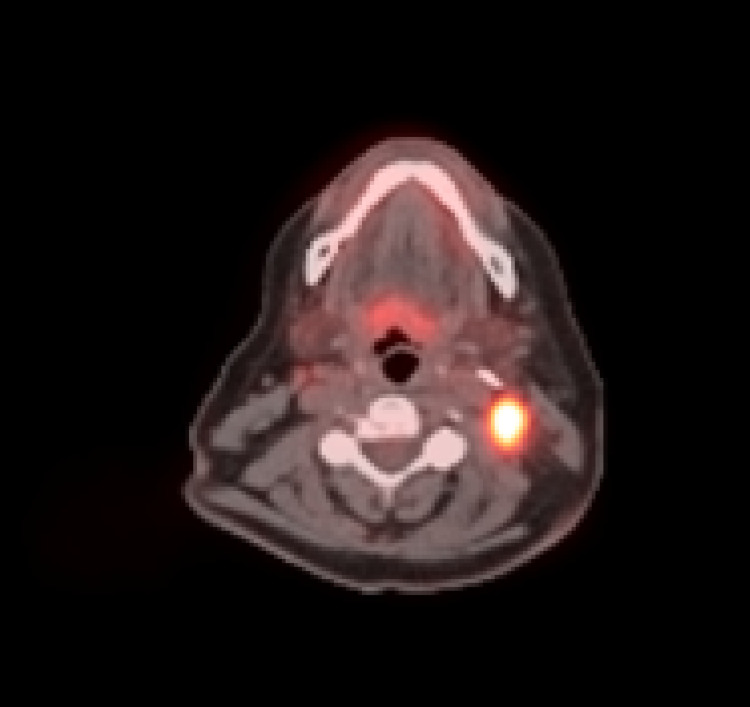
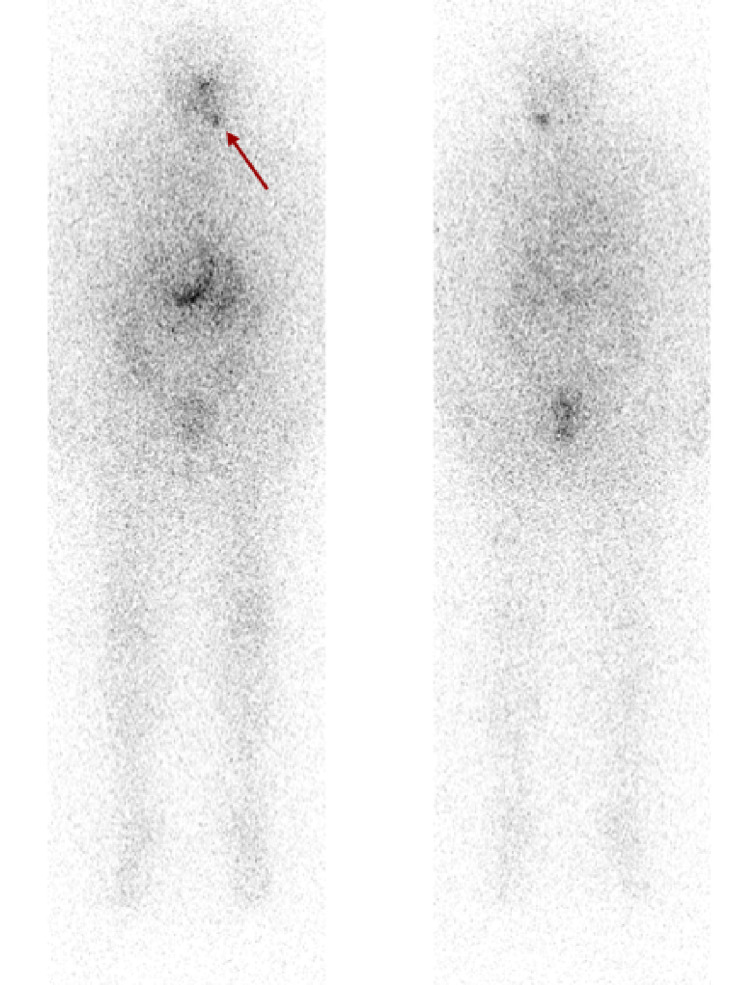
Radioactive iodine-refractory metastatic differentiated thyroid cancer (RAIR) is associated with a poor prognosis. Multikinase inhibitors have demonstrated improvement in progression-free but not overall survival in such patients, but usage is limited by significant adverse effects and the development of resistance. Clinical research has demonstrated improvement in progression-free survival with the combined use of the BRAF/MEK inhibitor in patients with metastatic melanoma and anaplastic thyroid cancer with the BRAFmutation and has shown promise in redifferentiation of BRAF-positive RAIR differentiated thyroid cancer. A 58-year-old woman went to her primary care physician for a growing mass on the left side of her neck. CT imaging noted a 6 x 8 x 6 cm mixed cystic and solid mass and lymphadenopathy. Core biopsy subsequently showed metastatic papillary thyroid cancer (Stage III, PT4a/PN1b), and she underwent a total thyroidectomy with left neck dissection. She then received 204mCi I post-total thyroidectomy. Unfortunately, her thyroglobulin continued to increase post-radioactive iodine (RAI) treatment, indicating persistent and/or recurrent thyroid cancer. An RAI-131 whole-body scan on the thyrogen protocol showed no significant RAI uptake. A fluorodeoxyglucose (FDG)-positron emission tomography (PET) CT scan was then performed, which showed recurrent metastatic disease with hypermetabolism noted in the left thyroid bed and FDG-avid bilateral cervical lymph nodes and pulmonary nodules. Given these findings, her cancer was classified as radioactive iodine refractory (RAIR). Molecular testing indicated the BRAF mutation. After a discussion with the patient, it was decided to initiate therapy with a BRAF inhibitor (dabrafenib 150 mg twice a day) and MEK inhibitor (trametinib 2 mg once a day) in an attempt to redifferentiate RAIR. Repeat RAI-131 thyrogen whole body scan one month after initiation of therapy demonstrated left level 2 cervical lymphadenopathy radioiodine uptake. The patient subsequently received 216 mCi I treatment given evidence of redifferentiation. Her post-treatment scan indicated additional uptake in a left lower lobe pulmonary nodule as well as a left paratracheal mass indicating successful RAI-131 uptake by metastases. Her thyroglobulin level, six months post-RAI, decreased to 4.0 indicating an encouraging response. Further surveillance, including imaging studies, is planned. This case illustrates the re-differential potential for dabrafenib and trametinib treatment in patients with BRAF-mutated RAIR differentiated thyroid cancer. This therapy has been shown to be successful in small series of patients and could potentially be offered to RAIR patients with the BRAF mutation as an alternative to multikinase treatment given its favorable side-effect profile.
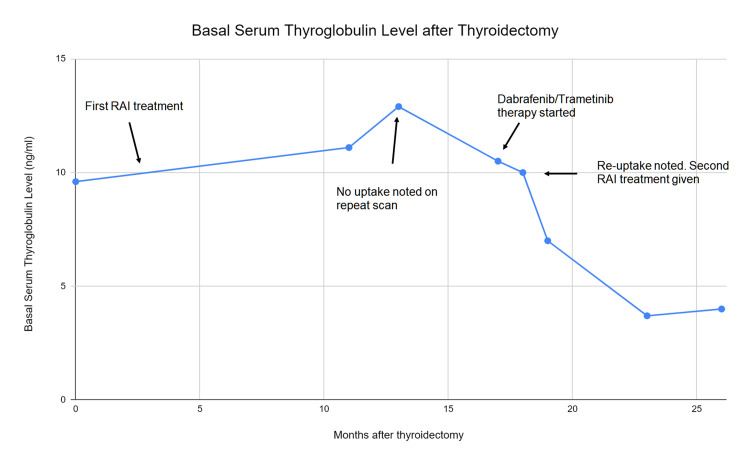
放射性碘难治性转移性分化型甲状腺癌(RAIR)预后较差。多激酶抑制剂已证明可改善此类患者的无进展生存期,但对总生存期无改善,且其使用受到显著不良反应和耐药性发展的限制。临床研究表明,BRAF/MEK抑制剂联合使用可改善转移性黑色素瘤和BRAF突变的间变性甲状腺癌患者的无进展生存期,并在BRAF阳性的RAIR分化型甲状腺癌的再分化方面显示出前景。一名58岁女性因左侧颈部肿物增大前往其初级保健医生处就诊。CT成像发现一个6×8×6cm的混合性囊实性肿物及淋巴结病。随后的核心活检显示为转移性乳头状甲状腺癌(III期,PT4a/PN1b),她接受了全甲状腺切除术及左侧颈部清扫术。全甲状腺切除术后她接受了204mCi的碘治疗。不幸的是放射性碘(RAI)治疗后她的甲状腺球蛋白持续升高,提示存在持续性和/或复发性甲状腺癌。甲状腺激素刺激下的RAI-131全身扫描显示无明显的RAI摄取。随后进行了氟脱氧葡萄糖(FDG)-正电子发射断层扫描(PET)CT,显示左侧甲状腺床有代谢亢进的复发性转移性疾病,双侧颈部淋巴结及肺结节呈FDG摄取阳性。基于这些发现,她的癌症被归类为放射性碘难治性(RAIR)。分子检测显示BRAF突变。与患者讨论后,决定开始使用BRAF抑制剂(达拉非尼150mg,每日两次)和MEK抑制剂(曲美替尼2mg,每日一次)进行治疗,试图使RAIR再分化。治疗开始后1个月重复进行甲状腺激素刺激下的RAI-131全身扫描显示左侧2区颈部淋巴结有放射性碘摄取。鉴于有再分化的证据,患者随后接受了216mCi的碘治疗。她的治疗后扫描显示左下叶肺结节及左侧气管旁肿物有额外摄取,提示转移灶成功摄取RAI-131。RAI治疗6个月后她的甲状腺球蛋白水平降至4.0,表明有令人鼓舞的反应。计划进行包括影像学检查在内的进一步监测。该病例说明了达拉非尼和曲美替尼治疗BRAF突变的RAIR分化型甲状腺癌患者的再分化潜力。这种治疗方法在一小部分患者中已被证明是成功的,鉴于其良好的副作用 profile,对于BRAF突变的RAIR患者,有可能作为多激酶治疗的替代方案提供给他们。