Rosario Fredrick J, Pardo Sammy, Michelsen Trond M, Erickson Kathryn, Moore Lorna, Powell Theresa L, Weintraub Susan T, Jansson Thomas
Division of Reproductive Sciences, Department of OB/GYN, University of Colorado Anschutz Medical Campus, Aurora, CO, United States.
Department of Biochemistry and Structural Biology, University of Texas Health Science Center at San Antonio, San Antonio, TX, United States.
Front Cell Dev Biol. 2021 Sep 14;9:704781. doi: 10.3389/fcell.2021.704781. eCollection 2021.
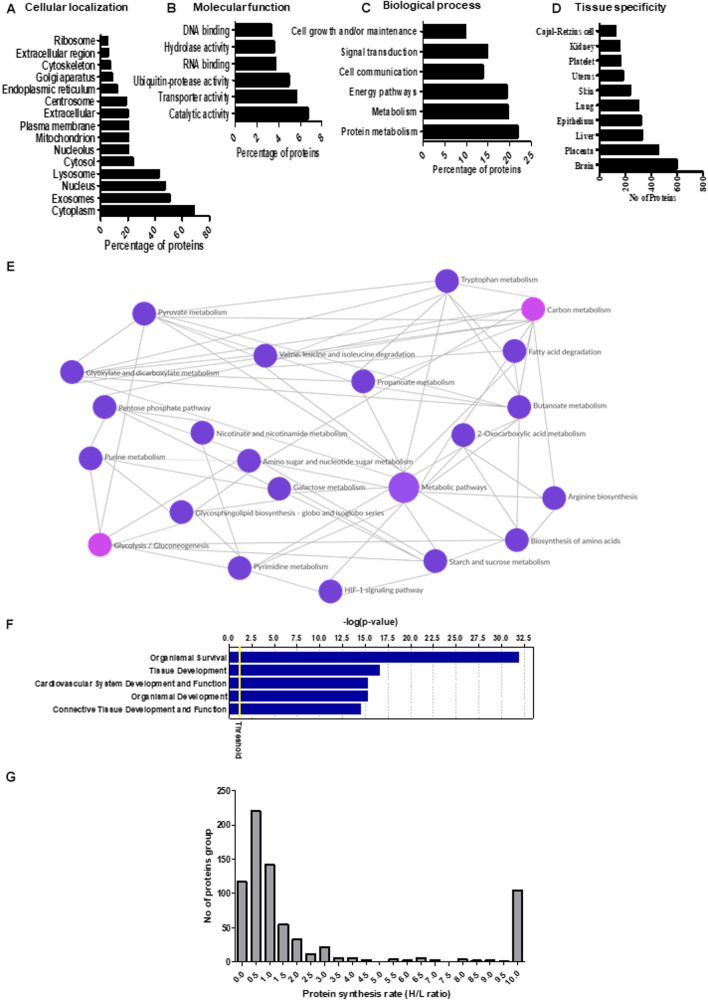
The placental villus syncytiotrophoblast, the nutrient-transporting and hormone-producing epithelium of the human placenta, is a critical regulator of fetal development and maternal physiology. However, the identities of the proteins synthesized and secreted by primary human trophoblast (PHT) cells remain unknown. Stable Isotope Labeling with Amino Acids in Cell Culture followed by mass spectrometry analysis of the conditioned media was used to identify secreted proteins and obtain information about their relative rates of synthesis in syncytialized multinucleated PHT cells isolated from normal term placental villus tissue ( = 4/independent placenta). A total of 1,344 proteins were identified, most of which have not previously been reported to be secreted by the human placenta or trophoblast. The majority of secreted proteins are involved in energy and carbon metabolism, glycolysis, biosynthesis of amino acids, purine metabolism, and fatty acid degradation. Histone family proteins and mitochondrial proteins were among proteins with the slowest synthesis rate whereas proteins associated with signaling and the plasma membrane were synthesized rapidly. There was a significant overlap between the PHT secretome and proteins known be secreted to the fetal circulation by the human placenta . The generated data will guide future experiments to determine the function of individual secreted proteins and will help us better understand how the placenta controls maternal and fetal physiology.
胎盘绒毛合体滋养层细胞是人类胎盘负责营养运输和激素分泌的上皮细胞,是胎儿发育和母体生理的关键调节因子。然而,原代人滋养层(PHT)细胞合成和分泌的蛋白质的具体成分仍不清楚。本研究采用细胞培养中氨基酸稳定同位素标记技术,随后对条件培养基进行质谱分析,以鉴定分泌蛋白,并获取其在从足月正常胎盘绒毛组织分离的多核PHT细胞中的相对合成速率信息(n = 4/独立胎盘)。共鉴定出1344种蛋白质,其中大多数此前未被报道由人胎盘或滋养层细胞分泌。大多数分泌蛋白参与能量和碳代谢、糖酵解、氨基酸生物合成、嘌呤代谢和脂肪酸降解。组蛋白家族蛋白和线粒体蛋白是合成速率最慢的蛋白质,而与信号传导和质膜相关的蛋白合成迅速。PHT分泌组与已知由人胎盘分泌到胎儿循环中的蛋白质之间存在显著重叠。本研究生成的数据将指导未来的实验,以确定单个分泌蛋白的功能,并将帮助我们更好地理解胎盘如何控制母体和胎儿生理。