Department of Cardiology, Charité-Universitätsmedizin Berlin, Campus Benjamin Franklin, Hindenburgdamm 30, 12203 Berlin, Germany.
German Center for Cardiovascular Research (DZHK), Partner Site Berlin, Berlin, Germany.
Eur Heart J. 2022 Feb 10;43(6):518-533. doi: 10.1093/eurheartj/ehab644.
Atherosclerotic cardiovascular disease (ACVD) is a major cause of mortality and morbidity worldwide, and increased low-density lipoproteins (LDLs) play a critical role in development and progression of atherosclerosis. Here, we examined for the first time gut immunomodulatory effects of the microbiota-derived metabolite propionic acid (PA) on intestinal cholesterol metabolism.
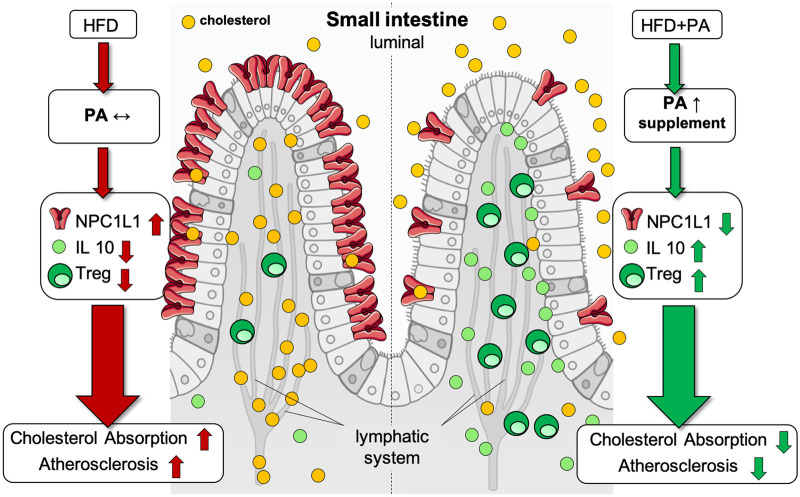
Using both human and animal model studies, we demonstrate that treatment with PA reduces blood total and LDL cholesterol levels. In apolipoprotein E-/- (Apoe-/-) mice fed a high-fat diet (HFD), PA reduced intestinal cholesterol absorption and aortic atherosclerotic lesion area. Further, PA increased regulatory T-cell numbers and interleukin (IL)-10 levels in the intestinal microenvironment, which in turn suppressed the expression of Niemann-Pick C1-like 1 (Npc1l1), a major intestinal cholesterol transporter. Blockade of IL-10 receptor signalling attenuated the PA-related reduction in total and LDL cholesterol and augmented atherosclerotic lesion severity in the HFD-fed Apoe-/- mice. To translate these preclinical findings to humans, we conducted a randomized, double-blinded, placebo-controlled human study (clinical trial no. NCT03590496). Oral supplementation with 500 mg of PA twice daily over the course of 8 weeks significantly reduced LDL [-15.9 mg/dL (-8.1%) vs. -1.6 mg/dL (-0.5%), P = 0.016], total [-19.6 mg/dL (-7.3%) vs. -5.3 mg/dL (-1.7%), P = 0.014] and non-high-density lipoprotein cholesterol levels [PA vs. placebo: -18.9 mg/dL (-9.1%) vs. -0.6 mg/dL (-0.5%), P = 0.002] in subjects with elevated baseline LDL cholesterol levels.
Our findings reveal a novel immune-mediated pathway linking the gut microbiota-derived metabolite PA with intestinal Npc1l1 expression and cholesterol homeostasis. The results highlight the gut immune system as a potential therapeutic target to control dyslipidaemia that may introduce a new avenue for prevention of ACVDs.
动脉粥样硬化性心血管疾病(ACVD)是全球死亡和发病的主要原因,而低密度脂蛋白(LDL)的增加在动脉粥样硬化的发展和进展中起着关键作用。在这里,我们首次研究了微生物衍生代谢产物丙酸(PA)对肠道胆固醇代谢的肠道免疫调节作用。
使用人体和动物模型研究,我们证明 PA 治疗可降低血液总胆固醇和 LDL 胆固醇水平。在高脂饮食(HFD)喂养的载脂蛋白 E 基因敲除(Apoe-/-)小鼠中,PA 降低了肠道胆固醇吸收和主动脉粥样硬化病变面积。此外,PA 增加了肠道微环境中的调节性 T 细胞数量和白细胞介素(IL)-10 水平,进而抑制了主要肠道胆固醇转运蛋白尼曼-匹克 C1 样 1(Npc1l1)的表达。阻断 IL-10 受体信号减弱了与 PA 相关的总胆固醇和 LDL 胆固醇降低,并增加了 HFD 喂养的 Apoe-/-小鼠的动脉粥样硬化病变严重程度。为了将这些临床前发现转化为人类,我们进行了一项随机、双盲、安慰剂对照的人体研究(临床试验编号 NCT03590496)。在 8 周的时间内每天口服补充 500mgPA 两次,可显著降低 LDL [-15.9mg/dL(-8.1%)比-1.6mg/dL(-0.5%),P=0.016]、总胆固醇[-19.6mg/dL(-7.3%)比-5.3mg/dL(-1.7%),P=0.014]和非高密度脂蛋白胆固醇水平[PA 与安慰剂:-18.9mg/dL(-9.1%)比-0.6mg/dL(-0.5%),P=0.002],在 LDL 胆固醇水平升高的受试者中。
我们的研究结果揭示了一种新的免疫介导途径,将肠道微生物衍生代谢产物 PA 与肠道 Npc1l1 表达和胆固醇稳态联系起来。这些结果强调了肠道免疫系统作为控制血脂异常的潜在治疗靶点,可能为预防 ACVDs 提供了新途径。