Institute of Applied Economics and Health Research, Copenhagen, Denmark.
Steno Diabetes Center Odense, Department of Clinical Research, Odense University Hospital and University of Southern Denmark, Odense, Denmark.
Diabetologia. 2021 Dec;64(12):2741-2750. doi: 10.1007/s00125-021-05571-8. Epub 2021 Oct 2.
AIMS/HYPOTHESIS: Data on type 1 diabetes incidence and prevalence are limited, particularly for adults. This study aims to estimate global numbers of incident and prevalent cases of type 1 diabetes in 2017 for all age groups, by country and areas defined by income and region.
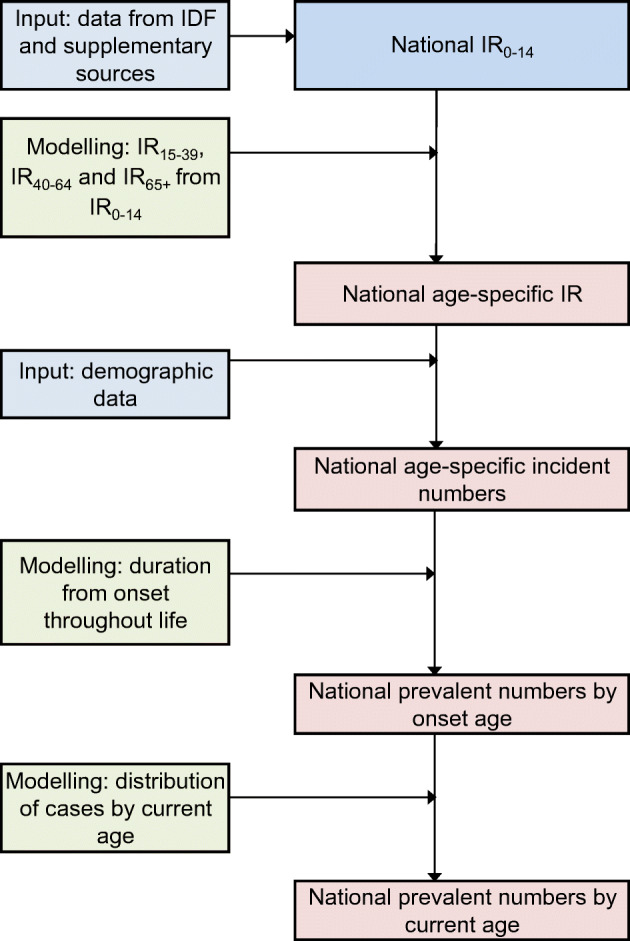
Incidence rates of type 1 diabetes in children (available from 94 countries) from the IDF Atlas were used and extrapolated to countries without data. Age-specific incidence rates in adults (only known across full age range for fewer than ten countries) were obtained by applying scaling ratios for each adult age group relative to the incidence rate in children. Age-specific incidence rates were applied to population estimates to obtain incident case numbers. Duration of diabetes was estimated from available data and adjusted using differences in childhood mortality rate between countries from United Nations demographic data. Prevalent case numbers were derived by modelling the relationship between prevalence, incidence and disease duration. Sensitivity analyses were performed to quantify the impact of alternative assumptions and model inputs.
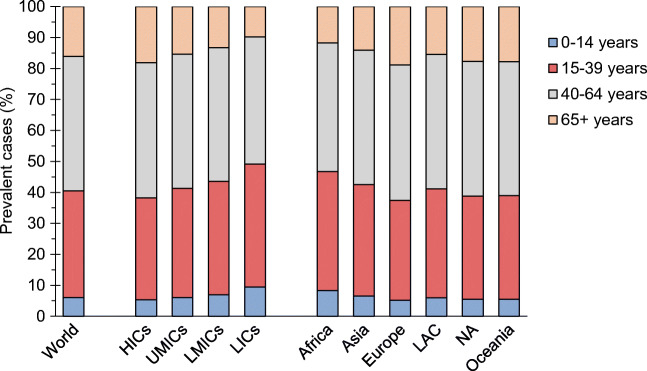
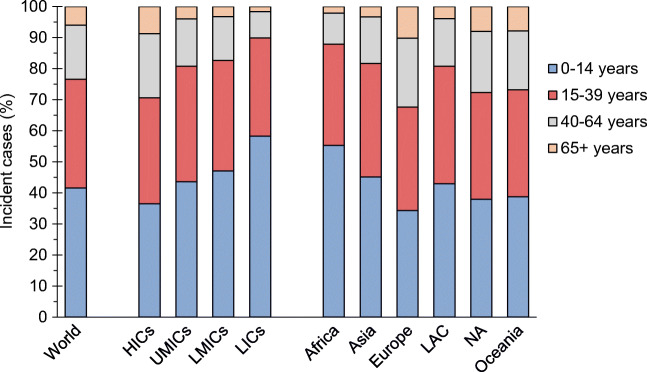
Global numbers of incident and prevalent cases of type 1 diabetes were estimated to be 234,710 and 9,004,610, respectively, in 2017. High-income countries, with 17% of the global population, accounted for 49% of global incident cases and 52% of prevalent cases. Asia, which has the largest proportion of the world's population (60%), had the largest number of incident (32%) and prevalent (31%) cases of type 1 diabetes. Globally, 6%, 35%, 43% and 16% of prevalent cases were in the age groups 0-14, 15-39, 40-64 and 65+ years, respectively. Based on sensitivity analyses, the estimates could deviate by ±15%.
CONCLUSIONS/INTERPRETATION: Globally, type 1 diabetes represents about 2% of the estimated total cases of diabetes, ranging from less than 1% in certain Pacific countries to more than 15% in Northern European populations in 2017. This study provides information for the development of healthcare and policy approaches to manage type 1 diabetes. The estimates need further validation due to limitations and assumptions related to data availability and estimation methods.
目的/假设:1 型糖尿病的发病率和患病率数据有限,特别是针对成年人。本研究旨在估算 2017 年所有年龄段、按收入和地区划分的国家和地区的 1 型糖尿病新发病例和现患病例全球数量。
使用国际糖尿病联盟图谱中 94 个国家的儿童 1 型糖尿病发病率数据,并对无数据的国家进行外推。成年人的年龄特异性发病率(在不到 10 个国家中仅在整个年龄范围内完全知晓)是通过对每个成年年龄组相对于儿童发病率的比例进行缩放获得的。将年龄特异性发病率应用于人口估计,以获得新发病例数量。使用联合国人口数据中各国间儿童死亡率的差异来估计糖尿病的持续时间,并进行调整。通过对患病率、发病率和疾病持续时间之间关系的建模来获得现患病例数量。进行了敏感性分析,以量化替代假设和模型输入的影响。
2017 年,全球 1 型糖尿病的新发病例和现患病例估计数分别为 234710 例和 9004610 例。高收入国家拥有全球 17%的人口,却占全球新发病例的 49%和现患病例的 52%。亚洲拥有世界上最大的人口比例(60%),其 1 型糖尿病的新发病例(32%)和现患病例(31%)数量最多。全球 0-14 岁、15-39 岁、40-64 岁和 65 岁以上年龄组的现患病例分别占 6%、35%、43%和 16%。基于敏感性分析,估计值可能存在±15%的偏差。
结论/解释:全球范围内,1 型糖尿病占估计的所有糖尿病病例的 2%左右,2017 年在某些太平洋国家不到 1%,在北欧人群中则超过 15%。本研究为制定管理 1 型糖尿病的医疗保健和政策方法提供了信息。由于与数据可用性和估计方法相关的限制和假设,这些估计需要进一步验证。