Global Health Institute, School of Life Sciences, EPFL, Lausanne, Switzerland.
Global Health Institute, School of Life Sciences, EPFL, Lausanne, Switzerland.
Dev Cell. 2021 Oct 25;56(20):2790-2807.e8. doi: 10.1016/j.devcel.2021.09.016. Epub 2021 Oct 1.
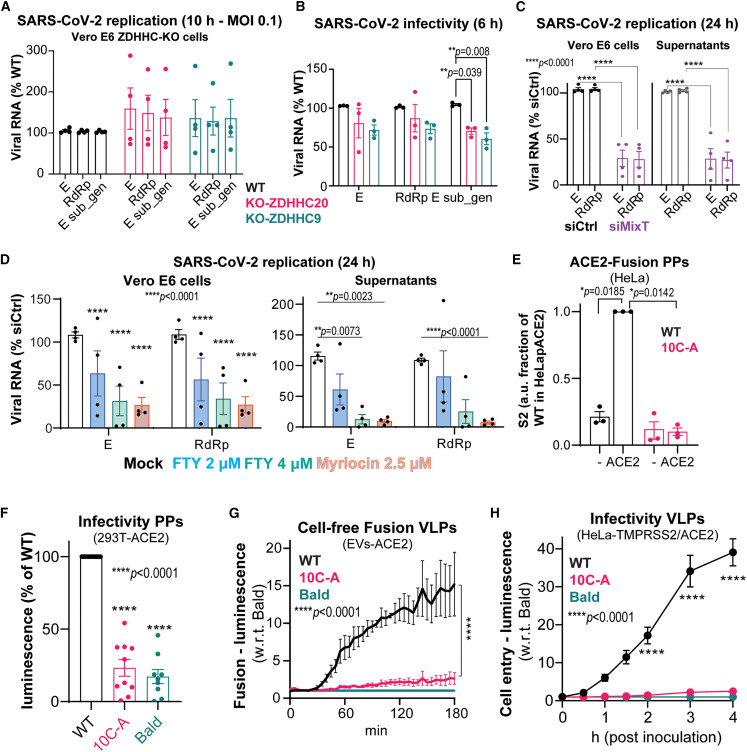
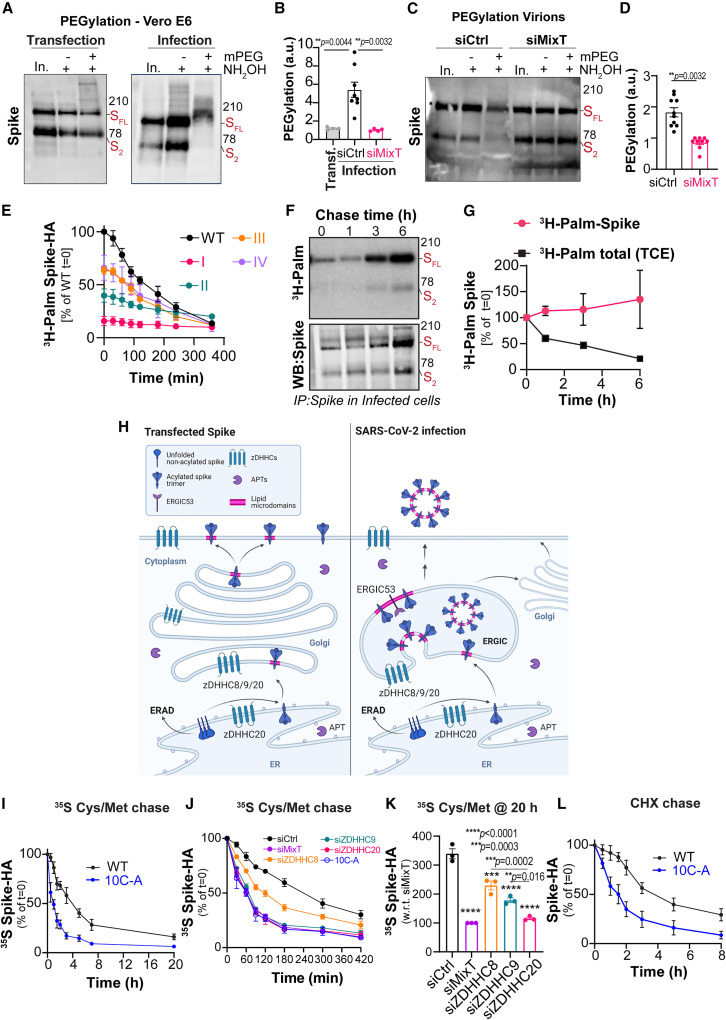
SARS-CoV-2 virions are surrounded by a lipid bilayer that contains membrane proteins such as spike, responsible for target-cell binding and virus fusion. We found that during SARS-CoV-2 infection, spike becomes lipid modified, through the sequential action of the S-acyltransferases ZDHHC20 and 9. Particularly striking is the rapid acylation of spike on 10 cytosolic cysteines within the ER and Golgi. Using a combination of computational, lipidomics, and biochemical approaches, we show that this massive lipidation controls spike biogenesis and degradation, and drives the formation of localized ordered cholesterol and sphingolipid-rich lipid nanodomains in the early Golgi, where viral budding occurs. Finally, S-acylation of spike allows the formation of viruses with enhanced fusion capacity. Our study points toward S-acylating enzymes and lipid biosynthesis enzymes as novel therapeutic anti-viral targets.
SARS-CoV-2 病毒体被一个脂质双层所包围,该双层包含膜蛋白,如负责靶细胞结合和病毒融合的刺突蛋白。我们发现,在 SARS-CoV-2 感染过程中,刺突蛋白通过 S-酰基转移酶 ZDHHC20 和 9 的顺序作用而发生脂质修饰。特别引人注目的是,刺突蛋白在 ER 和高尔基体中的 10 个细胞质半胱氨酸上迅速发生酰化。我们使用计算、脂质组学和生化方法的组合表明,这种大量的脂质化控制着刺突蛋白的生物发生和降解,并在早期高尔基体中驱动局部有序胆固醇和富含神经鞘脂的富含脂质的纳米域的形成,病毒出芽发生在那里。最后,刺突蛋白的 S 酰化允许形成融合能力增强的病毒。我们的研究表明,S 酰化酶和脂质生物合成酶是新型抗病毒治疗的潜在靶点。