Department of Medical Oncology and Hematology, University Hospital Zurich, Zurich, Switzerland.
Department of Radiation Oncology, University Hospital Zurich, Zurich, Switzerland.
Radiat Oncol. 2021 Oct 2;16(1):194. doi: 10.1186/s13014-021-01920-4.
Systemic response to local anticancer treatment is a phenomenon called 'abscopal effect'. The immune system is thought to play a pivotal role in its occurrence. To date, several cases have been reported, particularly in patients receiving combined local treatment and immune checkpoint inhibitors. In such cases, it is impossible to discriminate between the effects of local and systemic treatment. Only a few cases of abscopal effect have been described with radiotherapy alone.
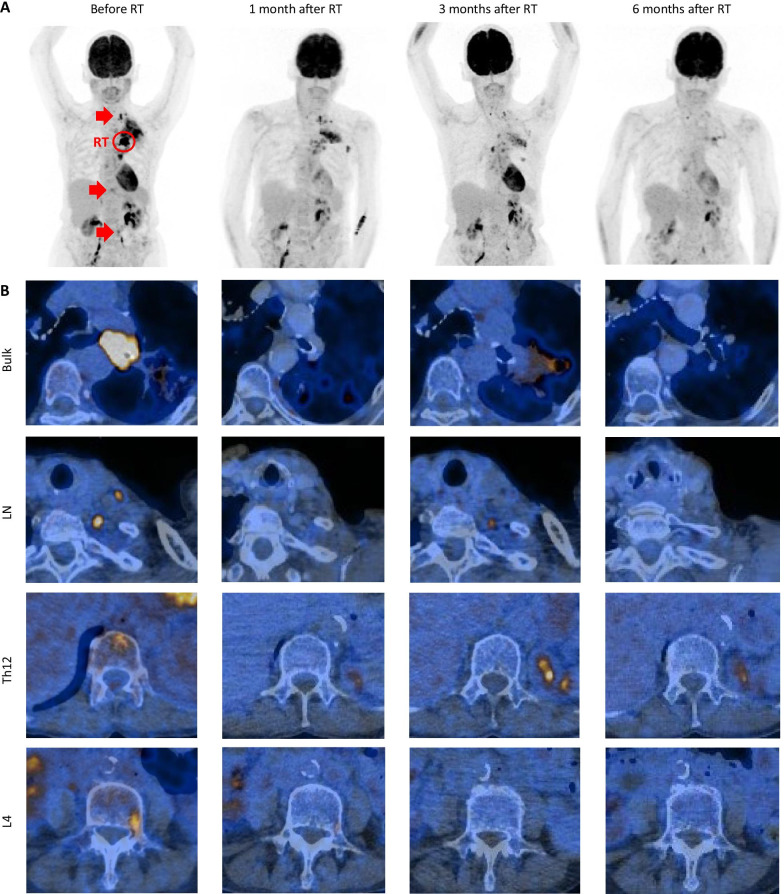
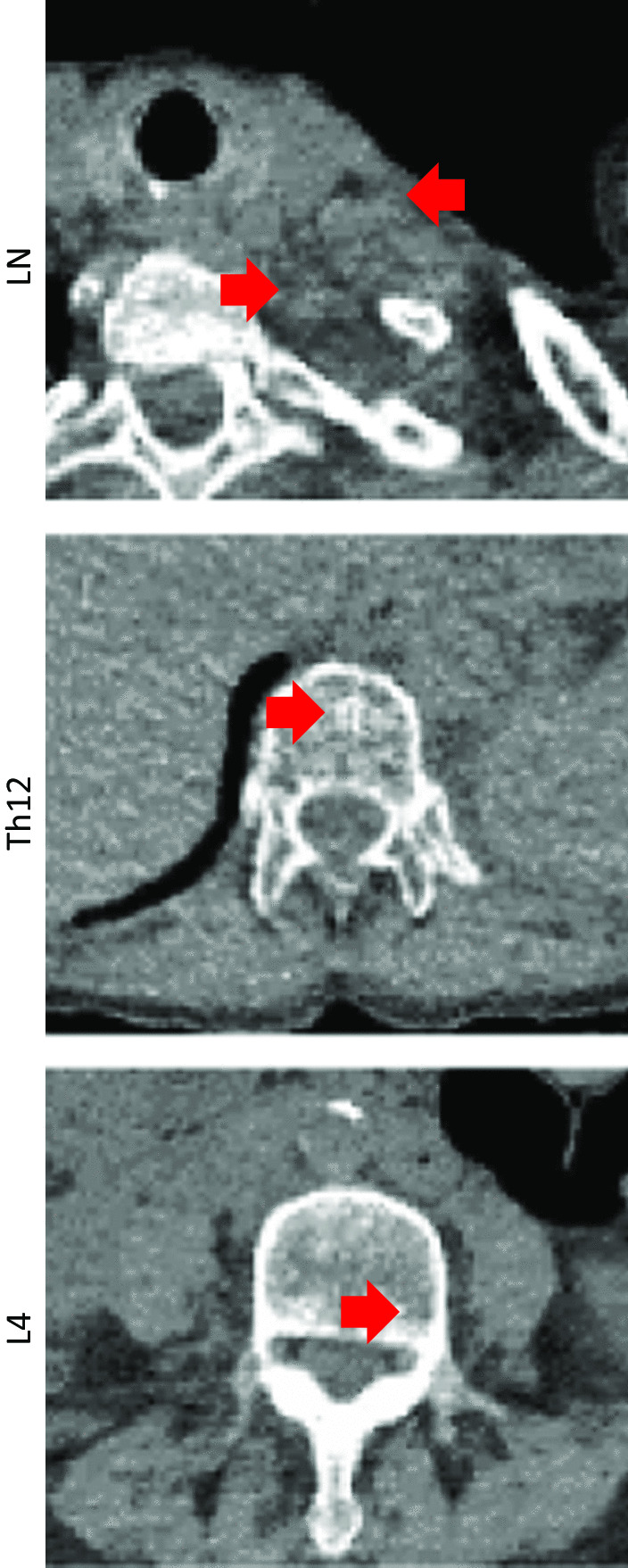
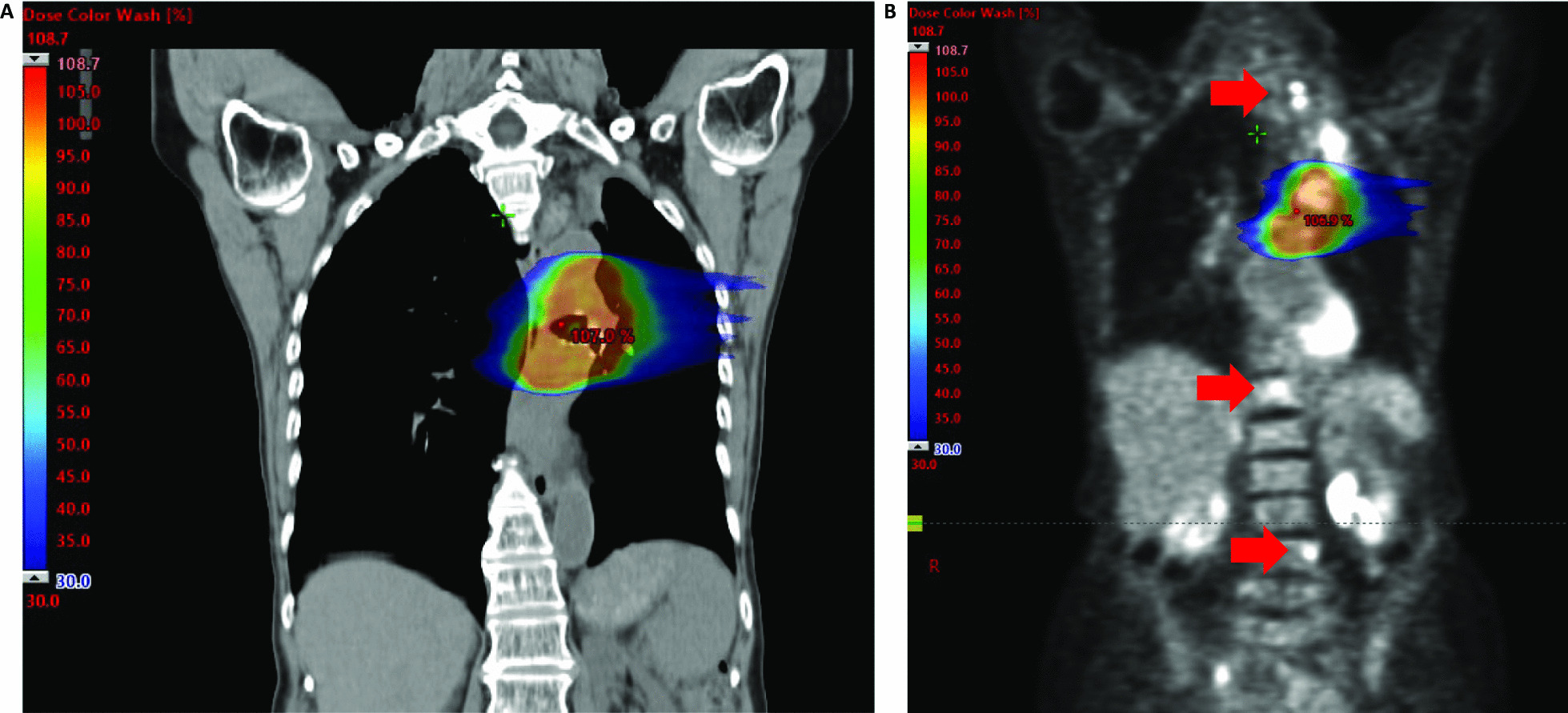
Here, we report on the case of an 81-year-old woman with recurrent metastatic squamous cell carcinoma of the lung with mediastinal tumor bulk, lymph node and bone metastases. The patient refused to undergo systemic treatment, and palliative stereotactic radiotherapy of the mediastinal tumor was performed. At restaging with FDG-PET/CT, the patient presented with a decrease in size and FDG-avidity both of the irradiated site and of the lymph node and bone metastases (which did not receive radiotherapy). At 25 months after radiotherapy, the patient is still in remission at all sites.
This is a rare case of an abscopal effect after radiotherapy as monotherapy. It is one of the few hitherto reported for lung cancer. Several ongoing studies with a combination of radiotherapy and immunotherapy are seeking to exploit a potential synergy to induce abscopal effects.
局部抗癌治疗的全身反应是一种称为“远隔效应”的现象。免疫系统被认为在其发生中起着关键作用。迄今为止,已经报道了几例病例,特别是在接受联合局部治疗和免疫检查点抑制剂治疗的患者中。在这些情况下,不可能区分局部和全身治疗的效果。只有少数单独放疗引起远隔效应的病例被描述过。
在这里,我们报告了一例 81 岁女性复发性转移性肺鳞癌,伴有纵隔肿瘤肿块、淋巴结和骨转移。患者拒绝接受全身治疗,接受了纵隔肿瘤的姑息性立体定向放疗。在 FDG-PET/CT 重新分期时,患者接受照射部位以及淋巴结和骨转移部位(未接受放疗)的大小和 FDG 摄取均减少。放疗后 25 个月,患者所有部位仍处于缓解状态。
这是一例罕见的单独放疗后远隔效应的病例。这是迄今为止报道的少数几例肺癌病例之一。目前正在进行几项联合放疗和免疫治疗的研究,旨在利用潜在的协同作用诱导远隔效应。