Advanced Medical Technology Center, The First Affiliated Hospital, Zhongshan School of Medicine, Sun Yat-sen University, Guangzhou 510080, China; Department of Biochemistry, Zhongshan School of Medicine, Sun Yat-sen University, Guangzhou 510080, China.
Department of Biochemistry, Zhongshan School of Medicine, Sun Yat-sen University, Guangzhou 510080, China.
Mol Ther. 2022 Feb 2;30(2):606-620. doi: 10.1016/j.ymthe.2021.07.015. Epub 2021 Oct 1.
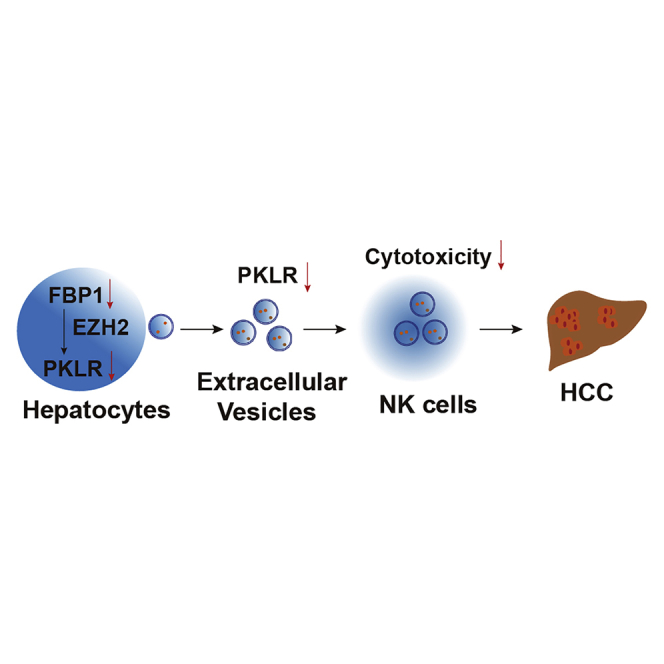
Hepatocellular carcinoma (HCC) is frequently characterized by metabolic and immune remodeling in the tumor microenvironment. We previously discovered that liver-specific deletion of fructose-1, 6-bisphosphatase 1 (FBP1), a gluconeogenic enzyme ubiquitously suppressed in HCC tissues, promotes liver tumorigenesis and induces metabolic and immune perturbations closely resembling human HCC. However, the underlying mechanisms remain incompletely understood. Here, we reported that FBP1-deficient livers exhibit diminished amounts of natural killer (NK) cells and accelerated tumorigenesis. Using the diethylnitrosamine-induced HCC mouse model, we analyzed potential changes in the immune cell populations purified from control and FBP1-depleted livers and found that NK cells were strongly suppressed. Mechanistically, FBP1 attenuation in hepatocytes derepresses an zeste homolog 2 (EZH2)-dependent transcriptional program to inhibit PKLR expression. This leads to reduced levels of PKLR cargo proteins sorted into hepatocyte-derived extracellular vesicles (EVs), dampened activity of EV-targeted NK cells, and accelerated liver tumorigenesis. Our study demonstrated that hepatic FBP1 depletion promotes HCC-associated immune remodeling, partly through the transfer of hepatocyte-secreted, PKLR-attenuated EVs to NK cells.
肝细胞癌 (HCC) 常表现为肿瘤微环境中的代谢和免疫重塑。我们之前发现,在肝脏中特异性敲除果糖-1,6-二磷酸酶 1 (FBP1),一种在 HCC 组织中普遍受到抑制的糖异生酶,可促进肝肿瘤发生,并诱导与人类 HCC 非常相似的代谢和免疫紊乱。然而,其潜在机制仍不完全清楚。在这里,我们报告 FBP1 缺陷型肝脏中自然杀伤 (NK) 细胞数量减少,并加速肿瘤发生。我们使用二乙基亚硝胺诱导的 HCC 小鼠模型,分析了从对照组和 FBP1 耗尽的肝脏中纯化的免疫细胞群体的潜在变化,发现 NK 细胞受到强烈抑制。从机制上讲,肝细胞中 FBP1 的衰减解除了 EZH2 依赖性转录程序的抑制,从而抑制 PKLR 的表达。这导致 PKLR 货物蛋白在肝细胞衍生的细胞外囊泡 (EV) 中的分拣减少,靶向 EV 的 NK 细胞的活性降低,从而加速肝肿瘤发生。我们的研究表明,肝 FBP1 耗竭促进 HCC 相关的免疫重塑,部分通过将肝细胞分泌的、PKLR 减弱的 EV 转移到 NK 细胞。