Department of Psychiatry, Boston University School of Medicine, Boston, MA, USA.
The Bioinformatics Program, Boston University Graduate School of Arts and Sciences, Boston, MA, USA.
Transl Psychiatry. 2021 Oct 2;11(1):504. doi: 10.1038/s41398-021-01635-w.
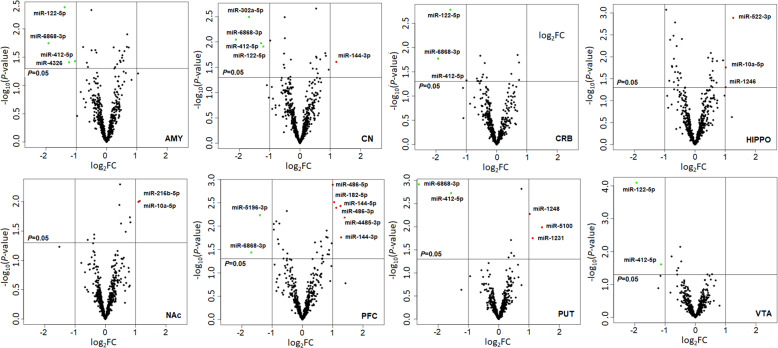
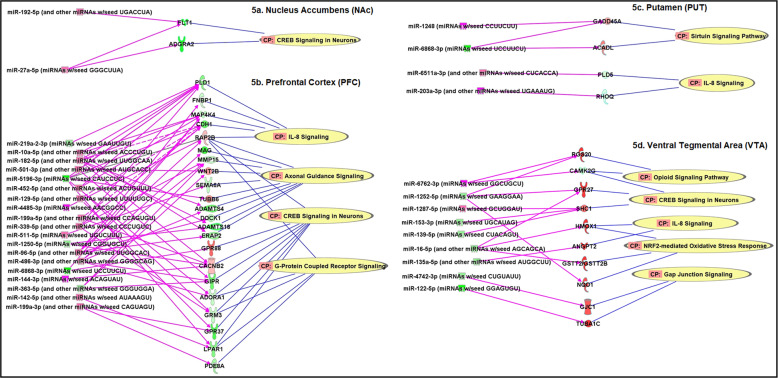
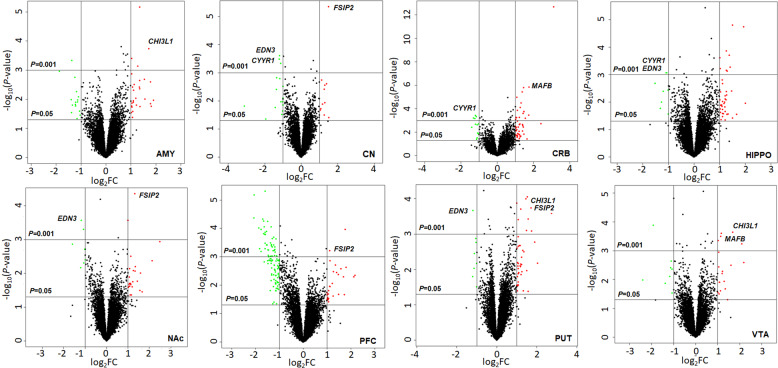
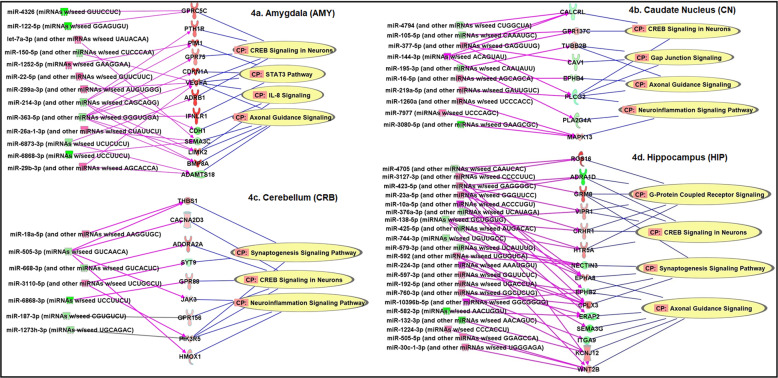
Transcriptomic changes in specific brain regions can influence the risk of alcohol use disorder (AUD), but the underlying mechanism is not fully understood. We investigated AUD-associated miRNA-mRNA regulatory networks in multiple brain regions by analyzing transcriptomic changes in two sets of postmortem brain tissue samples and ethanol-exposed human embryonic stem cell (hESC)-derived cortical interneurons. miRNA and mRNA transcriptomes were profiled in 192 tissue samples (Set 1) from eight brain regions (amygdala, caudate nucleus, cerebellum, hippocampus, nucleus accumbens, prefrontal cortex, putamen, and ventral tegmental area) of 12 AUD and 12 control European Australians. Nineteen differentially expressed miRNAs (fold-change>2.0 & P < 0.05) and 97 differentially expressed mRNAs (fold-change>2.0 & P < 0.001) were identified in one or multiple brain regions of AUD subjects. AUD-associated miRNA-mRNA regulatory networks in each brain region were constructed using differentially expressed and negatively correlated miRNA-mRNA pairs. AUD-relevant pathways (including CREB Signaling, IL-8 Signaling, and Axonal Guidance Signaling) were potentially regulated by AUD-associated brain miRNA-mRNA pairs. Moreover, miRNA and mRNA transcriptomes were mapped in additional 96 tissue samples (Set 2) from six of the above eight brain regions of eight AUD and eight control European Australians. Some of the AUD-associated miRNA-mRNA regulatory networks were confirmed. In addition, miRNA and mRNA transcriptomes were analyzed in hESC-derived cortical interneurons with or without ethanol exposure, and ethanol-influenced miRNA-mRNA regulatory networks were constructed. This study provided evidence that alcohol could induce concerted miRNA and mRNA expression changes in reward-related or alcohol-responsive brain regions. We concluded that altered brain miRNA-mRNA regulatory networks might contribute to AUD development.
特定脑区的转录组变化可能会影响酒精使用障碍(AUD)的风险,但其中的潜在机制尚不完全清楚。我们通过分析两组死后脑组织样本和乙醇暴露的人类胚胎干细胞(hESC)衍生皮质中间神经元中的转录组变化,研究了多个脑区与 AUD 相关的 miRNA-mRNA 调控网络。我们在来自 12 名 AUD 和 12 名对照欧洲澳大利亚人的 8 个脑区(杏仁核、尾状核、小脑、海马体、伏隔核、前额叶皮层、壳核和腹侧被盖区)的 192 个组织样本(数据集 1)中对 miRNA 和 mRNA 转录组进行了分析。在 AUD 受试者的一个或多个脑区中,鉴定出了 19 个差异表达的 miRNA(fold-change>2.0 & P<0.05)和 97 个差异表达的 mRNA(fold-change>2.0 & P<0.001)。使用差异表达且呈负相关的 miRNA-mRNA 对构建了每个脑区的 AUD 相关 miRNA-mRNA 调控网络。与 AUD 相关的途径(包括 CREB 信号、IL-8 信号和轴突导向信号)可能受到 AUD 相关脑 miRNA-mRNA 对的调控。此外,在来自上述 8 个脑区的 6 个脑区的另外 96 个组织样本(数据集 2)中,对 miRNA 和 mRNA 转录组进行了映射。一些与 AUD 相关的 miRNA-mRNA 调控网络得到了证实。此外,还分析了有或没有乙醇暴露的 hESC 衍生皮质中间神经元的 miRNA 和 mRNA 转录组,并构建了受乙醇影响的 miRNA-mRNA 调控网络。本研究提供了证据表明,酒精可以在与奖励相关或对酒精有反应的脑区诱导协调的 miRNA 和 mRNA 表达变化。我们得出结论,改变的大脑 miRNA-mRNA 调控网络可能导致 AUD 的发展。