Yang Zhenyu, Tan Xingliang, Wang Yanjun, Zou Yuantao, Chen Dong, Wu Zhiming, Liu Zhuowei, Li Yonghong, Qin Zike, Han Hui, Zhou Fangjian, Yao Kai
Department of Urology, Sun Yat-sen University Cancer Center, Guangzhou, China.
State Key Laboratory of Oncology in South China, Sun Yat-sen University Cancer Center, Guangzhou, China.
Front Oncol. 2021 Sep 15;11:715799. doi: 10.3389/fonc.2021.715799. eCollection 2021.
To evaluate the relationship between deep inguinal lymph node metastasis (ILNM) and pelvic lymph node metastasis (PLNM) and explore the prognostic value of deep ILNM in penile squamous cell carcinoma (PSCC).
The records of 189 patients with ILNM treated for PSCC were analysed retrospectively. Logistic regression models were used to test for predictors of PLNM. Cox regression was performed in univariable and multivariable analyses of cancer-specific survival (CSS). CSS was compared using Kaplan-Meier analyses and log rank tests.
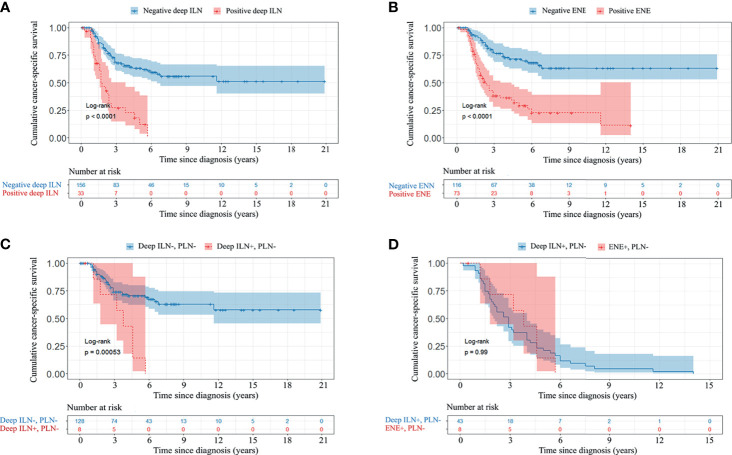
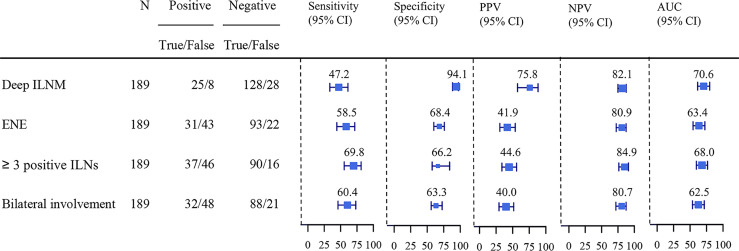
PLNM were observed in 53 cases (28.0%). According to logistic regression models, only deep ILNM (OR 9.72, p<0.001) and number (≥3) of metastatic inguinal lymph nodes (ILNs) (OR 2.36, p=0.03) were independent predictors of PLNM. The incidences of PLNM were 18% and 19% with negative deep ILNM and extranodal extension (ENE); and 76% and 42% with positive deep ILNM and ENE, respectively. The accuracy of deep ILNM, ENE, bilateral involvement and number (≥3) of ILNMs for predicting PLNM were 81.0%, 65.6%, 63.5% and 67.2%, respectively. The CSS was significantly different in patients with positive and negative deep ILNM (median 1.7 years not reached, p<0.01). Patients who presented with deep ILNM had worse CSS (median 3.8 years not reached, p<0.01) in those with negative PLNs.
Deep ILNM is the most accurate factor for predicting PLNM in PSCC according to our data. We recommend that patients with deep ILNM should be referred for pelvic lymph node dissection. Involvement of deep ILNs indicates poor prognosis. We propose that patients with metastases of deep ILNs may be staged as pN3.
评估腹股沟深淋巴结转移(ILNM)与盆腔淋巴结转移(PLNM)之间的关系,并探讨腹股沟深淋巴结转移在阴茎鳞状细胞癌(PSCC)中的预后价值。
回顾性分析189例接受PSCC治疗且发生ILNM患者的记录。采用逻辑回归模型检验PLNM的预测因素。对癌症特异性生存(CSS)进行单变量和多变量分析时采用Cox回归。使用Kaplan-Meier分析和对数秩检验比较CSS。
53例(28.0%)观察到PLNM。根据逻辑回归模型,仅腹股沟深淋巴结转移(比值比9.72,p<0.001)和转移腹股沟淋巴结(ILN)数量(≥3个)(比值比2.36,p=0.03)是PLNM的独立预测因素。腹股沟深淋巴结转移阴性且无结外扩展(ENE)时PLNM的发生率分别为18%和19%;腹股沟深淋巴结转移阳性且有ENE时PLNM的发生率分别为76%和42%。腹股沟深淋巴结转移、ENE、双侧受累及ILNM数量(≥3个)预测PLNM的准确率分别为81.0%、65.6%、63.5%和67.2%。腹股沟深淋巴结转移阳性和阴性患者的CSS有显著差异(中位数1.7年 未达到,p<0.01)。在PLN阴性的患者中,出现腹股沟深淋巴结转移的患者CSS更差(中位数3.8年 未达到,p<0.01)。
根据我们的数据,腹股沟深淋巴结转移是预测PSCC中PLNM最准确的因素。我们建议腹股沟深淋巴结转移患者应转诊进行盆腔淋巴结清扫。腹股沟深淋巴结受累提示预后不良。我们建议腹股沟深淋巴结转移患者可分期为pN3。