Gao Yabin, Yang Ruibing, Guo Lan, Wang Yaoxian, Liu Wei Jing, Ai Sinan, Woon Ting Hui, Wang Zheng, Zhai Yuanyuan, Wang Zhen, Peng Liang
Department of Nephrology, Dongzhimen Hospital, Beijing University of Chinese Medicine, Beijing, China.
The First Affiliated Hospital of Henan University of Traditional Chinese Medicine, Zhengzhou, China.
Front Med (Lausanne). 2021 Sep 16;8:719950. doi: 10.3389/fmed.2021.719950. eCollection 2021.
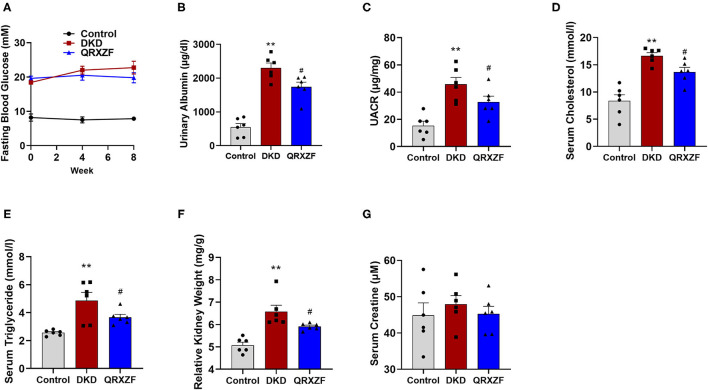
Evidence indicates that the metabolic inflammation induced by gut microbiota dysbiosis contributes to diabetic kidney disease. Prebiotic supplementations to prevent gut microbiota dysbiosis, inhibit inflammatory responses, and protect the renal function in DKD. Qing-Re-Xiao-Zheng formula (QRXZF) is a Traditional Chinese Medicine (TCM) formula that has been used for DKD treatment in China. Recently, there are growing studies show that regulation of gut microbiota is a potential therapeutic strategy for DKD as it is able to reduce metabolic inflammation associated with DKD. However, it is unknown whether QRXZF is effective for DKD by regulating of gut microbiota. In this study, we investigated the reno-protective effect of QRXZF by exploring its potential mechanism between gut microbiota and downstream inflammatory pathways mediated by gut-derived lipopolysaccharide (LPS) in the kidney. High-fat diet (HFD) and streptozotocin injection-induced DKD mice model was established to assess the QRXZF effect . Mice treated with QRXZF for 8 weeks had significantly lower levels of urinary albumin, serum cholesterol and triglycerides. The renal injuries observed through histological analysis were attenuated as well. Also, mice in the QRXZF group had higher levels of Zonula occludens protein-1 (ZO-1) expression, lower levels of serum fluorescein-isothiocyanate (FITC)-dextran and less-damaged colonic mucosa as compared to the DKD group, implying the benefit role for the gut barrier integrity. QRXZF treatment also reversed gut dysbiosis and reduced levels of gut-derived LPS. Notably, the expression of toll-like receptor 4 (TLR4) and nuclear factor-κB (NF-κB), which are important inflammation pathways in DKD, were suppressed in the QRXZF groups. In conclusion, our results indicated that the reno-protective effects of QRXZF was probably associated with modulating gut microbiota and inhibiting inflammatory responses in the kidney.
有证据表明,肠道微生物群失调引起的代谢性炎症会导致糖尿病肾病。益生元补充剂可预防肠道微生物群失调,抑制炎症反应,并保护糖尿病肾病患者的肾功能。清热消症方(QRXZF)是一种中药配方,在中国已用于糖尿病肾病的治疗。最近,越来越多的研究表明,调节肠道微生物群是糖尿病肾病的一种潜在治疗策略,因为它能够减少与糖尿病肾病相关的代谢性炎症。然而,尚不清楚清热消症方是否通过调节肠道微生物群对糖尿病肾病有效。在本研究中,我们通过探索其在肠道微生物群与肾脏中肠道来源的脂多糖(LPS)介导的下游炎症途径之间的潜在机制,研究了清热消症方的肾脏保护作用。建立高脂饮食(HFD)和链脲佐菌素注射诱导的糖尿病肾病小鼠模型来评估清热消症方的效果。用清热消症方治疗8周的小鼠尿白蛋白、血清胆固醇和甘油三酯水平显著降低。通过组织学分析观察到的肾损伤也有所减轻。此外,与糖尿病肾病组相比,清热消症方组小鼠的紧密连接蛋白-1(ZO-1)表达水平更高,血清异硫氰酸荧光素(FITC)-葡聚糖水平更低,结肠黏膜损伤更小,这意味着对肠道屏障完整性有益。清热消症方治疗还逆转了肠道菌群失调并降低了肠道来源的LPS水平。值得注意的是,清热消症方组中 toll样受体4(TLR4)和核因子-κB(NF-κB)的表达受到抑制,这两者是糖尿病肾病中重要的炎症途径。总之,我们的结果表明,清热消症方的肾脏保护作用可能与调节肠道微生物群和抑制肾脏中的炎症反应有关。