Han Dong, Hooshangnejad Hamed, Chen Chin-Cheng, Ding Kai
Departments of Radiation Oncology and Molecular Radiation Sciences, Johns Hopkins School of Medicine, Baltimore, Maryland.
Maryland Proton Treatment Center, Departments of Radiation Oncology; University of Maryland School of Medicine, Baltimore, Maryland.
Adv Radiat Oncol. 2021 Jul 29;6(6):100757. doi: 10.1016/j.adro.2021.100757. eCollection 2021 Nov-Dec.
We investigate two margin-based schemes for optimization target volumes (OTV), both isotropic expansion (2 mm) and beam-specific OTV, to account for uncertainties due to the setup errors and range uncertainties in pancreatic stereotactic pencil beam scanning (PBS) proton therapy. Also, as 2-mm being one of the extreme sizes of margin, we also study whether the plan quality of 2-mm uniform expansion could be comparable to other plan schemes.
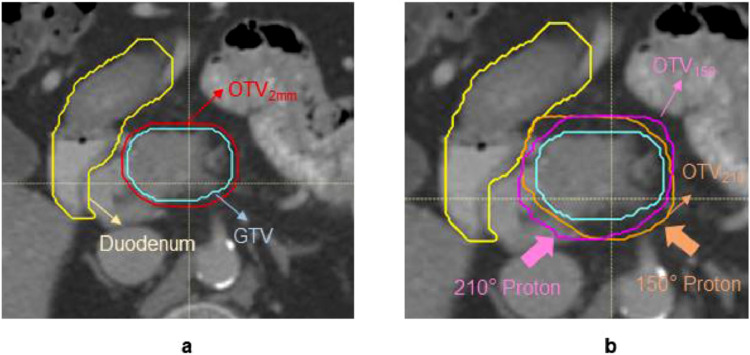
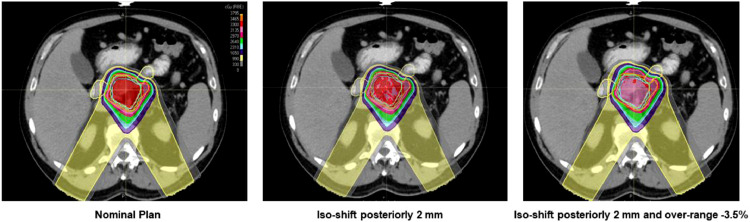
We developed 2 schemes for OTV: (1) a uniform expansion of 2 mm (OTV) for setup uncertainty and (2) a water equivalent thickness-based, beam-specific expansion (OTV) on beam direction and 2 mm expansion laterally. Six LAPC patients were planned with a prescribed dose of 33 Gy (RBE) in 5 fractions. Robustness optimization (RO) plans on gross tumor volumes, with setup uncertainties of 2 mm and range uncertainties of 3.5%, were implemented as a benchmark.
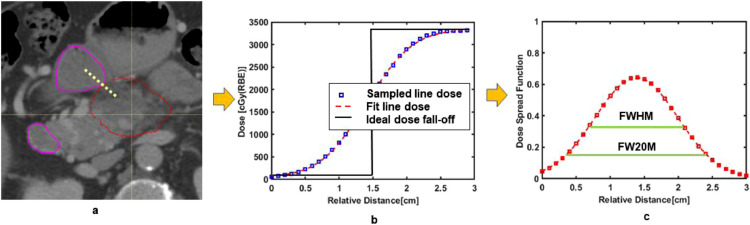
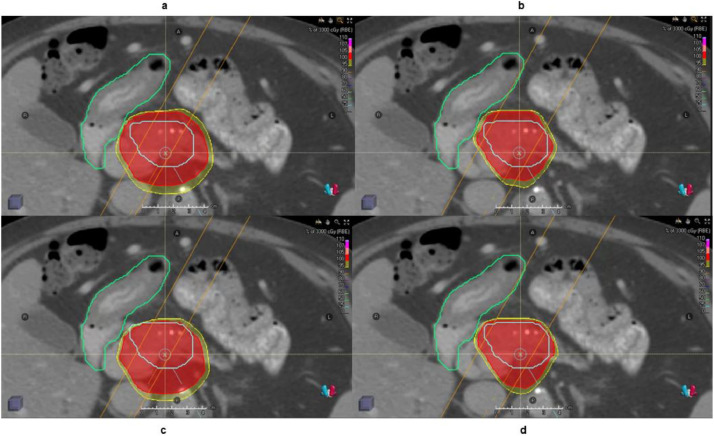
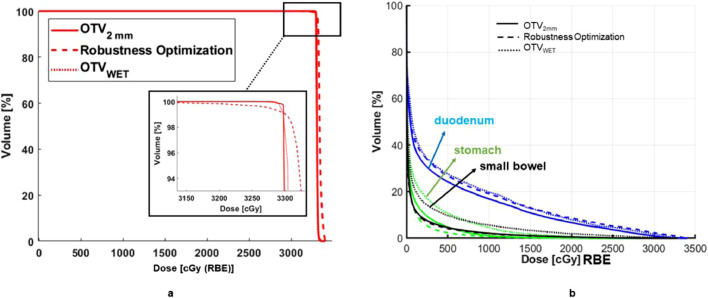
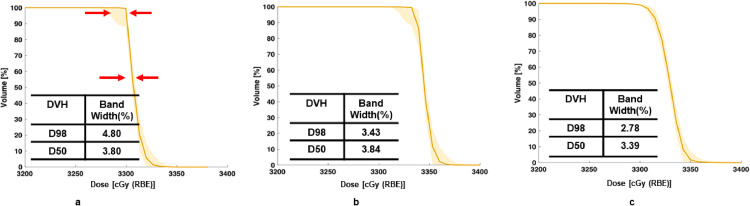
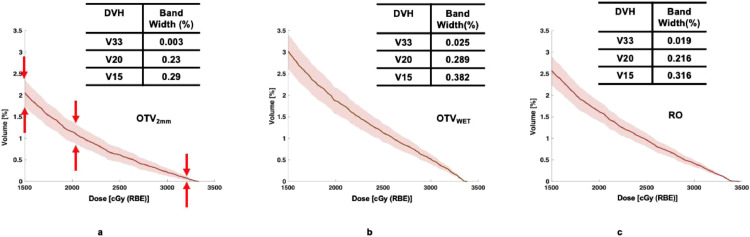
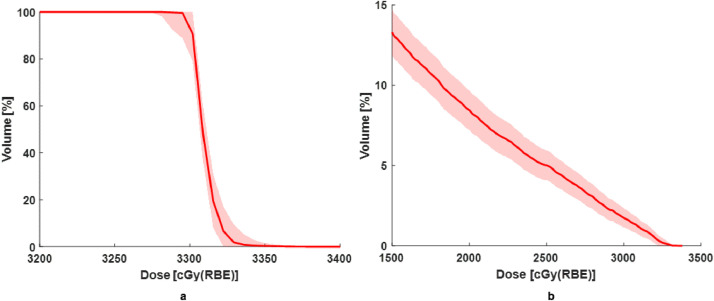
All 3 optimization schemes achieved decent target coverage with no significant difference. The OTV plans show superior organ at risk (OAR) sparing, especially for proximal duodenum. However, OTV plans demonstrate severe susceptibility to range and setup uncertainties with a passing rate of 19% of the plans meeting the goal of 95% volume covered by the prescribed dose. The proposed dose spread function analysis shows no significant difference.
The use of OTV mimics a union volume for all scenarios in robust optimization but saves optimization time noticeably. The beam-specific margin can be attractive to online adaptive stereotactic body proton therapy owing to the efficiency of the plan optimization.
我们研究了两种基于边缘的优化靶区体积(OTV)方案,即各向同性扩展(2毫米)和射束特定OTV,以考虑胰腺立体定向笔形束扫描(PBS)质子治疗中由于摆位误差和射程不确定性引起的不确定性。此外,由于2毫米是边缘的极端尺寸之一,我们还研究了2毫米均匀扩展的计划质量是否能与其他计划方案相媲美。
我们开发了两种OTV方案:(1)为摆位不确定性进行2毫米的均匀扩展(OTV),以及(2)在射束方向上基于水等效厚度的射束特定扩展(OTV),并在横向扩展2毫米。对6例LAPC患者进行计划,处方剂量为33 Gy(RBE),分5次给予。以肿瘤总体积的稳健优化(RO)计划为基准,摆位不确定性为2毫米,射程不确定性为3.5%。
所有3种优化方案均实现了良好的靶区覆盖,无显著差异。OTV计划在危及器官(OAR)保护方面表现更优,尤其是对于近端十二指肠。然而,OTV计划对射程和摆位不确定性表现出严重的敏感性,只有19%的计划达到了处方剂量覆盖95%体积的目标。所提出的剂量分布函数分析显示无显著差异。
在稳健优化中,使用OTV模拟了所有情况下的联合体积,但显著节省了优化时间。由于计划优化的效率,射束特定边缘对于在线自适应立体定向体部质子治疗可能具有吸引力。