Shtepliuk Ivan, Yakimova Rositsa
Department of Physics, Chemistry and Biology-IFM, Linköpings Universitet, 58183 Linköping, Sweden.
ACS Omega. 2021 Sep 15;6(38):24739-24751. doi: 10.1021/acsomega.1c03577. eCollection 2021 Sep 28.
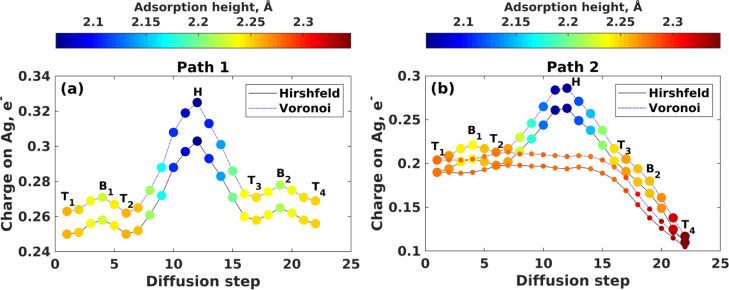
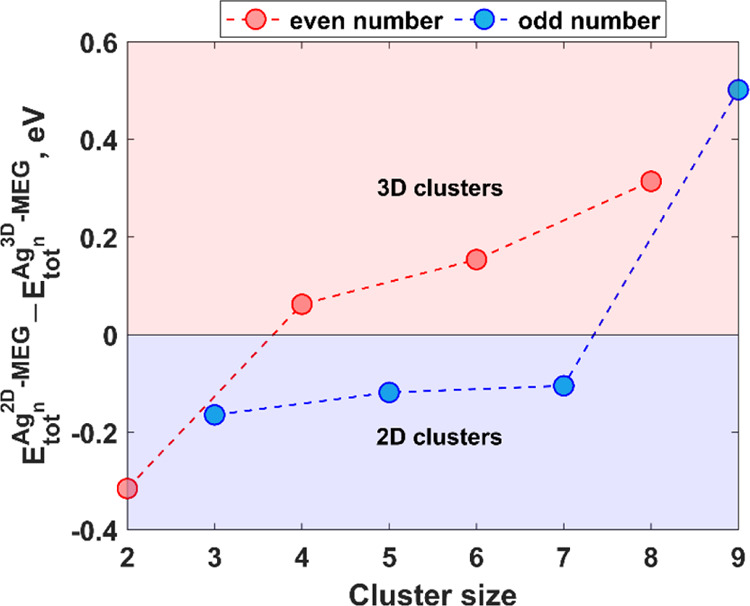
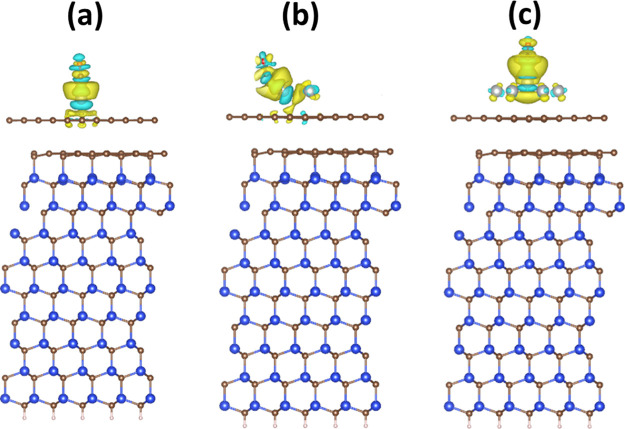
Early stages of silver nucleation on a two-dimensional (2D) substrate, here, monolayer epitaxial graphene (MEG) on SiC, play a critical role in the formation of application-specific Ag nanostructures. Therefore, it is of both fundamental and practical importance to investigate the growth steps when Ag adatoms start to form a new phase. In this work, we exploit density functional theory to study the kinetics of early-stage nuclei Ag ( = 1-9) assembly of Ag nanoparticles on MEG. We find that the Ag monomer tends to occupy hollow site positions of MEG and interacts with the surface mainly through weak dispersion forces. The pseudoepitaxial growth regime is revealed to dominate the formation of the planar silver clusters. The adsorption and nucleation energies of Ag clusters exhibit evident odd-even oscillations with cluster size, pointing out the preferable adsorption and nucleation of odd-numbered clusters on MEG. The character of the interaction between a chemisorbed Ag cluster and MEG makes it possible to consider this trimer as the most stable nucleus for the subsequent growth of Ag nanoparticles. We reveal the general correlation between Ag/MEG interaction and Ag-Ag interaction: with increasing cluster size, the interaction between Ag adatoms increases, while the Ag/MEG interaction decreases. The general trend is also supported by the results of charge population analysis, according to which the average charge per Ag adatom in a Ag cluster demonstrates a drastic decrement with cluster size increase. 2D-3D structural transition in Ag clusters was investigated. We anticipate that the present investigation is beneficial by providing a better understanding of the early-stage nucleation of Ag nanoparticles on MEG at the atomic scale. Specific interaction between odd-numbered Ag clusters preadsorbed onto the MEG surface and carbon monoxide (CO) as well as clusters' stability at 300 K is discussed in terms of sensing applications.
二维(2D)衬底上银成核的早期阶段,在这里是碳化硅上的单层外延石墨烯(MEG),在特定应用的银纳米结构形成中起着关键作用。因此,研究银原子开始形成新相时的生长步骤具有重要的基础意义和实际意义。在这项工作中,我们利用密度泛函理论研究了MEG上银纳米颗粒早期核Agₙ(n = 1 - 9)组装的动力学。我们发现银单体倾向于占据MEG的中空位点位置,并主要通过弱色散力与表面相互作用。揭示了准外延生长机制主导平面银簇的形成。Agₙ簇的吸附能和成核能随簇尺寸呈现明显的奇偶振荡,表明奇数簇在MEG上更易于吸附和成核。化学吸附的银簇与MEG之间相互作用的特性使得可以将这种三聚体视为银纳米颗粒后续生长中最稳定的核。我们揭示了Ag/MEG相互作用与Ag - Ag相互作用之间的一般相关性:随着簇尺寸的增加,银原子之间的相互作用增加,而Ag/MEG相互作用减小。电荷布居分析结果也支持了这一总体趋势,据此,Agₙ簇中每个银原子的平均电荷随簇尺寸增加而急剧减少。研究了Agₙ簇中的二维 - 三维结构转变。我们预计,本研究通过在原子尺度上更好地理解MEG上银纳米颗粒的早期成核将是有益的。从传感应用的角度讨论了预吸附在MEG表面的奇数银簇与一氧化碳(CO)之间的特定相互作用以及簇在300 K时的稳定性。