Bliem Roland, Kosak Rukan, Perneczky Lukas, Novotny Zbynek, Gamba Oscar, Fobes David, Mao Zhiqiang, Schmid Michael, Blaha Peter, Diebold Ulrike, Parkinson Gareth S
Institute of Applied Physics, Vienna University of Technology , Vienna, Austria.
ACS Nano. 2014 Jul 22;8(7):7531-7. doi: 10.1021/nn502895s. Epub 2014 Jun 24.
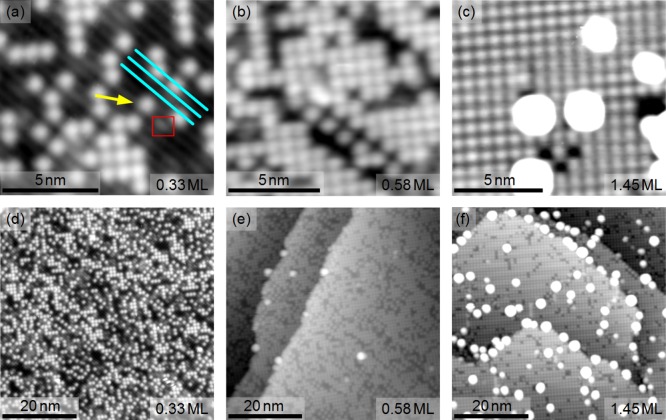
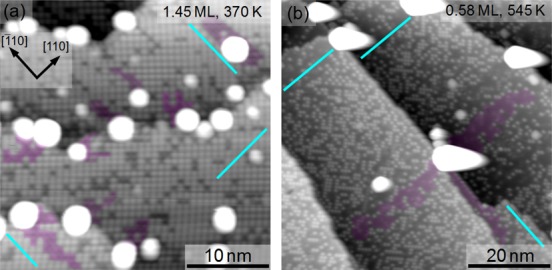
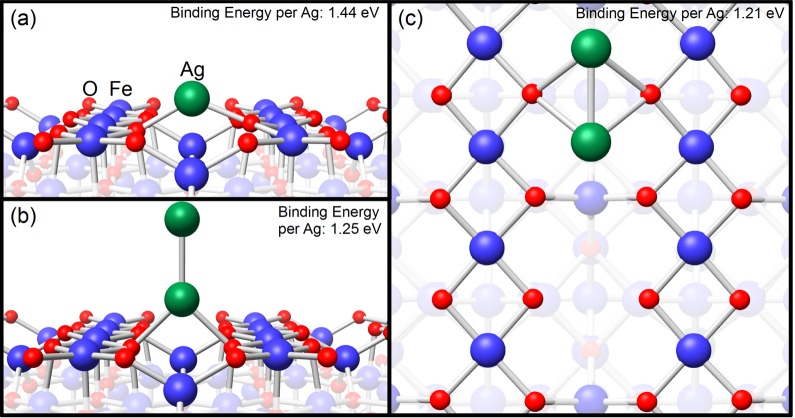
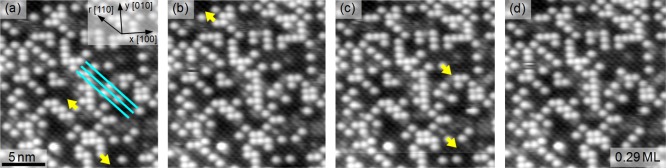
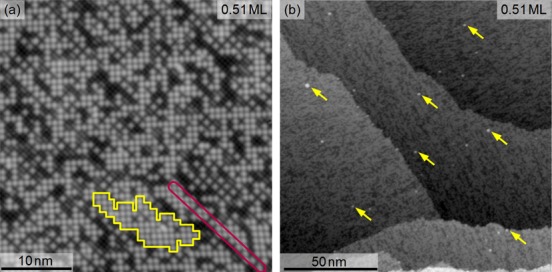
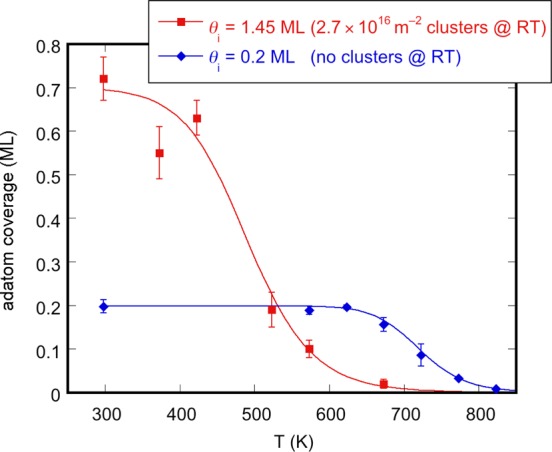
The atomic-scale mechanisms underlying the growth of Ag on the (√2×√2)R45°-Fe3O4(001) surface were studied using scanning tunneling microscopy and density functional theory based calculations. For coverages up to 0.5 ML, Ag adatoms populate the surface exclusively; agglomeration into nanoparticles occurs only with the lifting of the reconstruction at 720 K. Above 0.5 ML, Ag clusters nucleate spontaneously and grow at the expense of the surrounding material with mild annealing. This unusual behavior results from a kinetic barrier associated with the (√2×√2)R45° reconstruction, which prevents adatoms from transitioning to the thermodynamically favorable 3D phase. The barrier is identified as the large separation between stable adsorption sites, which prevents homogeneous cluster nucleation and the instability of the Ag dimer against decay to two adatoms. Since the system is dominated by kinetics as long as the (√2×√2)R45° reconstruction exists, the growth is not well described by the traditional growth modes. It can be understood, however, as the result of supersaturation within an adsorption template system.
利用扫描隧道显微镜和基于密度泛函理论的计算方法,研究了Ag在(√2×√2)R45°-Fe3O4(001)表面生长的原子尺度机制。对于覆盖率高达0.5 ML的情况,Ag吸附原子仅占据表面;只有在720 K下重构解除时,才会聚集成纳米颗粒。覆盖率高于0.5 ML时,Ag团簇自发形核,并在温和退火条件下以周围材料为代价生长。这种不寻常的行为源于与(√2×√2)R45°重构相关的动力学势垒,该势垒阻止吸附原子转变为热力学上更有利的三维相。该势垒被确定为稳定吸附位点之间的大间距,这阻止了均匀团簇形核以及Ag二聚体分解为两个吸附原子的不稳定性。由于只要(√2×√2)R45°重构存在,系统就由动力学主导,因此传统的生长模式无法很好地描述这种生长。然而,它可以被理解为吸附模板系统内过饱和的结果。