Division of Biology and Biological Engineering, California Institute of Technology, Pasadena 91125, CA
The Electronics-Inspired Interdisciplinary Research Institute (EIIRIS), Toyohashi University of Technology, Toyohashi 441-8580, Japan.
eNeuro. 2021 Oct 12;8(5). doi: 10.1523/ENEURO.0133-21.2021. Print 2021 Sep-Oct.
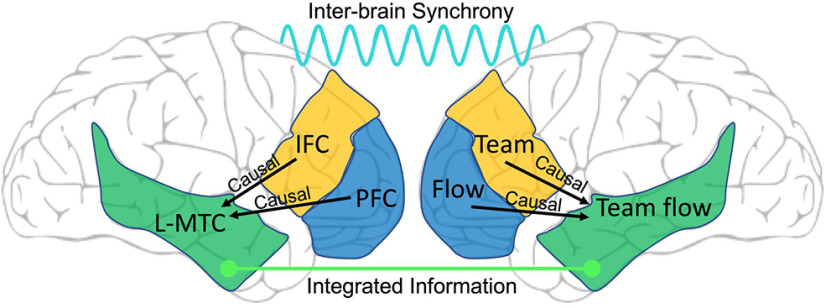
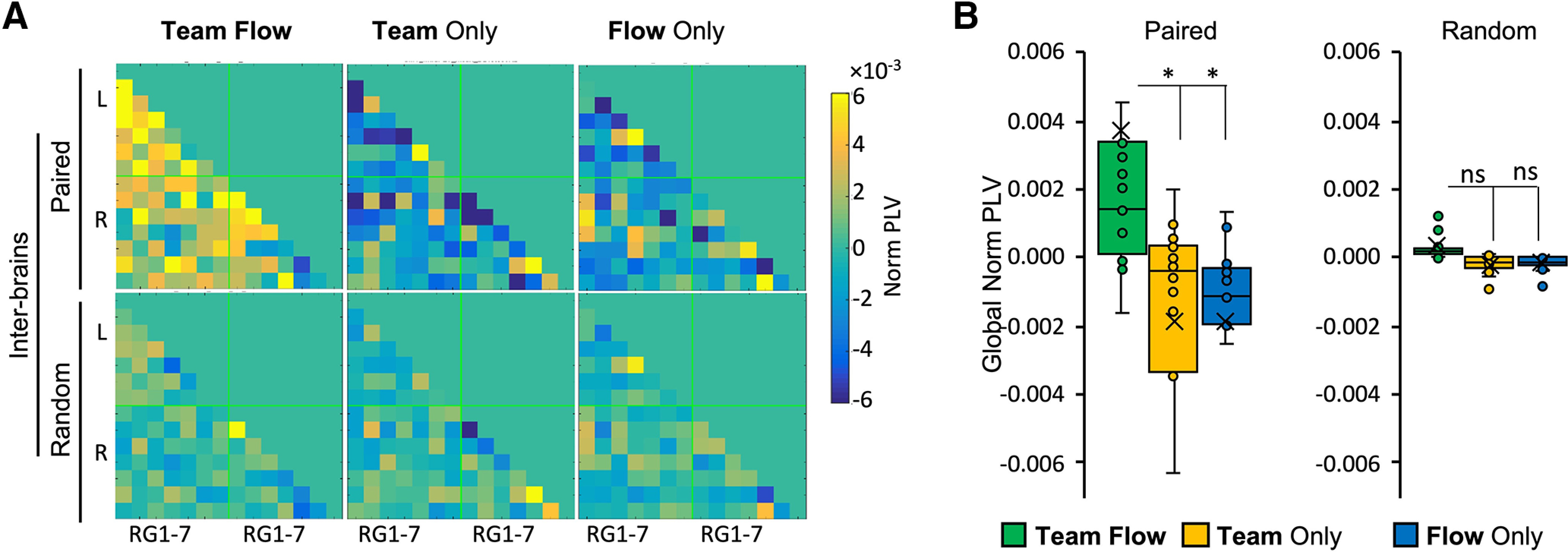
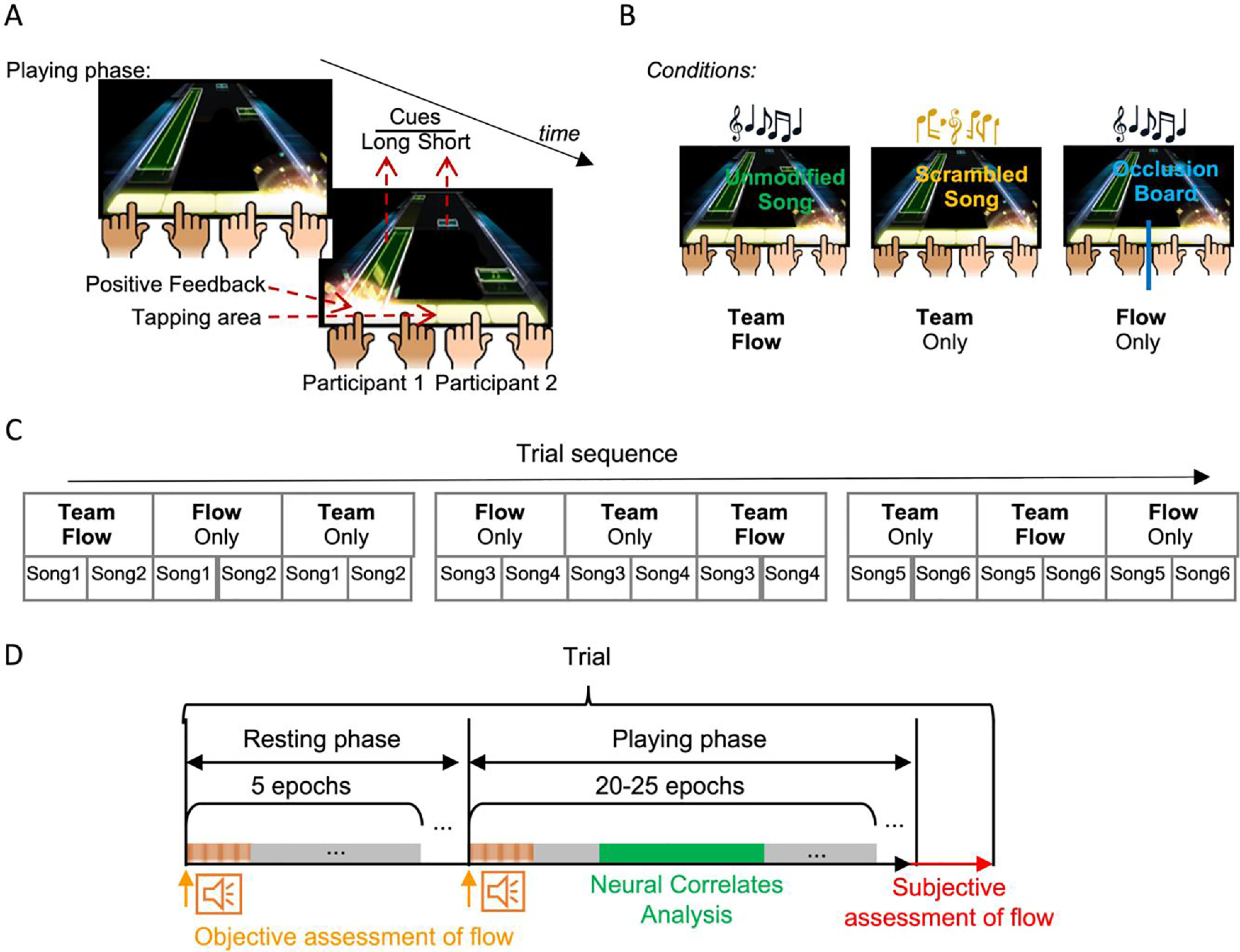
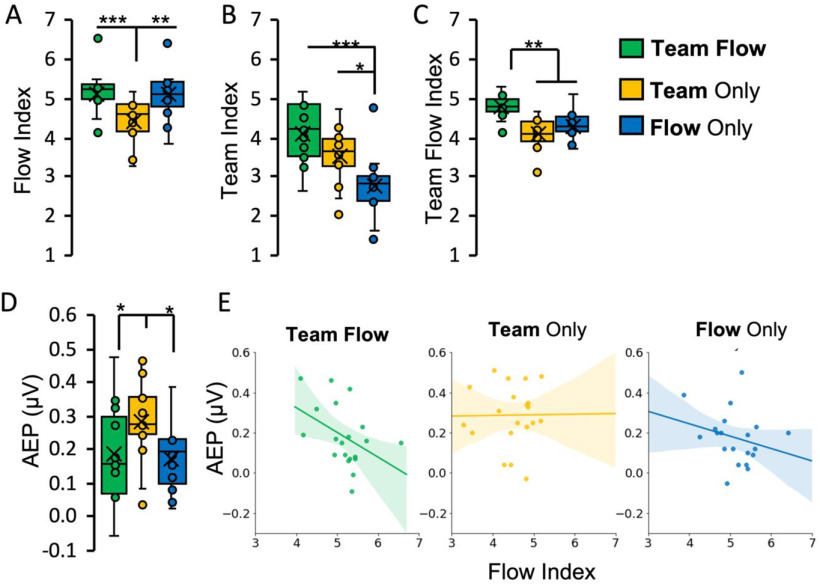
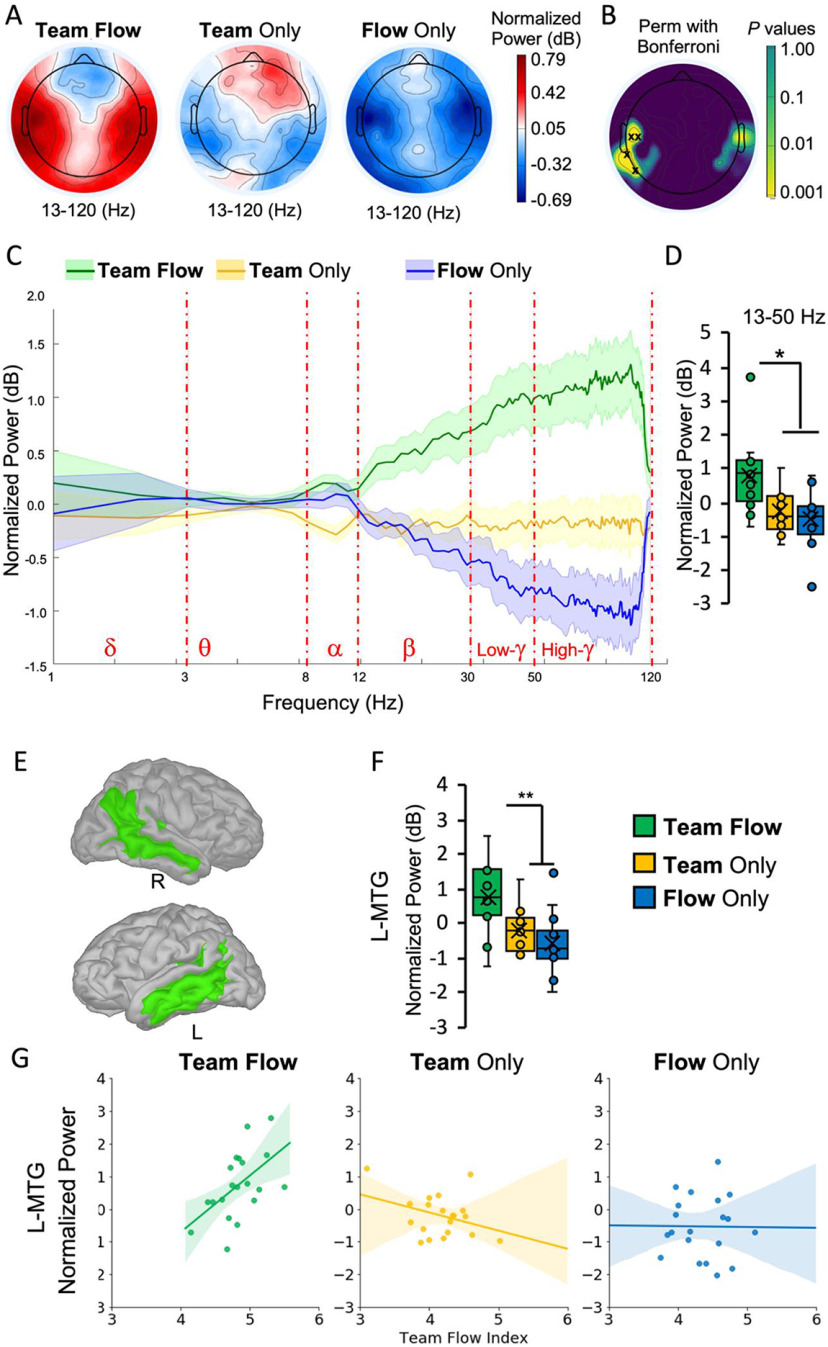
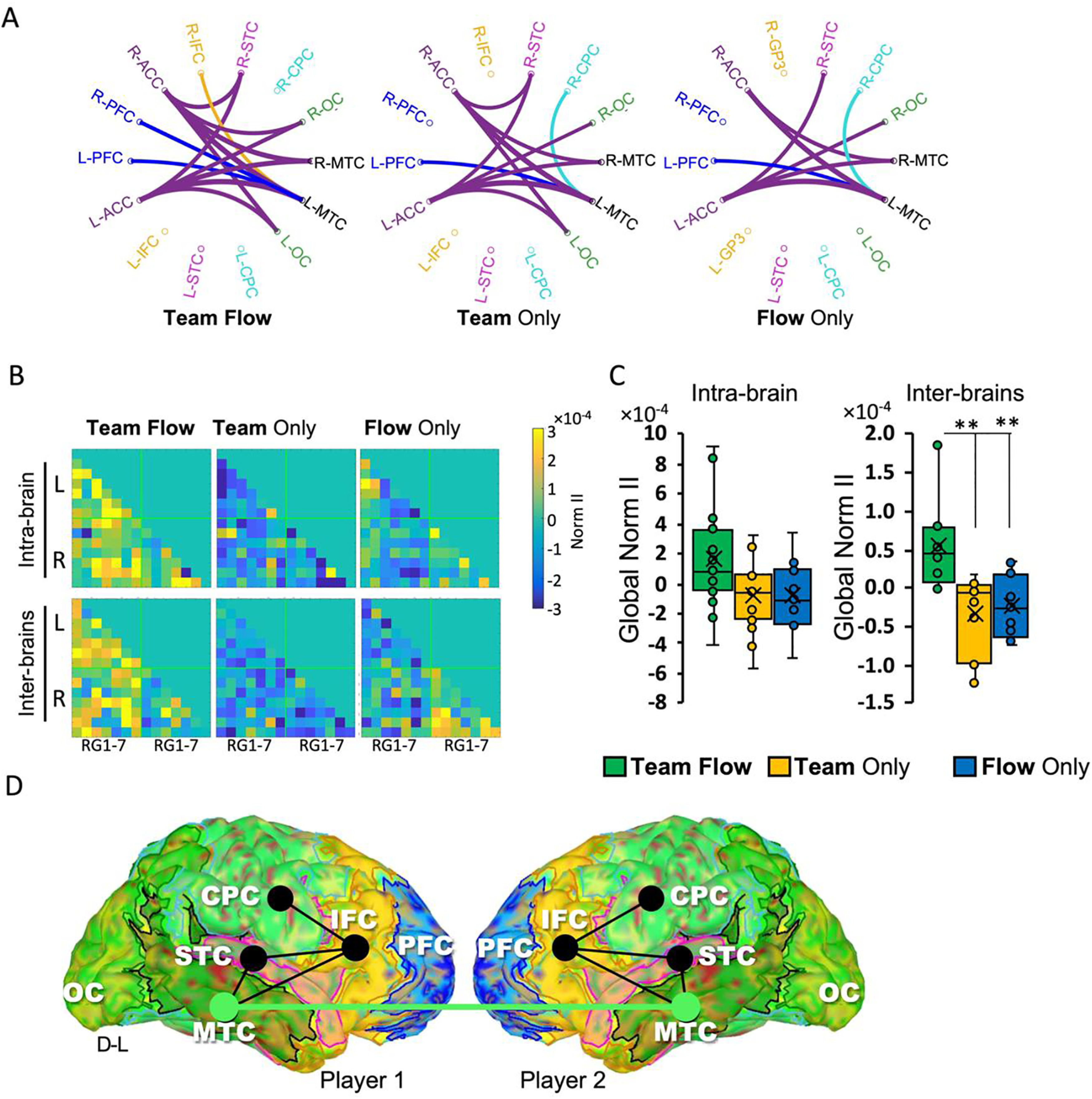
Team flow occurs when a group functions in a high task engagement to achieve a goal, commonly seen in performance and sports. Team flow can enable enhanced positive experiences, as compared with individual flow or regular socializing. However, the neural basis for this enhanced behavioral state remains unclear. Here, we identified neural correlates (NCs) of team flow in human participants using a music rhythm task with electroencephalogram hyperscanning. Experimental manipulations held the motor task constant while disrupting the corresponding hedonic music to interfere with the flow state or occluding the partner's positive feedback to impede team interaction. We validated these manipulations by using psychometric ratings and an objective measure for the depth of flow experience, which uses the auditory-evoked potential (AEP) of a task-irrelevant stimulus. Spectral power analysis at both the scalp sensors and anatomic source levels revealed higher β-γ power specific to team flow in the left middle temporal cortex (L-MTC). Causal interaction analysis revealed that the L-MTC is downstream in information processing and receives information from areas encoding the flow or social states. The L-MTC significantly contributes to integrating information. Moreover, we found that team flow enhances global interbrain integrated information (II) and neural synchrony. We conclude that the NCs of team flow induce a distinct brain state. Our results suggest a neurocognitive mechanism to create this unique experience.
团队流畅是指一个团队在高任务投入下运作以实现目标,这种现象在表现和运动中很常见。与个体流畅或常规社交相比,团队流畅可以带来增强的积极体验。然而,这种增强的行为状态的神经基础仍不清楚。在这里,我们使用脑电图超扫描的音乐节奏任务,确定了人类参与者的团队流畅的神经相关物(NC)。实验操作保持运动任务不变,同时扰乱相应的愉悦音乐以干扰流畅状态,或阻断伙伴的积极反馈以阻碍团队互动。我们使用心理测量评分和用于衡量流畅体验深度的客观测量(使用与任务无关的刺激的听觉诱发电位(AEP))验证了这些操作。头皮传感器和解剖源水平的频谱功率分析显示,左中颞皮质(L-MTC)的团队流畅具有更高的β-γ功率。因果相互作用分析表明,L-MTC 在信息处理中处于下游,接收编码流畅或社交状态的区域的信息。L-MTC 显著有助于整合信息。此外,我们发现团队流畅会增强全局脑间综合信息(II)和神经同步性。我们得出结论,团队流畅的神经相关物会引起独特的大脑状态。我们的结果表明了一种神经认知机制来创造这种独特的体验。