Instituto Oncoclínicas, São Paulo, Brazil.
MSD Brazil, São Paulo, Brazil.
JCO Glob Oncol. 2021 Sep;7:1454-1461. doi: 10.1200/GO.21.00228.
Non-small-cell lung cancer (NSCLC) is the most common type of lung cancer and accounts for 80%-90% of the cases. In Brazil, between 2018 and 2019, lung cancer was ranked as the second most frequent cancer among men and the fourth among women. The primary objectives were to describe the journey and survival rates of patients with advanced NSCLC treated in the Brazilian private health care system (HCS).
A retrospective cohort study was based on the search in administrative databases to analyze the Brazilian private HCS. Patients with advanced NSCLC diagnosed between 2011 and 2016 were included. The data on demographics, cancer-related information, treatment-related information, and resources used were collected. Survival analyses were performed using the semiparametric Kaplan-Meier method to assess mortality by NSCLC stage, with NSCLC diagnosis as the index date.
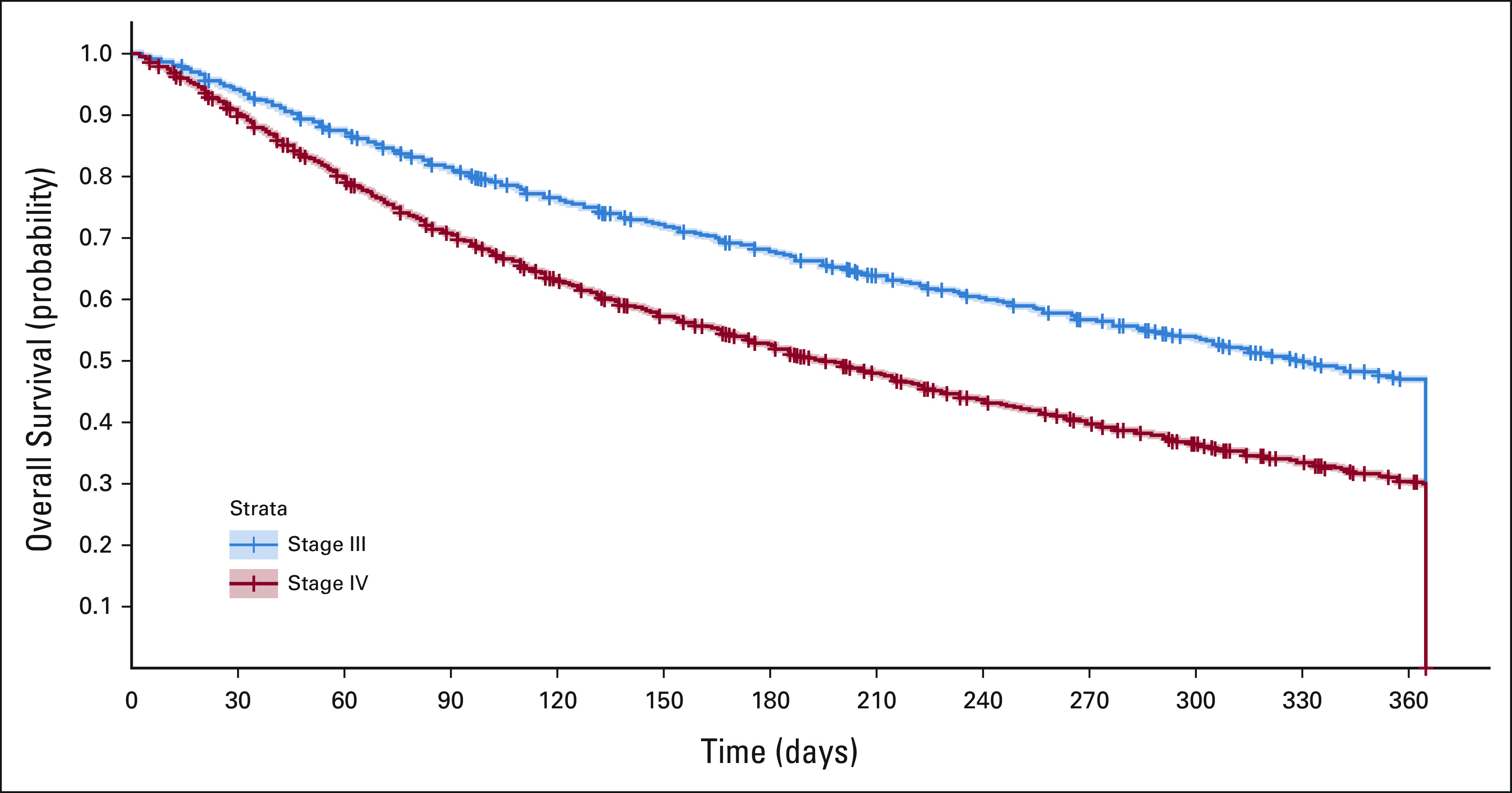
A total of 5,016 patients were included. Most patients were between 60 and 69 years old (33.6%) and had completed elementary school (52.2%). There was a greater proportion of men (58.1% 41.9%), and the majority of patients had stage IV NSCLC (67%). It took an average of 31 days, from the first consultation, to have diagnosis. In 44% of the cases, a clinical oncologist was the first specialist in the HCS that the patient was referred to. After the diagnosis, the median time to start of treatment was 35 days. Chemotherapy alone was the most common treatment regimen (32%). The median overall survival was 11.5 months and 6 months for stage II and IV NSCLC, respectively.
This study provides contemporary data on stage III and IV NSCLC in private health care in Brazil, which has shown a high rate of metastatic disease diagnoses, high health care-related costs, and low survival rates.
非小细胞肺癌(NSCLC)是最常见的肺癌类型,占病例的 80%-90%。在巴西,2018 年至 2019 年间,肺癌在男性中排名第二,在女性中排名第四。主要目的是描述在巴西私立医疗保健系统(HCS)中治疗的晚期 NSCLC 患者的治疗过程和生存率。
这是一项基于对行政数据库进行搜索的回顾性队列研究,旨在分析巴西私立 HCS。纳入 2011 年至 2016 年间诊断为晚期 NSCLC 的患者。收集人口统计学、癌症相关信息、治疗相关信息和使用资源的数据。使用半参数 Kaplan-Meier 方法进行生存分析,根据 NSCLC 分期评估 NSCLC 诊断为指数日期的死亡率。
共纳入 5016 例患者。大多数患者年龄在 60-69 岁之间(33.6%),完成了小学教育(52.2%)。男性比例较高(58.1% 41.9%),大多数患者为 IV 期 NSCLC(67%)。从第一次就诊到确诊平均需要 31 天。在 44%的病例中,临床肿瘤学家是患者首先在 HCS 中就诊的专科医生。诊断后,开始治疗的中位时间为 35 天。单独化疗是最常见的治疗方案(32%)。总生存期中位数为 11.5 个月,II 期和 IV 期 NSCLC 分别为 6 个月。
本研究提供了巴西私立医疗保健中 III 期和 IV 期 NSCLC 的当代数据,表明转移性疾病诊断率高、医疗保健相关费用高、生存率低。