Van de Velde S, Buffel V, van der Heijde C, Çoksan S, Bracke P, Abel T, Busse H, Zeeb H, Rabiee-Khan F, Stathopoulou T, Van Hal G, Ladner J, Tavolacci M, Tholen R, Wouters E
Centre for Population, Family and Health, Department of Sociology, University of Antwerp, Sint-Jacobsstraat 2-4, 2000, Antwerpen, Belgium.
Student Health Services, University of Amsterdam, the Netherlands.
SSM Popul Health. 2021 Dec;16:100936. doi: 10.1016/j.ssmph.2021.100936. Epub 2021 Oct 1.
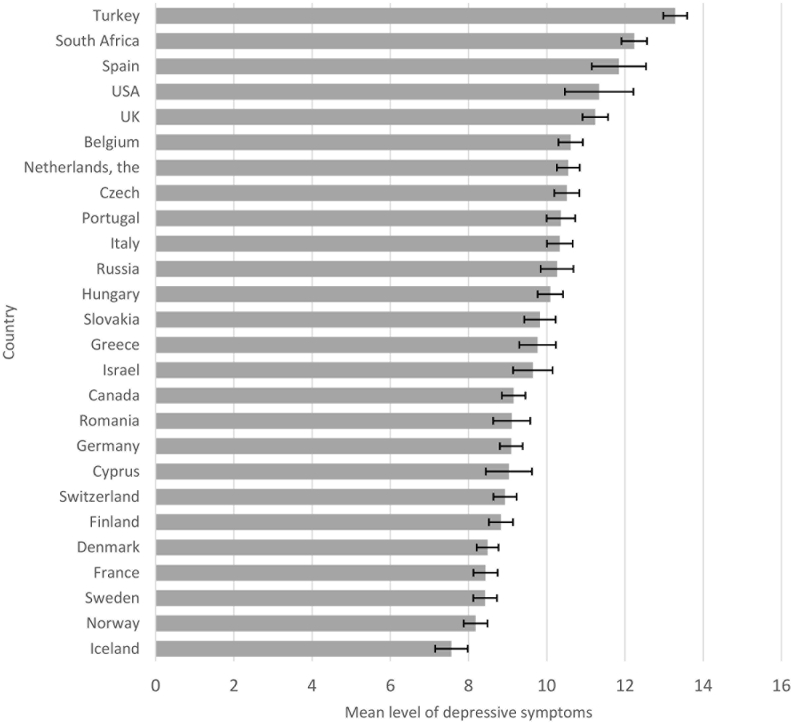
Higher-education students face substantial risks for developing depressive symptoms during the COVID-19 pandemic or experiencing exacerbated pre-existing depressive symptoms. This study uses data from the COVID-19 International Student Well-Being Study, which collected data through a non-representative convenience sample in 125 higher-education institutions (HEI) across 26 high- and middle-income countries (N: 20,103) during the first wave of the COVID-19 pandemic. It describes the prevalence of depressive symptoms in higher-education students. We find substantial cross-national variation in depressive symptoms, with lowest mean levels established in the Nordic countries and France, while highest mean levels of depressive symptoms were found in Turkey, South Africa, Spain and the USA. Elevated risk for depressive symptoms was found in female students, students with fewer social support resources and in a more disadvantaged socioeconomic position, and students with a migrant background. COVID-19 related stressors, such as reduced social contact, increased financial insecurity, and academic stress explained a relatively larger proportion of the variance in depressive symptoms compared to non-COVID-19 related stressors. This finding shows that not the pandemic itself, but rather the secondary effects of the pandemic relate to students' mental health. Our results enable HEIs to be better equipped to target groups that are particularly at risk during a pandemic.
在新冠疫情期间,高等教育学生面临出现抑郁症状或使原有抑郁症状加重的重大风险。本研究使用了新冠疫情国际学生福祉研究的数据,该研究在新冠疫情第一波期间,通过非代表性便利样本,收集了26个高收入和中等收入国家125所高等教育机构(N:20,103)的数据。它描述了高等教育学生中抑郁症状的患病率。我们发现抑郁症状存在显著的跨国差异,北欧国家和法国的平均水平最低,而土耳其、南非、西班牙和美国的抑郁症状平均水平最高。在女学生、社会支持资源较少且社会经济地位较不利的学生以及有移民背景的学生中,出现抑郁症状的风险较高。与非新冠相关压力源相比,与新冠疫情相关的压力源,如社交接触减少、经济不安全感增加和学业压力,在抑郁症状差异中所占比例相对更大。这一发现表明,与学生心理健康相关的并非疫情本身,而是疫情的次生影响。我们得出的结果能让高等教育机构在疫情期间更好地针对特别有风险的群体。