School of Computer Science and Statistics, Trinity College Dublin, Dublin, Ireland.
Department of Psychological Science, University of California, Irvine, Irvine, CA, United States.
JMIR Mhealth Uhealth. 2021 Oct 6;9(10):e26712. doi: 10.2196/26712.
A range of mobile apps for anxiety have been developed in response to the high prevalence of anxiety disorders. Although the number of publicly available apps for anxiety is increasing, attrition rates among mobile apps are high. These apps must be engaging and relevant to end users to be effective; thus, engagement features and the ability to tailor delivery to the needs of individual users are key. However, our understanding of the functionality of these apps concerning engagement and tailoring features is limited.
The aim of this study is to review how cognitive behavioral elements are delivered by anxiety apps and their functionalities to support user engagement and tailoring based on user needs.
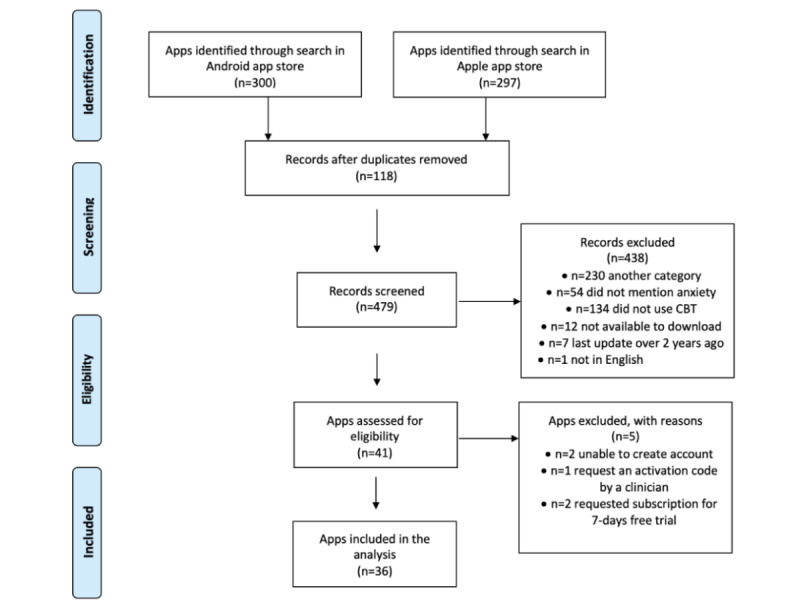
A systematic search for anxiety apps described as being based on cognitive behavioral therapy (CBT) was conducted on Android and iPhone marketplaces. Apps were included if they mentioned the use of CBT for anxiety-related disorders. We identified 597 apps, of which 36 met the inclusion criteria and were reviewed through direct use.
Cognitive behavioral apps for anxiety incorporate a variety of functionalities, offer several engagement features, and integrate low-intensity CBT exercises. However, the provision of features to support engagement is highly uneven, and support is provided only for low-intensity CBT treatment. Cognitive behavioral elements combine various modalities to deliver intervention content and support the interactive delivery of these elements. Options for personalization are limited and restricted to goal selection upon beginning use or based on self-monitoring entries. Apps do not appear to provide individualized content to users based on their input.
Engagement and tailoring features can be significantly expanded in existing apps, which make limited use of social features and clinical support and do not use sophisticated features such as personalization based on sensor data. To guide the evolution of these interventions, further research is needed to explore the effectiveness of different types of engagement features and approaches to tailoring therapeutic content.
为了应对焦虑障碍的高患病率,开发了一系列用于焦虑的移动应用程序。尽管可用于焦虑的公开应用程序数量在增加,但移动应用程序的淘汰率很高。这些应用程序必须对最终用户具有吸引力并且与他们相关,才能发挥作用;因此,参与功能和根据用户需求定制交付的能力是关键。然而,我们对这些应用程序在参与和定制功能方面的功能的理解是有限的。
本研究旨在回顾焦虑应用程序如何提供认知行为元素及其功能,以根据用户需求支持用户参与和定制。
在 Android 和 iPhone 市场上对被描述为基于认知行为疗法 (CBT) 的焦虑应用程序进行了系统搜索。如果应用程序提到使用 CBT 治疗与焦虑相关的疾病,则将其包括在内。我们确定了 597 个应用程序,其中 36 个符合纳入标准并通过直接使用进行了审查。
用于焦虑的认知行为应用程序结合了多种功能,提供了多种参与功能,并整合了低强度的 CBT 练习。然而,支持参与的功能提供非常不均衡,仅支持低强度的 CBT 治疗。认知行为元素结合了各种模式来提供干预内容,并支持这些元素的交互交付。个性化选项有限,仅限于开始使用时选择目标或基于自我监测条目。应用程序似乎不会根据用户的输入向用户提供个性化内容。
现有的应用程序可以显著扩展参与和定制功能,这些应用程序对社交功能和临床支持的使用有限,并且不使用基于传感器数据的个性化等复杂功能。为了指导这些干预措施的发展,需要进一步研究来探索不同类型的参与功能和定制治疗内容的方法的有效性。