Ophthalmic Clinic, Department of Medicine and Science of Ageing, University "G. d'Annunzio" of Chieti-Pescara, Via dei Vestini, 31, 66100, Chieti, Italy.
IRCCS Centro Neurolesi "Bonino-Pulejo", 98124, Messina, Italy.
Sci Rep. 2021 Oct 6;11(1):19817. doi: 10.1038/s41598-021-99344-3.
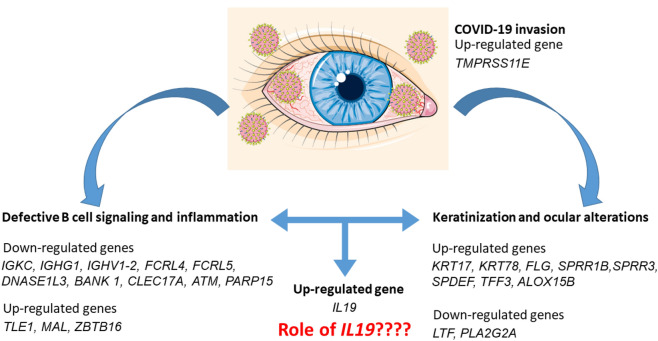
Recent studies have focused their attention on conjunctivitis as one of the symptoms of coronavirus disease 2019 (COVID-19). Therefore, tear samples were taken from COVID-19 patients and the presence of SARS-CoV-2 was evidenced using Real Time reverse transcription polymerase chain reaction. The main aim of this study was to analyze mRNA expression in the tears of patients with COVID-19 compared with healthy subjects using Next Generation Sequencing (NGS). The functional evaluation of the transcriptome highlighted 25 genes that differ statistically between healthy individuals and patients affected by COVID-19. In particular, the NGS analysis identified the presence of several genes involved in B cell signaling and keratinization. In particular, the genes involved in B cell signaling were downregulated in the tears of COVID-19 patients, while those involved in keratinization were upregulated. The results indicated that SARS-CoV-2 may induce a process of ocular keratinization and a defective B cell response.
最近的研究将注意力集中在结膜炎上,将其作为 2019 年冠状病毒病(COVID-19)的症状之一。因此,从 COVID-19 患者中采集泪液样本,并使用实时逆转录聚合酶链反应(RT-PCR)检测 SARS-CoV-2 的存在。本研究的主要目的是使用下一代测序(NGS)分析 COVID-19 患者泪液中的 mRNA 表达,并与健康受试者进行比较。对转录组的功能评估突出显示了 25 个在健康个体和 COVID-19 患者之间存在统计学差异的基因。特别是,NGS 分析鉴定出存在几种参与 B 细胞信号转导和角化的基因。特别是,COVID-19 患者泪液中参与 B 细胞信号转导的基因下调,而参与角化的基因上调。结果表明,SARS-CoV-2 可能引起眼表角化和 B 细胞反应缺陷的过程。