Faculty of Environment and Natural Resources, University of Freiburg, Tennenbacher Straße 4, 79106, Freiburg, Germany.
Faculty of Forestry and Wood Sciences, Czech University of Life Sciences Prague, Kamýcká 1176, 16521, Prague 6, Czech Republic.
Sci Rep. 2021 Oct 6;11(1):19868. doi: 10.1038/s41598-021-99337-2.
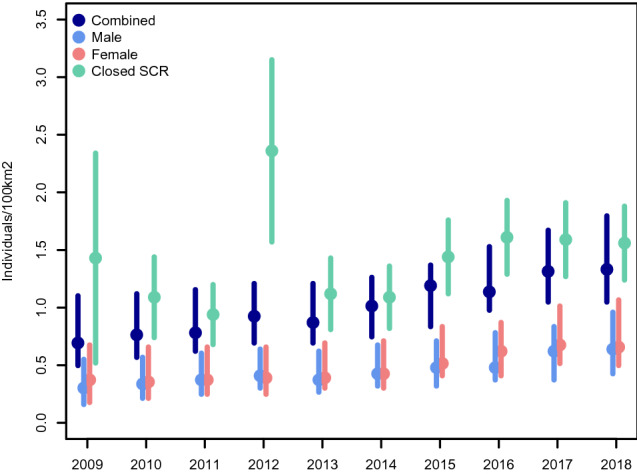
Large carnivores promote crucial ecosystem processes but are increasingly threatened by human persecution and habitat destruction. Successful conservation of this guild requires information on long-term population dynamics obtained through demographic surveys. We used camera traps to monitor Eurasian lynx between 2009 and 2018 in a strictly protected area in the Bohemian Forest Ecosystem, located in the core of the distribution of the Bohemian-Bavarian-Austrian lynx population. Thereby, we estimated sex-specific demographic parameters using spatial capture-recapture (SCR) models. Over 48,677 trap nights, we detected 65 unique lynx individuals. Density increased from 0.69 to 1.33 and from 1.09 to 2.35 individuals/100 km for open and closed population SCR models, respectively, with corresponding positive population growth rates (mean = 1.06). Estimated yearly sex-specific survival probabilities for the entire monitoring period were high (females 82%, males 90%) and per capita recruitment rate was low (females 12%, males 9%), indicating a low yearly population turnover. We ascertained an average number of recruits of 1.97 and a generation time of 2.64 years when considering resident reproducing females. We confirmed that reproduction in the study area took place successfully every year. Despite the overall increase in local lynx densities, the number of detected family groups remained constant throughout the study period. These results indicated that the strictly protected study area acts as a source for the multi-use landscapes in its surroundings. In this first open population SCR study on lynx, we provide sex-specific demographic parameters that are fundamental information for lynx management in the study area as well as in similar contexts Europe-wide.
大型食肉动物促进了关键的生态系统过程,但它们越来越受到人类迫害和栖息地破坏的威胁。要成功保护这个群体,需要通过人口调查获得有关长期种群动态的信息。我们使用相机陷阱在波希米亚森林生态系统的一个严格保护区(位于波希米亚-巴伐利亚-奥地利猞猁种群分布的核心区)监测欧亚猞猁的种群动态,该保护区自 2009 年至 2018 年。我们使用空间捕获-再捕获(SCR)模型估计了性别特异性的人口统计参数。在 48677 个陷阱夜间,我们检测到了 65 只独特的猞猁个体。密度分别从开放式和封闭式种群 SCR 模型的 0.69 增加到 1.33 和 1.09 增加到 2.35 只/100km,相应的种群增长率为正(平均值为 1.06)。整个监测期的估计年性别特异性存活率很高(雌性 82%,雄性 90%),人均招募率很低(雌性 12%,雄性 9%),表明每年的人口更替率较低。当考虑到居住繁殖的雌性时,我们确定了平均 1.97 只的招募数量和 2.64 年的世代时间。我们证实,研究区域的繁殖每年都成功进行。尽管当地猞猁的密度总体上有所增加,但在整个研究期间,检测到的家族群体数量保持不变。这些结果表明,严格保护区作为其周围多用途景观的源头发挥了作用。在这项关于猞猁的首次开放式种群 SCR 研究中,我们提供了性别特异性的人口统计参数,这些参数是研究区域以及欧洲类似背景下猞猁管理的基本信息。