Barón-Mendoza Isabel, Maqueda-Martínez Emely, Martínez-Marcial Mónica, De la Fuente-Granada Marisol, Gómez-Chavarin Margarita, González-Arenas Aliesha
Departamento de Medicina Genómica y Toxicología Ambiental, Instituto de Investigaciones Biomédicas, Universidad Nacional Autónoma de México, Mexico City, Mexico.
Unidad de Modelos Biológicos, Instituto de Investigaciones Biomédicas, Universidad Nacional Autónoma de México, Mexico City, Mexico.
Front Cell Neurosci. 2021 Sep 20;15:726501. doi: 10.3389/fncel.2021.726501. eCollection 2021.
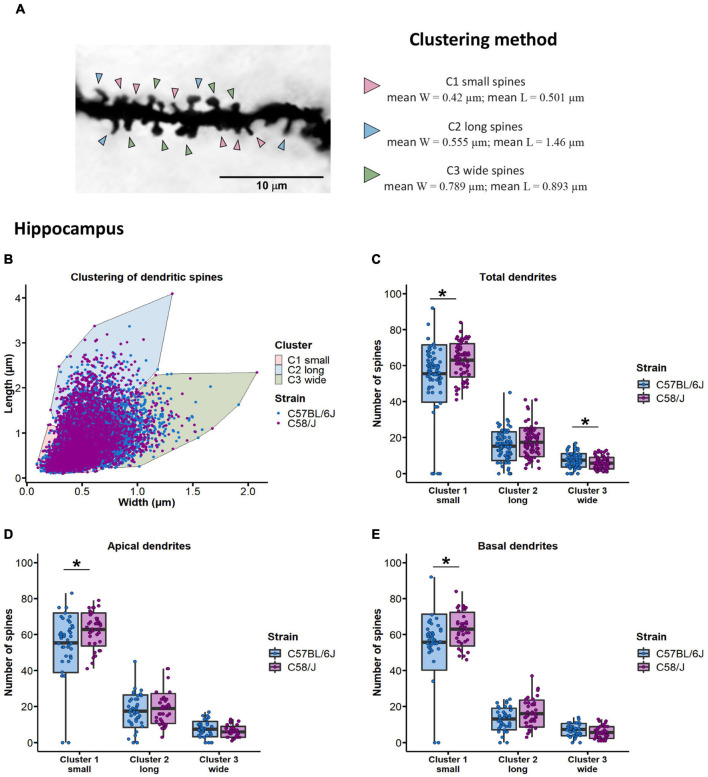
Autism spectrum disorder (ASD) has a broad range of neurobiological characteristics, including alterations in dendritic spines, where approximately 90% of excitatory synapses occur. Therefore, changes in their number or morphology would be related to atypical brain communication. The C58/J inbred mouse strain displays low sociability, impaired communication, and stereotyped behavior; hence, it is considered among the animal models suitable for the study of idiopathic autism. Thus, this study aimed to evaluate the dendritic spine differences in the hippocampus and the prefrontal cortex of C58/J mice. We found changes in the number of spines and morphology in a brain region-dependent manner: a subtle decrease in spine density in the prefrontal cortex, higher frequency of immature phenotype spines characterized by filopodia-like length or small morphology, and a lower number of mature phenotype spines with mushroom-like or wide heads in the hippocampus. Moreover, an analysis showed single nucleotide polymorphisms (SNPs) at genes collectively involved in regulating structural plasticity with a likely association with ASD, including MAP1A (Microtubule-Associated Protein 1A), GRM7 (Metabotropic Glutamate Receptor, 7), ANKRD11 (Ankyrin Repeat Domain 11), and SLC6A4 (Solute Carrier Family 6, member 4), which might support the relationship between the C58/J strain genome, an autistic-like behavior, and the observed anomalies in the dendritic spines.
自闭症谱系障碍(ASD)具有广泛的神经生物学特征,包括树突棘的改变,约90%的兴奋性突触发生于此。因此,它们数量或形态的变化可能与大脑的异常通讯有关。C58/J近交系小鼠表现出社交能力低下、通讯障碍和刻板行为;因此,它被认为是适合研究特发性自闭症的动物模型之一。因此,本研究旨在评估C58/J小鼠海马体和前额叶皮质中树突棘的差异。我们发现,树突棘的数量和形态变化具有脑区依赖性:前额叶皮质中棘密度略有下降,以丝状伪足样长度或小形态为特征的未成熟表型棘频率较高,海马体中具有蘑菇样或宽头的成熟表型棘数量较少。此外,一项分析显示,在共同参与调节结构可塑性且可能与ASD相关的基因上存在单核苷酸多态性(SNP),这些基因包括MAP1A(微管相关蛋白1A)、GRM7(代谢型谷氨酸受体7)、ANKRD11(锚蛋白重复结构域11)和SLC6A4(溶质载体家族6成员4),这可能支持C58/J品系基因组、自闭症样行为与观察到的树突棘异常之间的关系。