Wu Qi, Zhang Zhiyuan, Chen Yijiao, Chang Jiang, Jiang Yudong, Zhu Dexiang, Wei Ye
Department of General Surgery, Zhongshan Hospital, Fudan University, Shanghai, China.
Front Oncol. 2021 Sep 20;11:736678. doi: 10.3389/fonc.2021.736678. eCollection 2021.
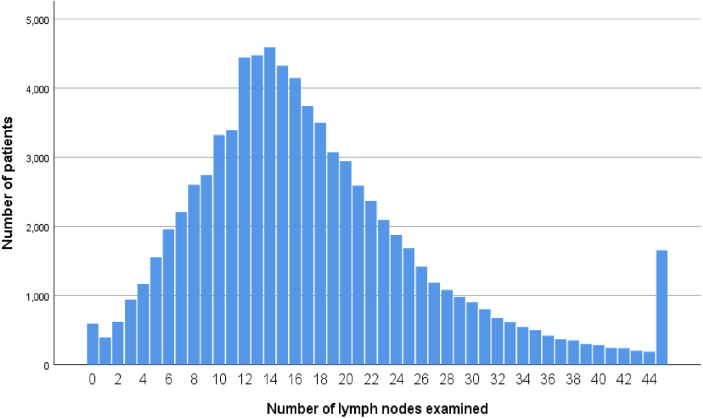
Inadequate number of lymph nodes examined was not uncommon. We aimed to assess the clinical role of inadequate number of lymph nodes examined in stage II colon cancer.
The cancer data used in our study were obtained from the SEER (Surveillance, Epidemiology and End Results) program. Using the chi-square test, all the variables obtained in our study were compared based on whether patients had enough (≥12) lymph nodes examined. Kaplan-Meier analysis was used for overall survival (OS) analysis, and log-rank test was applied to compare different N stages with the total number of lymph nodes examined. Multivariate analysis was carried out by creating a Cox proportional hazard model to assess the prognostic roles of different variables.
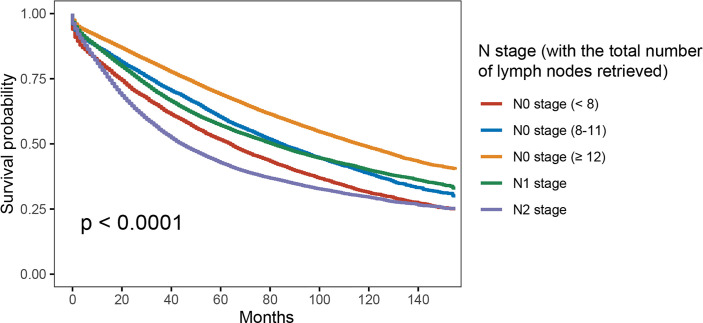
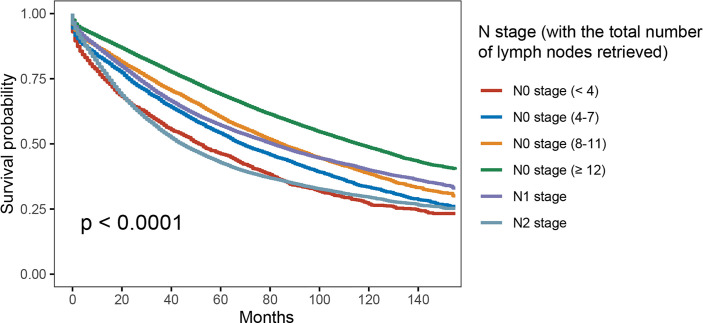
In total, 80,296 stage II/III colon cancer patients were recruited for our study. N0 stage with <8 lymph nodes examined would present with a worse prognosis compared to N1 stage (5-year OS rates, 51.6% vs. 57.1%, < 0.001). Multivariate analyses indicated that OS of N0 stage with <8 lymph nodes examined was similar to that of N1 stage after adjusting for other recognized prognostic factors [hazard ratios (HRs) = 1.051, 95% confidence intervals (CIs) = 1.014-1.090, = 0.018].
N0 stage with less than eight lymph nodes examined in stage II colon cancer presented with no better OS compared to that of N1 stage. Stage II colon cancer with less than eight lymph nodes examined needed to be given greater emphasis in clinical practice.
检查的淋巴结数量不足并不罕见。我们旨在评估检查的淋巴结数量不足在II期结肠癌中的临床作用。
我们研究中使用的癌症数据来自监测、流行病学和最终结果(SEER)计划。使用卡方检验,根据患者是否检查了足够数量(≥12个)的淋巴结,对我们研究中获得的所有变量进行比较。采用Kaplan-Meier分析进行总生存(OS)分析,并应用对数秩检验比较不同N分期与检查的淋巴结总数。通过创建Cox比例风险模型进行多变量分析,以评估不同变量的预后作用。
总共招募了80296例II/III期结肠癌患者进行我们的研究。检查的淋巴结<8个的N0期患者的预后比N1期更差(5年总生存率分别为51.6%和57.1%,<0.001)。多变量分析表明,在调整其他公认的预后因素后,检查的淋巴结<8个的N0期患者的总生存率与N1期相似[风险比(HRs)=1.051,95%置信区间(CIs)=1.014-1.090,=0.018]。
II期结肠癌中检查的淋巴结少于8个的N0期患者的总生存率并不优于N1期。临床实践中需要更重视检查的淋巴结少于8个的II期结肠癌。