Claridge Bethany, Lozano Jonathan, Poh Qi Hui, Greening David W
Department of Biochemistry and Genetics, La Trobe Institute for Molecular Science (LIMS), La Trobe University, Melbourne, VIC, Australia.
Baker Heart and Diabetes Institute, Melbourne, VIC, Australia.
Front Cell Dev Biol. 2021 Sep 20;9:734720. doi: 10.3389/fcell.2021.734720. eCollection 2021.
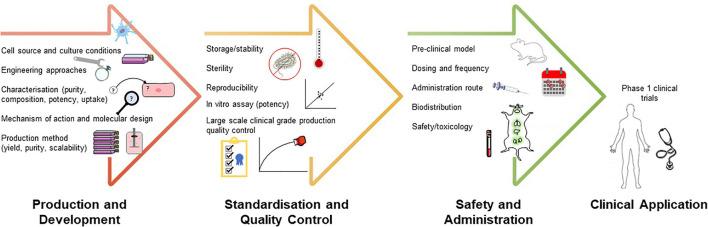
Extracellular vesicles (EVs) hold great promise as therapeutic modalities due to their endogenous characteristics, however, further bioengineering refinement is required to address clinical and commercial limitations. Clinical applications of EV-based therapeutics are being trialed in immunomodulation, tissue regeneration and recovery, and as delivery vectors for combination therapies. Native/biological EVs possess diverse endogenous properties that offer stability and facilitate crossing of biological barriers for delivery of molecular cargo to cells, acting as a form of intercellular communication to regulate function and phenotype. Moreover, EVs are important components of paracrine signaling in stem/progenitor cell-based therapies, are employed as standalone therapies, and can be used as a drug delivery system. Despite remarkable utility of native/biological EVs, they can be improved using bio/engineering approaches to further therapeutic potential. EVs can be engineered to harbor specific pharmaceutical content, enhance their stability, and modify surface epitopes for improved tropism and targeting to cells and tissues . Limitations currently challenging the full realization of their therapeutic utility include scalability and standardization of generation, molecular characterization for design and regulation, therapeutic potency assessment, and targeted delivery. The fields' utilization of advanced technologies (imaging, quantitative analyses, multi-omics, labeling/live-cell reporters), and utility of biocompatible natural sources for producing EVs (plants, bacteria, milk) will play an important role in overcoming these limitations. Advancements in EV engineering methodologies and design will facilitate the development of EV-based therapeutics, revolutionizing the current pharmaceutical landscape.
细胞外囊泡(EVs)因其内源性特性作为治疗方式具有巨大潜力,然而,需要进一步的生物工程优化来解决临床和商业限制。基于EV的疗法的临床应用正在免疫调节、组织再生和恢复以及作为联合疗法的递送载体方面进行试验。天然/生物EVs具有多种内源性特性,这些特性提供稳定性并促进跨越生物屏障将分子货物递送至细胞,作为一种细胞间通讯形式来调节功能和表型。此外,EVs是基于干细胞/祖细胞疗法中旁分泌信号的重要组成部分,可作为独立疗法使用,并且可以用作药物递送系统。尽管天然/生物EVs具有显著效用,但可以使用生物/工程方法对其进行改进以进一步挖掘治疗潜力。可以对EVs进行工程改造以携带特定药物成分、增强其稳定性并修饰表面表位以改善对细胞和组织的趋向性和靶向性。目前阻碍其治疗效用充分实现的限制包括生成的可扩展性和标准化、用于设计和监管的分子表征、治疗效力评估以及靶向递送。该领域对先进技术(成像、定量分析、多组学、标记/活细胞报告基因)的利用以及用于生产EVs的生物相容性天然来源(植物、细菌、牛奶)的效用将在克服这些限制方面发挥重要作用。EV工程方法和设计的进步将促进基于EV的疗法的发展,彻底改变当前的制药格局。