Rissanen Matti
Aerosol Physics Laboratory, Physics Unit, Faculty of Engineering and Natural Sciences, Tampere University, 33720 Tampere, Finland.
J Phys Chem A. 2021 Oct 21;125(41):9027-9039. doi: 10.1021/acs.jpca.1c06465. Epub 2021 Oct 7.
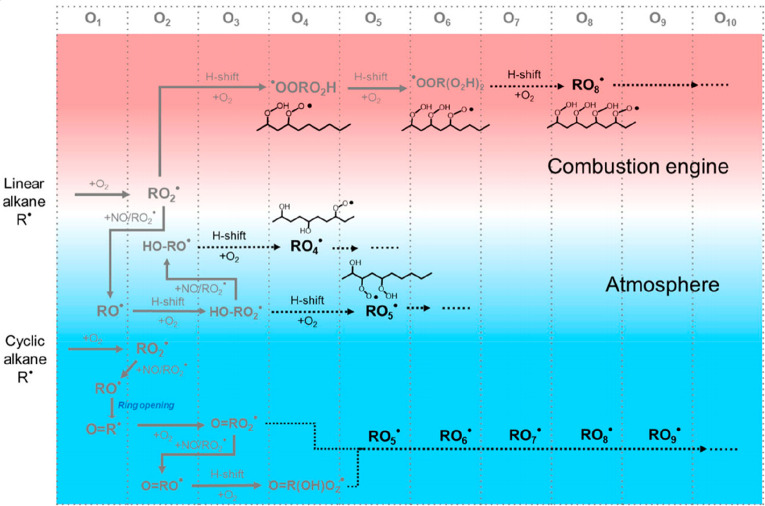
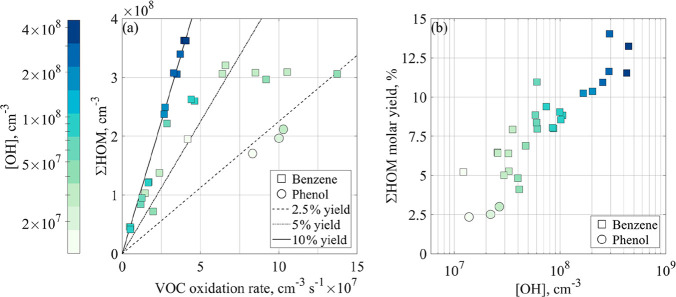
Gas-phase hydrocarbon autoxidation is a rapid pathway for the production of in situ aerosol precursor compounds. It is a highway to molecular growth and lowering of vapor pressure, and it produces hydrogen-bonding functional groups that allow a molecule to bind into a substrate. It is the crucial process in the formation and growth of atmospheric secondary organic aerosol (SOA). Recently, the rapid gas-phase autoxidation of several volatile organic compounds (VOC) has been shown to yield highly oxygenated organic molecules (HOM). Most of the details on HOM formation have been obtained from biogenic monoterpenes and their surrogates, with cyclic structures and double bonds both found to strongly facilitate HOM formation, especially in ozonolysis reactions. Similar structural features in common aromatic compounds have been observed to facilitate high HOM formation yields, despite the lack of appreciable O reaction rates. Similarly, the recently observed autoxidation and subsequent HOM formation in the oxidation of saturated hydrocarbons cannot be initiated by O and require different mechanistic steps for initiating and propagating the autoxidation sequence. This Perspective reflects on these recent findings in the context of the direct aerosol precursor formation in urban atmospheres.
气相烃类自氧化是原位气溶胶前体化合物生成的快速途径。它是分子增长和蒸气压降低的一条通道,并且会产生氢键官能团,使分子能够结合到基质中。它是大气二次有机气溶胶(SOA)形成和增长的关键过程。最近研究表明,几种挥发性有机化合物(VOC)的快速气相自氧化会产生高度氧化的有机分子(HOM)。关于HOM形成的大多数细节是从生物源单萜及其替代物中获得的,发现环状结构和双键都能强烈促进HOM形成,尤其是在臭氧分解反应中。尽管常见芳香化合物的O反应速率不高,但已观察到其类似的结构特征有助于高HOM形成产率。同样,最近在饱和烃氧化过程中观察到的自氧化及随后的HOM形成不能由O引发,并且需要不同的机理步骤来引发和传播自氧化序列。这篇综述文章在城市大气中直接气溶胶前体形成的背景下对这些最新发现进行了思考。