Department of Animal Sciences, University of Minnesota, College of Food, Agricultural, and Natural Resource Sciences, 1988 Fitch Ave., Saint Paul, MN, 55108, USA.
Department of Veterinary and Biomedical Sciences, College of Veterinary Medicine, University of Minnesota, Saint Paul, MN, USA.
BMC Genomics. 2021 Oct 7;22(1):726. doi: 10.1186/s12864-021-08046-7.
The golden lion tamarin (Leontopithecus rosalia) is an endangered Platyrrhine primate endemic to the Atlantic coastal forests of Brazil. Despite ongoing conservation efforts, genetic data on this species remains scarce. Complicating factors include limitations on sample collection and a lack of high-quality reference sequences. Here, we used nanopore adaptive sampling to resequence the L. rosalia mitogenome from feces, a sample which can be collected non-invasively.
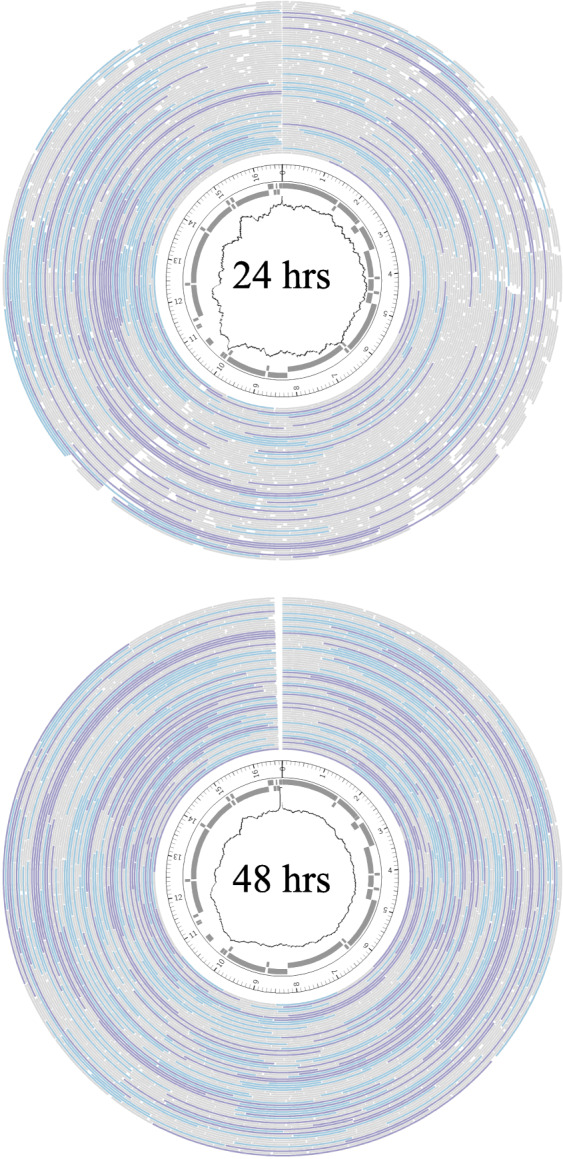
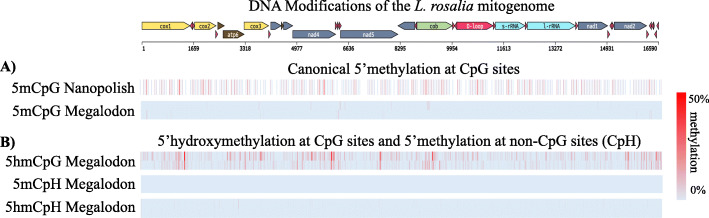
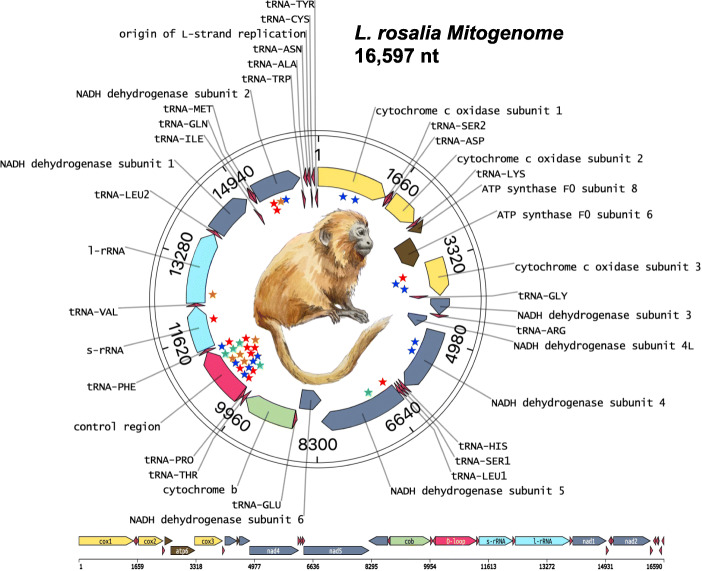
Adaptive sampling doubled the fraction of both host-derived and mitochondrial sequences compared to sequencing without enrichment. 258x coverage of the L. rosalia mitogenome was achieved in a single flow cell by targeting the unfinished genome of the distantly related emperor tamarin (Saguinus imperator) and the mitogenome of the closely related black lion tamarin (Leontopithecus chrysopygus). The L. rosalia mitogenome has a length of 16,597 bp, sharing 99.68% sequence identity with the L. chrysopygus mitogenome. A total of 38 SNPs between them were identified, with the majority being found in the non-coding D-loop region. DNA methylation and hydroxymethylation were directly detected using a neural network model applied to the raw signal from the MinION sequencer. In contrast to prior reports, DNA methylation was negligible in mitochondria in both CpG and non-CpG contexts. Surprisingly, a quarter of the 642 CpG sites exhibited DNA hydroxymethylation greater than 1% and 44 sites were above 5%, with concentration in the 3' side of several coding regions.
Overall, we report a robust new mitogenome assembly for L. rosalia and direct detection of cytosine base modifications in all contexts.
金狮狨(Leontopithecus rosalia)是一种濒危的扁鼻猴,仅分布于巴西大西洋沿岸森林。尽管保护工作一直在进行,但该物种的遗传数据仍然很少。复杂的因素包括样本收集的限制和缺乏高质量的参考序列。在这里,我们使用纳米孔自适应采样从粪便中重新测序了 L. rosalia 的线粒体基因组,这种样本可以无创采集。
与不富集的测序相比,自适应采样将宿主衍生序列和线粒体序列的比例提高了一倍。通过靶向亲缘关系较远的皇帝绢毛猴(Saguinus imperator)未完成的基因组和亲缘关系较近的黑狮狨(Leontopithecus chrysopygus)的线粒体基因组,在单个流池中实现了 L. rosalia 线粒体基因组的 258x 覆盖率。L. rosalia 线粒体基因组的长度为 16597bp,与 L. chrysopygus 线粒体基因组的序列同一性为 99.68%。共鉴定出 38 个 SNP,其中大多数位于非编码的 D 环区。使用应用于 MinION 测序仪原始信号的神经网络模型直接检测到 DNA 甲基化和羟甲基化。与之前的报道相反,CpG 和非 CpG 两种情况下线粒体中的 DNA 甲基化都可以忽略不计。令人惊讶的是,四分之一的 642 个 CpG 位点的羟甲基化程度超过 1%,44 个位点超过 5%,在几个编码区的 3'端浓度较高。
总体而言,我们报告了一个新的 L. rosalia 线粒体基因组组装,并直接检测到所有情况下的胞嘧啶碱基修饰。