Department of Respiratory and Critical Care Medicine, Yongchuan Hospital of Chongqing Medical University, Chongqing, China (mainland).
Department of Respiratory and Critical Care Medicine, The First Affiliated Hospital of Chongqing Medical University, Chongqing, China (mainland).
Med Sci Monit. 2021 Oct 8;27:e931779. doi: 10.12659/MSM.931779.
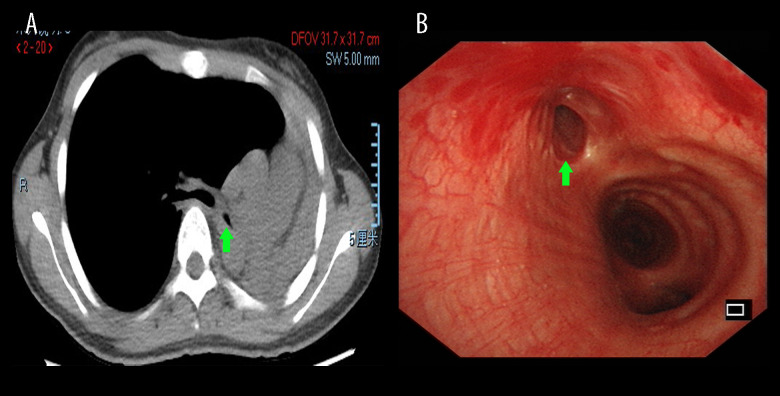
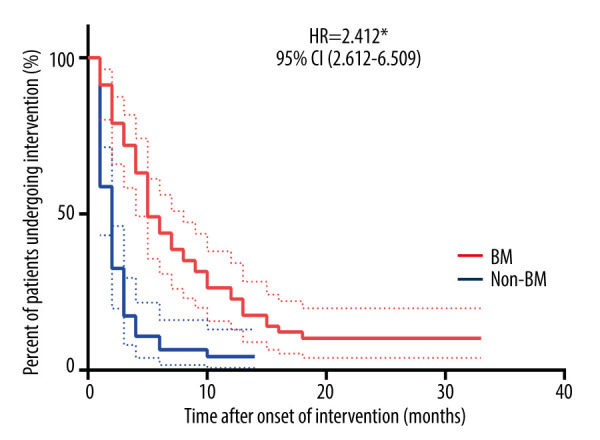
BACKGROUND Post-tuberculosis bronchomalacia (PTBM) is one of the main conditions occurring in patients after tracheobronchial tuberculosis (TBTB), and is also associated with the recurrence of symptoms. The present study aimed to investigate the predictors of PTBM in patients who had been undergoing appropriate TB treatment. MATERIAL AND METHODS Clinical data of 104 patients with symptomatic airway stenosis after TBTB between January 01, 2019 and June 31, 2020 were recorded and analyzed. The association between baseline clinical characteristics, laboratory results, and PTBM was calculated with logistical regression. The time from onset of bronchoscopic intervention was examined by Kaplan-Meier estimates; differences between the 2 groups were tested by the log-rank test. RESULTS Fifty-seven patients (54.81%) had PTBM. In the multivariate logistical analysis, the left main bronchus stenosis lesion (odds ratio [OR]=3.763), neutrophil (NEUT) count (OR=1.527), and platelet (PLT) (OR=1.010) count were predictors of PTBM. During follow-up, patients with BM had a significantly longer duration from onset of bronchoscopic intervention than patients without BM (hazard ratio=2.412, P<0.0001). Further, all patients needing long-term bronchoscopic intervention therapy were subsequently identified as having PTBM. Additionally, blood PLT counts were significantly decreased to normal levels in the non-BM group (P<0.05), but not in the BM group (P>0.05). CONCLUSIONS PTBM is most likely to occur in the left main bronchus. The inflammatory and immune responses associated with NEUT and PLT may represent therapeutic targets of PTBM. Our study is the first to report that decreased blood PLT count has the potential to monitor the treatment response.
肺结核性支气管软化症(PTBM)是支气管结核(TBTB)患者在适当的抗结核治疗后出现的主要病症之一,也是症状复发的原因之一。本研究旨在探讨 TBTB 后出现气道狭窄症状患者发生 PTBM 的预测因子。
记录并分析了 2019 年 1 月 1 日至 2020 年 6 月 31 日期间 104 例 TBTB 后出现气道狭窄症状患者的临床资料。采用逻辑回归分析了基线临床特征、实验室结果与 PTBM 的相关性。采用 Kaplan-Meier 估计时间,对数秩检验比较两组之间的差异。
57 例患者(54.81%)发生 PTBM。多变量逻辑回归分析显示,左主支气管狭窄病变(比值比 [OR]=3.763)、中性粒细胞(NEUT)计数(OR=1.527)和血小板(PLT)计数(OR=1.010)是 PTBM 的预测因子。在随访过程中,BM 患者的支气管镜介入治疗起始时间明显长于无 BM 患者(危险比=2.412,P<0.0001)。此外,所有需要长期支气管镜介入治疗的患者均被诊断为 PTBM。进一步的,非 BM 组患者的血 PLT 计数显著下降至正常水平(P<0.05),而 BM 组患者的血 PLT 计数无明显变化(P>0.05)。
PTBM 最有可能发生在左主支气管。与 NEUT 和 PLT 相关的炎症和免疫反应可能是 PTBM 的治疗靶点。本研究首次报道,血 PLT 计数降低可能有助于监测治疗反应。