Ding Yiran, Zeng Mengqi, Zheng Qijing, Zhang Jiaqian, Xu Ding, Chen Weiyin, Wang Chenyang, Chen Shulin, Xie Yingying, Ding Yu, Zheng Shuting, Zhao Jin, Gao Peng, Fu Lei
The Institute for Advanced Studies, Wuhan University, Wuhan, 430072, China.
College of Chemistry and Molecular Sciences, Wuhan University, Wuhan, 430072, China.
Nat Commun. 2021 Oct 7;12(1):5886. doi: 10.1038/s41467-021-26139-5.
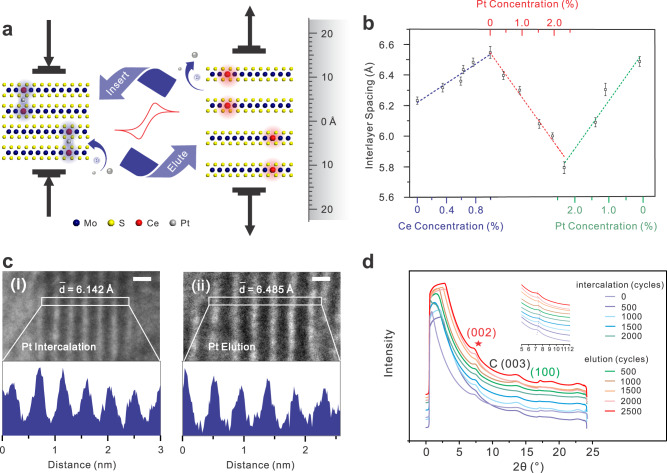
Interlayer spacing is expected to influence the properties of multilayer two-dimensional (2D) materials. However, the ability to non-destructively regulate the interlayer spacing bidirectionally and reversibly is challenging. Here we report the preparation of 2D materials with tunable interlayer spacing by introducing active sites (Ce ions) in 2D materials to capture and immobilize Pt single atoms. The strong chemical interaction between active sites and Pt atoms contributes to the intercalation behavior of Pt atoms in the interlayer of 2D materials and further promotes the formation of chemical bonding between Pt atom and host materials. Taking cerium-embedded molybdenum disulfide (MoS) as an example, intercalation of Pt atoms enables interlayer distance tuning via an electrochemical protocol, leading to interlayer spacing reversible and linear compression and expansion from 6.546 ± 0.039 Å to 5.792 ± 0.038 Å (~11 %). The electronic property evolution with the interlayer spacing variation is demonstrated by the photoluminescence (PL) spectra, delivering that the well-defined barrier between the multilayer and monolayer layered materials can be artificially designed.
层间距有望影响多层二维(2D)材料的性能。然而,双向且可逆地无损调节层间距的能力具有挑战性。在此,我们报告了通过在二维材料中引入活性位点(铈离子)以捕获和固定铂单原子来制备具有可调层间距的二维材料。活性位点与铂原子之间的强化学相互作用有助于铂原子在二维材料层间的插层行为,并进一步促进铂原子与主体材料之间化学键的形成。以嵌入铈的二硫化钼(MoS)为例,铂原子的插层可通过电化学方法实现层间距调节,导致层间距可逆且线性地从6.546±0.039 Å压缩至5.792±0.038 Å(约11%)。光致发光(PL)光谱证明了随着层间距变化的电子性质演变,表明多层和单层材料之间明确的势垒可以人工设计。